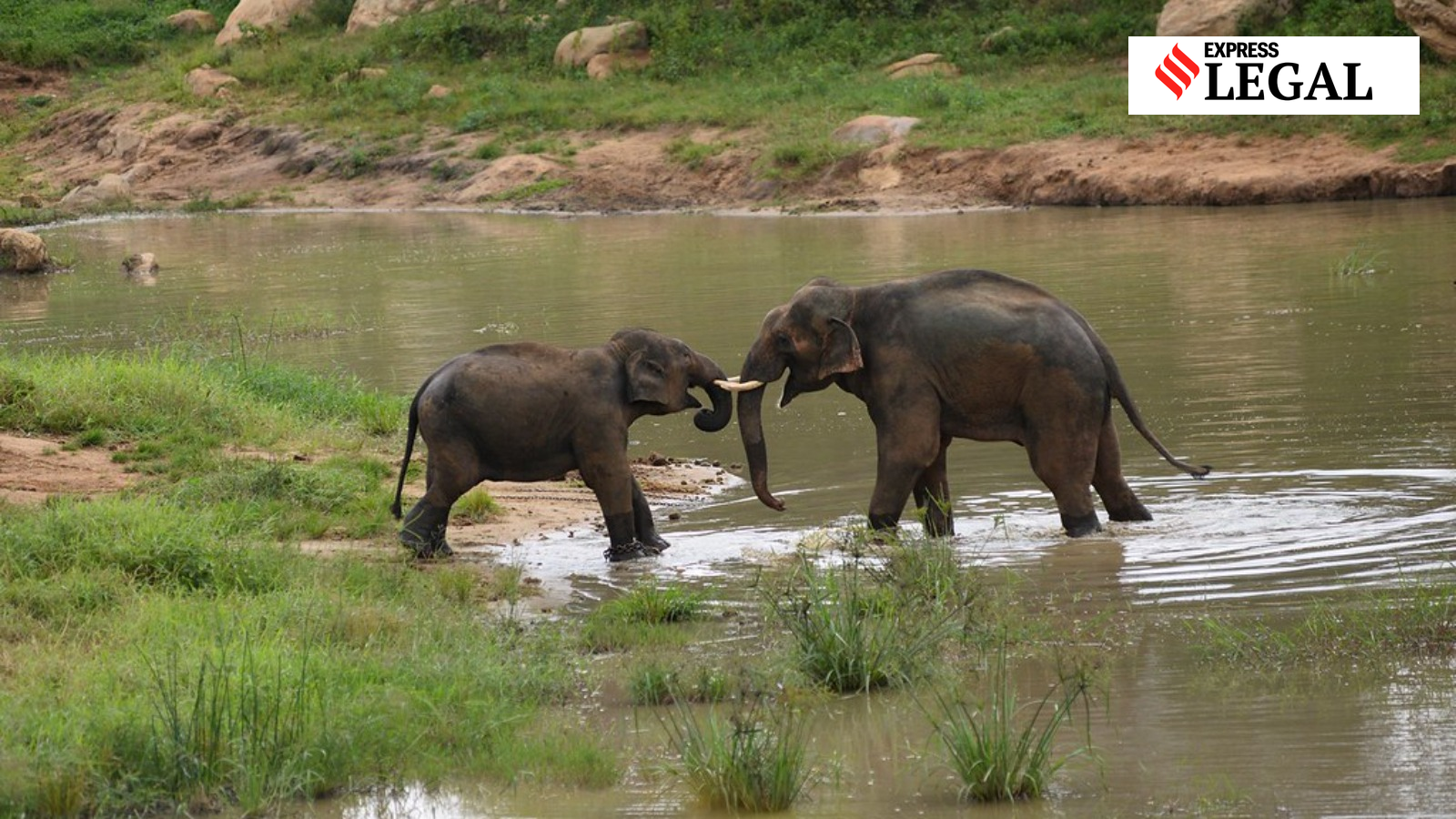
In a landmark judgment, the Karnataka High Court quashed land acquisition for a housing project, ruling that ecological conservation and elephant habitats supersede urban development.
- Karnataka High Court quashed land acquisition for a housing project in Anekal taluka.
- The court ruled that elephant corridors are essential habitats, not just passages.
- Environmental conservation was deemed to supersede the 'public purpose' of urban housing.
The Karnataka High Court has delivered a decisive blow to urban expansion at the cost of wildlife, observing that elephant corridors are not "merely a passage but an essential part of their natural habitat and existence." In a significant ruling, the bench comprising Justices D K Singh and H Shanthi Bhushan asserted that pachyderms cannot be treated as mere occupants whose homes can be displaced at will for the sake of construction.
The legal battle centered on the acquisition of land in the Anekal taluka of Bengaluru urban district for a residential project by the Karnataka Housing Board. Local landowners had challenged the acquisition, arguing that the lands were vital for agriculture and horticulture. However, the core of the court's concern shifted toward the environmental impact, specifically the project's location within the Bannerghatta National Park Eco-Sensitive Zone.
Why This Matters
BozokMedia analysis shows that this judgment sets a critical legal precedent in India, where 'public purpose' has historically been used as a blanket term to justify land grabs for infrastructure. By prioritizing ecological integrity over residential housing, the court is redefining the hierarchy of public interest, placing biodiversity and climate resilience above concrete urbanization.
The court noted that while development is necessary, it must be balanced with the interests of the environment. The bench described the proposed housing project as "misconceived" and warned that it could lead to "irreversible ecological, environmental and wildlife related consequences." The court emphasized that housing is not the sole requirement for human existence; rather, forests, water streams, and wildlife are equally indispensable.
"No public purpose can supersede the object of environmental and ecological conservation."
The judgment highlighted the immense biodiversity of Bannerghatta National Park, which supports species ranging from Asian elephants and leopards to Indian gaur and slender lorises. Specifically, the court found that the project would have severely disrupted the Karadikkal-Madeshwara Elephant Corridor, a vital link in the Mysore Elephant Reserve. The Forest Department had already warned that such encroachment would inevitably lead to an increase in human-wildlife conflict.
Ultimately, the court found the land acquisition process to be flawed, describing it as an exercise conducted without scientific rigor. The lack of a comprehensive Environment Impact Assessment (EIA) and a failure to consider socio-ecological factors rendered the proceedings invalid.
Frequently Asked Questions
Q1: Why did the court stop the housing project despite environmental clearance?
The court found that the clearances were insufficient and that the project's location in an Eco-Sensitive Zone posed irreversible risks to the Karadikkal-Madeshwara Elephant Corridor.
Q2: What is the significance of the Bannerghatta National Park in this case?
It is a critical habitat for Asian elephants and part of the Mysore Elephant Reserve, making its surrounding eco-sensitive zones vital for wildlife survival.