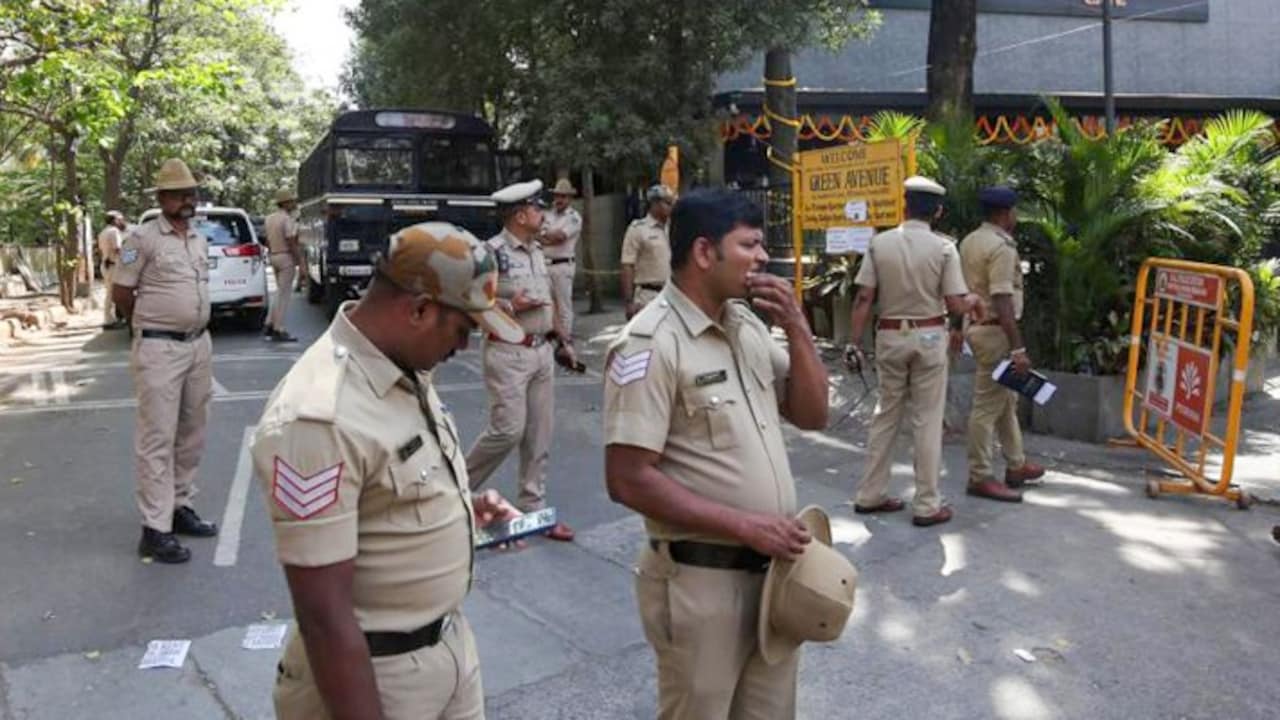
The implementation of new vehicle restrictions by the Bengaluru Traffic Police on four major elevated corridors led to widespread disruption and commuter fury on Friday. The Airport Road flyover faced unique challenges due to the ban on two-wheelers.
- Bengaluru Traffic Police (BTP) implemented vehicle bans on four major elevated corridors.
- The Airport Road flyover is uniquely restricted for two-wheelers.
- The move follows 15 fatal accidents on the KIA elevated corridor in 19 months.
- AI-enabled cameras will enforce a ₹500 fine for 'no-entry' violations.
Bengaluru: Commuters faced significant distress on Friday as the Bengaluru Traffic Police (BTP) began enforcing new vehicle restrictions on four major elevated corridors across the city. The most significant disruption was observed on the Airport Road flyover, where a ban on two-wheelers caused widespread confusion and massive traffic queues stretching nearly a kilometer near Sanjeevininagar Cross.
The enforcement process saw heated exchanges between motorists and police personnel. While heavy vehicles and autorickshaws were strictly diverted, many two-wheeler riders attempted to maneuver through gaps in traffic to evade the restrictions. Police officers, deployed in three-hour shifts, struggled to maintain order amidst the growing congestion and verbal abuse from enraged commuters.
Why This Matters
BozokMedia analysis shows that this move represents a critical attempt by urban authorities to mitigate rising road fatalities. The decision is heavily predicated on accident data, which reveals a grim reality of 15 fatal accidents occurring on the KIA elevated corridor stretch within just 19 months. Balancing commuter convenience with life-saving safety measures remains a monumental challenge for the city's infrastructure.
Strict enforcement without adequate lane discipline training may lead to temporary chaos rather than long-term safety improvements.
To ensure compliance, the BTP has integrated AI-equipped cameras along the elevated corridors. These smart surveillance systems are designed to automatically detect vehicles violating 'no-entry' zones, triggering an automatic penalty of ₹500. This technological layer aims to reduce the need for constant physical intervention by officers.
Historical Context and Public Reaction
Historically, Bengaluru has struggled with rapid urbanization and a disproportionate increase in vehicle density compared to road capacity. This new restriction is part of a broader strategy to manage high-speed corridors more effectively. However, the public response has been polarized.
Local residents, such as those from Yelahanka, have criticized the policy, suggesting that the police should focus on enforcing lane discipline rather than banning specific vehicle categories. They argue that banning two-wheelers is a reactive measure that fails to address the root cause of chaotic driving patterns.
Frequently Asked Questions
1. Which vehicles are banned on the Airport Road flyover?
The ban includes heavy vehicles, autorickshaws, and specifically two-wheelers.
2. How will the fines be collected?
Fines will be issued electronically via AI-equipped cameras for 'no-entry' violations.