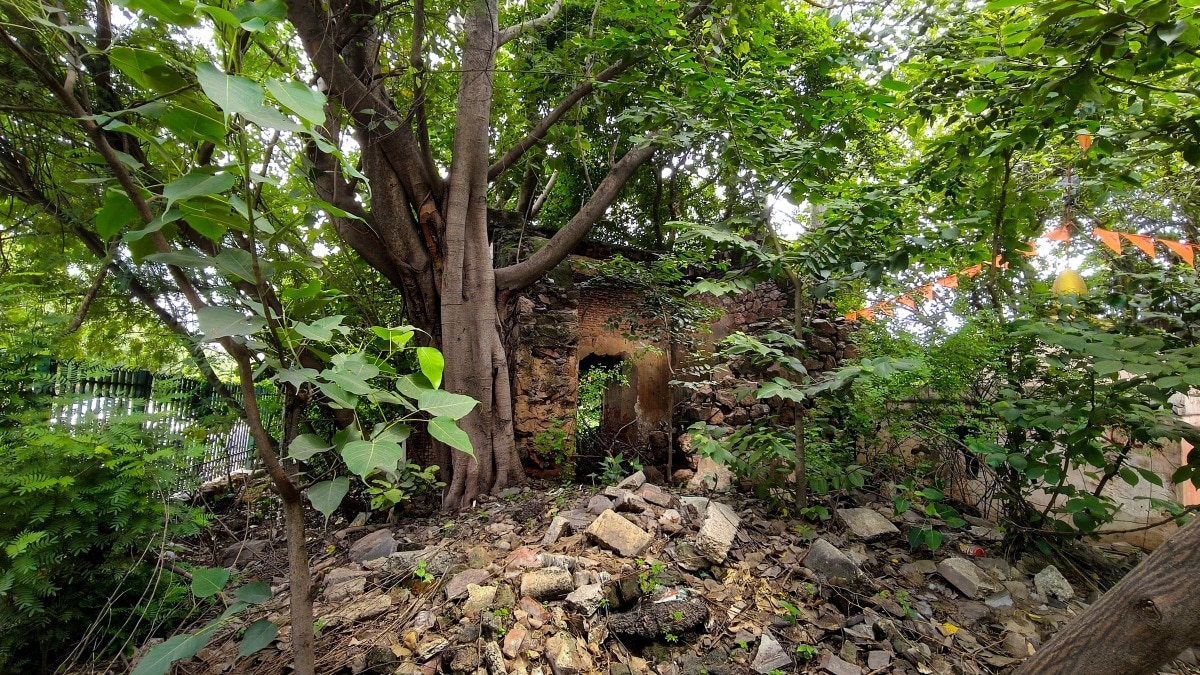
Ancient ruins discovered near Delhi's Modi Mill flyover are believed to be the remains of 'Sarai Juliana,' an 18th-century travelers' inn built by the Portuguese Dona Juliana Dias da Costa.
- Ruins near Modi Mill flyover may be the lost 'Sarai Juliana' from the 18th century.
- The site was likely built by Dona Juliana Dias da Costa, a prominent Portuguese figure in the Mughal court.
- The MCD is considering notifying the site as an official heritage monument.
A potential archaeological breakthrough has emerged in the heart of the national capital. Ancient ruins located beneath the Modi Mill flyover on Mathura Road are being examined as the long-lost Sarai Juliana. If officially recognized as a heritage site, these remains could restore a forgotten link to the Mughal era and the unique legacy of Dona Juliana Dias da Costa.
Dr. Aqil Ahmed, member secretary of the MCD's Heritage Cell, stated that the civic body is planning to notify the structure as a heritage site. The site, situated within a green space maintained by the PWD, contains fragments of walls, an arched opening, and a circular well that still holds water. The presence of Lakhori bricks—thin, flat bricks synonymous with Mughal-period construction—strongly suggests the antiquity of the structure.
Why This Matters
BozokMedia analysis shows that this discovery is crucial for understanding the historical connectivity of Delhi. Long before Mathura Road became a modern highway, it was part of the Sadak-e-Azam (Great Road), a vital artery for merchants, pilgrims, and diplomats traveling between Peshawar, Lahore, Delhi, and Agra.
The discovery of Sarai Juliana provides a physical trace of the complex cultural intersection between Portuguese travelers and the Mughal Empire.
Historical records, including the book 'Juliana Nama', suggest that Dona Juliana built the sarai in 1720 during the reign of Emperor Muhammad Shah 'Rangeela'. Juliana was a woman of extraordinary influence; a Portuguese Christian with medical knowledge, she served the royal household and even tutored Mughal princes, including the future Bahadur Shah I.
The sarai was likely a substantial establishment. Historical accounts suggest it featured at least 15 rooms, separate quarters for animals, and specialized kitchen arrangements to cater to both vegetarian and non-vegetarian travelers. The circular well found at the site remains one of the most significant identifying features of the location.
| Feature | Sarai Juliana (Potential) | Other Major Sarais |
|---|---|---|
| Location | Mathura Road (Modi Mill) | Sarai Kale Khan / Azimganj |
| Historical Era | 18th Century (Mughal) | Various Eras |
| Key Identifier | Circular Well & Lakhori Bricks | Architectural Arches |
This site represents a rare survival of the roadside infrastructure that once supported the massive caravans of the Grand Trunk Road era. As urban expansion continues to threaten historical footprints, the preservation of Sarai Juliana could offer invaluable insights into the socio-economic fabric of 18th-century India.
Frequently Asked Questions
1. What is a 'Sarai'?
A sarai is a historical travelers' inn or rest house used along major trade routes.
2. Who was Dona Juliana?
She was a Portuguese woman in the Mughal court who built a travelers' inn in 1720.