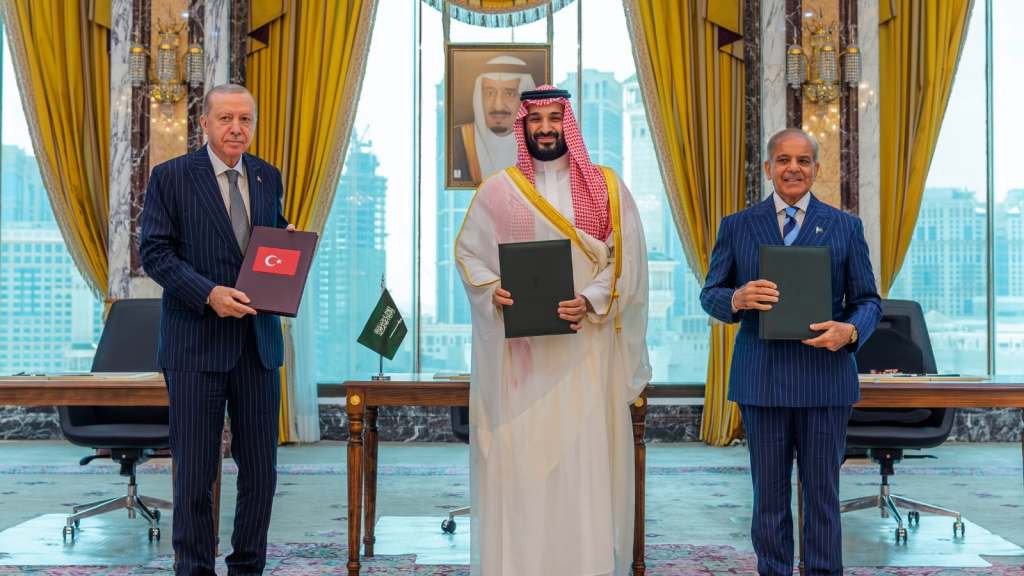
The Mecca Joint Defence Agreement between Saudi Arabia, Turkey, and Pakistan aims to project unity, but deeper analysis suggests it is a hedge against US unreliability rather than a sign of Islamic self-reliance.
Key Takeaways
- The Mecca Accord is a defense pact between Saudi Arabia, Turkey, and Pakistan.
- It serves as a hedge against the perceived unreliability of the United States.
- Structural contradictions remain between the imperial ambitions of Turkey and the leadership of Saudi Arabia.
- Pakistan's role has evolved from a strategic partner to a financial dependent.
The Mecca Joint Defence Agreement, signed on August 7 by Saudi Arabia, Turkey, and Pakistan, has sparked significant geopolitical debate. To understand its essence, one must recall the words of Huseyn Shaheed Suhrawardy, Pakistan’s PM during the 1956 Suez crisis, who noted that Arab and Muslim solidarity often amounts to "zero plus zero plus zero still equals zero." Seven decades later, this cynical arithmetic seems more relevant than ever.
History is littered with failed pan-Islamic and pan-Arab initiatives. From the dissolution of the United Arab Republic in 1961 to the internal fractures of the Gulf Cooperation Council (GCC), national interest has consistently trumped supranational identity. The only coalitions that have historically delivered results in the region were those engineered and powered by Washington's military might.
Why This Matters
BozokMedia analysis shows that the Mecca Accord is not an evolution toward Islamic security self-reliance. Instead, it is a reaction to the erratic nature of US foreign policy, particularly during the Trump era. Riyadh is attempting to demonstrate that it has other options, even if those options lack the systemic strength of the US Central Command.
"The Mecca Accord is a diplomatic signal to Tehran and Washington, not a fundamental break in the regional security order."
The most striking aspect is the "Turkish turn." The transition of President Recep Tayyip Erdogan from making Crown Prince Mohammed bin Salman a pariah to becoming a defense partner is a masterclass in realpolitik. However, the rivalry for leadership of the Islamic world—between the custodians of the Holy Places and Erdogan's neo-Ottoman ambitions—remains an unresolved structural contradiction.
Meanwhile, Pakistan's standing has diminished. Once a pivotal security actor in the Middle East, Pakistan is now largely viewed as a retainer for Saudi bailouts. Similarly, India, which was once the sheet anchor of Persian Gulf security, spent decades as a passive bystander, though this trend is now reversing as Delhi seeks a more active role.
Frequently Asked Questions
Q1: What is the primary goal of the Mecca Accord?
A: It is a joint defense agreement intended to foster security cooperation between Saudi Arabia, Turkey, and Pakistan.
Q2: Does this pact signal the end of US influence in the region?
A: No, the pact is largely seen as a hedge against US inconsistency rather than a replacement for US security guarantees.