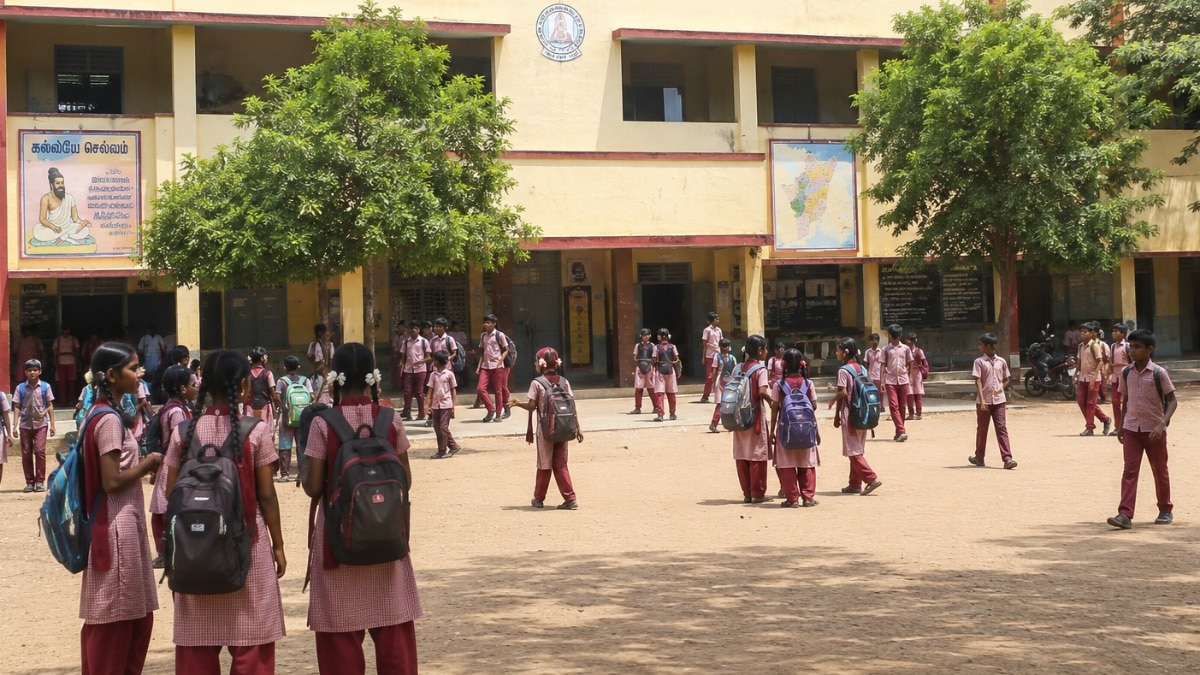
Tamil Nadu's government has issued a circular prohibiting party cadres and private individuals from entering government school classrooms for political events. The move, announced by Education Minister Raj Mohan, aims to keep schools neutral learning spaces and aligns with the state's strong performance in education metrics.
The administration led by Chief Minister Vijay in Tamil Nadu has today issued an official circular that strictly bans political party cadres and private individuals from entering government school classrooms and conducting events there. The directive, released by Education Minister Raj Mohan, clarifies that only elected representatives attending government‑sanctioned programmes will be allowed inside school premises.
Key Provisions of the Circular
The order emphasizes that classrooms are sanctuaries for learning and must not be used for praising political leaders or individuals. It also forbids the celebration of political leaders' birthdays or any personal milestones within school grounds, reinforcing the principle that schools are places for education, not political theatre.
Background and Historical Context
Tamil Nadu has long been a benchmark for school education in India. According to the latest Unified District Information System for Education (UDISE) data, the state boasts a pupil‑teacher ratio of 22:1, better than the national average of 24:1. Gross enrolment ratios stand at 92 % for primary, 95 % for upper primary, 97 % for secondary and 85 % for higher secondary levels—significantly ahead of the country‑wide figures.
Impact of Political Activities in Schools
In several Indian states, schools have increasingly become venues for political rallies, leader worship, and birthday celebrations, leading to distractions for students and a dilution of the learning environment. Tamil Nadu witnessed isolated incidents where party leaders addressed school assemblies or organised partisan events, prompting concerns about ideological bias and loss of focus on academics. The Vijay administration’s ban seeks to curb such practices and preserve the educational sanctity of classrooms.
Future Outlook and Potential Implications
The government has indicated that detailed guidelines for organising programmes in government schools will be released shortly, ensuring a uniform standard across the state. Education experts suggest that if implemented rigorously, this policy could set a precedent for other states, compelling political parties to seek alternative platforms for outreach while safeguarding academic integrity. Moreover, it may reinforce Tamil Nadu’s reputation as a leader in delivering high‑quality, politically neutral education.