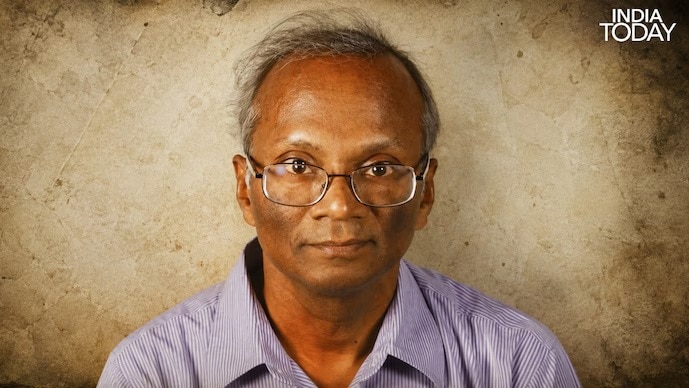
Dirac Medal winner Professor Deepak Dhar warns that while AI can provide instant answers, it cannot replicate the human drive for scientific understanding. He emphasizes that the essence of education lies in the process of reasoning, not the final result.
Key Takeaways
- AI can predict and calculate, but it cannot replicate the human 'search for understanding'.
- Over-reliance on instant AI answers threatens to weaken critical reasoning and curiosity in students.
- Fundamental science is an intellectual asset to a nation, regardless of immediate commercial returns.
In an era where Artificial Intelligence (AI) is writing complex code, solving intricate equations, and generating research summaries, a pivotal question has emerged across global laboratories: Will AI replace physicists? Professor Deepak Dhar, a towering figure in theoretical physics and a recent recipient of the prestigious Dirac Medal, believes the answer is a definitive no—at least not in the way the public imagines.
With a distinguished academic lineage spanning Allahabad University, IIT Kanpur, and Caltech—where he interacted with the legendary Richard Feynman—Professor Dhar brings immense authority to this debate. As the first Indian to receive the Boltzmann Medal (2022) and a Padma Bhushan awardee (2023), his career has been dedicated to understanding how complex patterns emerge from randomness.
Calculation vs. Understanding
Dhar draws a sharp distinction between the ability to predict and the ability to understand. He argues that while a machine can accurately predict where a ball will land, the human drive to ask why it behaves that way is what defines science. For Dhar, science is not a factory for answers, but a "fun adventure" akin to writing a novel, where the creative process holds intrinsic value beyond practical utility.
Why This Matters
BozokMedia analysis suggests that the danger of AI is not the replacement of the professional, but the erosion of the cognitive process. When students outsource their thinking to AI for homework, they are not just saving time; they are bypassing the mental struggle required to build intellectual muscle. The tool becomes the master, and the learner becomes a mere operator.
"The goal of solving a physics problem is not to produce the correct answer for the teacher; it is to develop the student’s ability to think."
Furthermore, Dhar addresses the economic pressure on modern science. He posits that fundamental science should be funded not for quick commercial returns, but because it makes a civilization intellectually richer and more resilient.
Frequently Asked Questions
Q1: Does Professor Dhar believe AI is useless in science?
A: Not at all. He acknowledges AI's utility in improving writing styles, searching literature, and handling tedious calculations.
Q2: What is the best advice for young researchers in the AI era?
A: Focus on asking better questions and building deep conceptual understanding rather than relying on instant AI-generated answers.