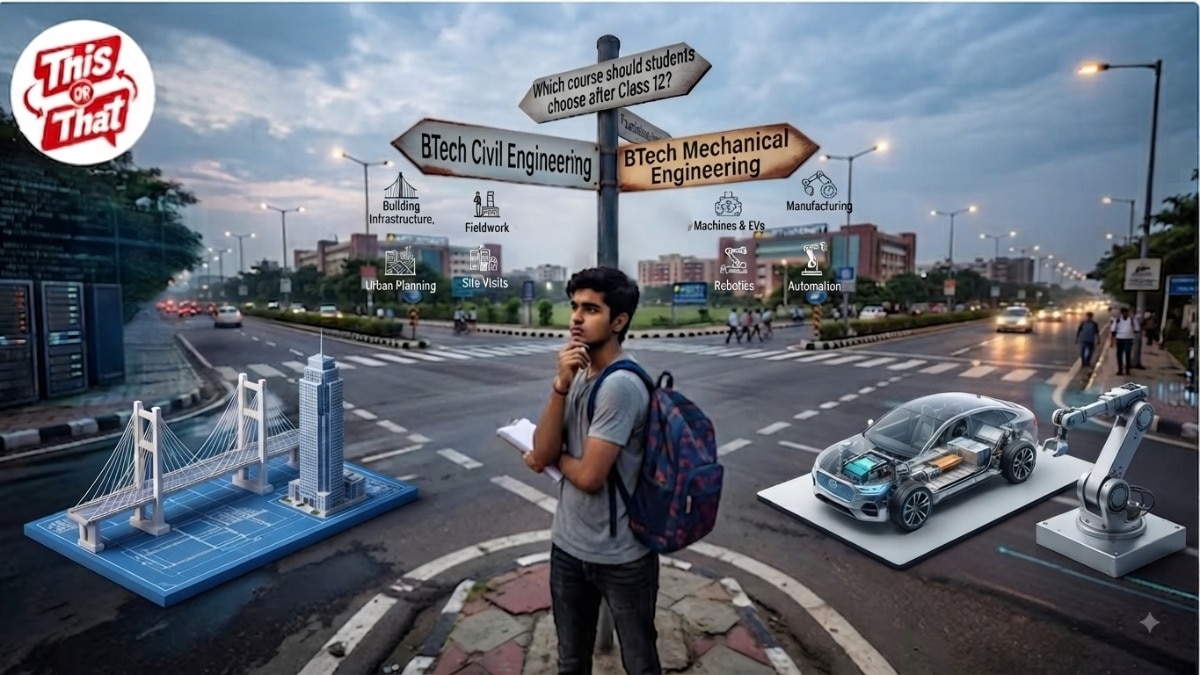
Struggling to decide between Civil and Mechanical Engineering? Discover the key differences in curriculum, career prospects, and skills to make an informed decision.
Key Takeaways
- Civil Engineering focuses on large-scale infrastructure and public projects.
- Mechanical Engineering centers on machines, robotics, and automation.
- Both sectors are being revolutionized by AI and Industry 4.0.
- Job security remains high in both branches due to national development goals.
Every year, lakhs of engineering aspirants face the same dilemma after Class 12. With AI and data science dominating the headlines, two core branches—BTech in Civil Engineering and BTech in Mechanical Engineering—continue to build the physical world around us. Choosing between them requires understanding your fundamental interests.
Curriculum and Skill Sets
Modern Civil Engineering has evolved far beyond bricks and mortar. According to industry experts, the curriculum now includes BIM (Building Information Modeling), GIS, and Drone Surveying. It is ideal for students who enjoy 3D visualization and large-scale project management.
Conversely, Mechanical Engineering is undergoing a massive transformation. The rise of Electric Vehicles (EVs) and Robotics has shifted the focus toward mechatronics and smart manufacturing. This branch is perfect for those fascinated by how things move, from tiny sensors to massive aircraft engines.
| Parameter | Civil Engineering | Mechanical Engineering |
|---|---|---|
| Core Subjects | Structural, Geotechnical, Environmental | Thermodynamics, Robotics, Mechatronics |
| Key Skills | Planning, 3D Visualization, Management | Problem-solving, Design, Technical Analysis |
| Top Recruiters | L&T, Tata Projects, NHAI, Adani | Tata Motors, Mahindra, Bosch, ISRO |
| Ideal For | Infrastructure & Public Works | Machines, Design & Automation |
Why This Matters
BozokMedia analysis shows that India's push for self-reliance in manufacturing and massive infrastructure spending (like the National Infrastructure Pipeline) ensures that neither branch is becoming obsolete. Instead, both are becoming more tech-driven and high-paying.
Whatever we see around us—from the roads we drive on to the machines we use—is the result of civil and mechanical engineering expertise.
While Civil Engineering leans toward planning systems that serve society, Mechanical Engineering leans toward creating the tools and machines that drive industry. Both require a strong foundation in Physics and Mathematics.
Did You Know?
Frequently Asked Questions
1. Which branch has better placement opportunities?
Both offer excellent prospects. Civil is driven by infrastructure projects, while Mechanical is driven by the manufacturing and EV revolution.
2. Can I switch from Mechanical to Civil later?
While it is difficult to switch core branches, you can pursue interdisciplinary fields like construction machinery or smart infrastructure.