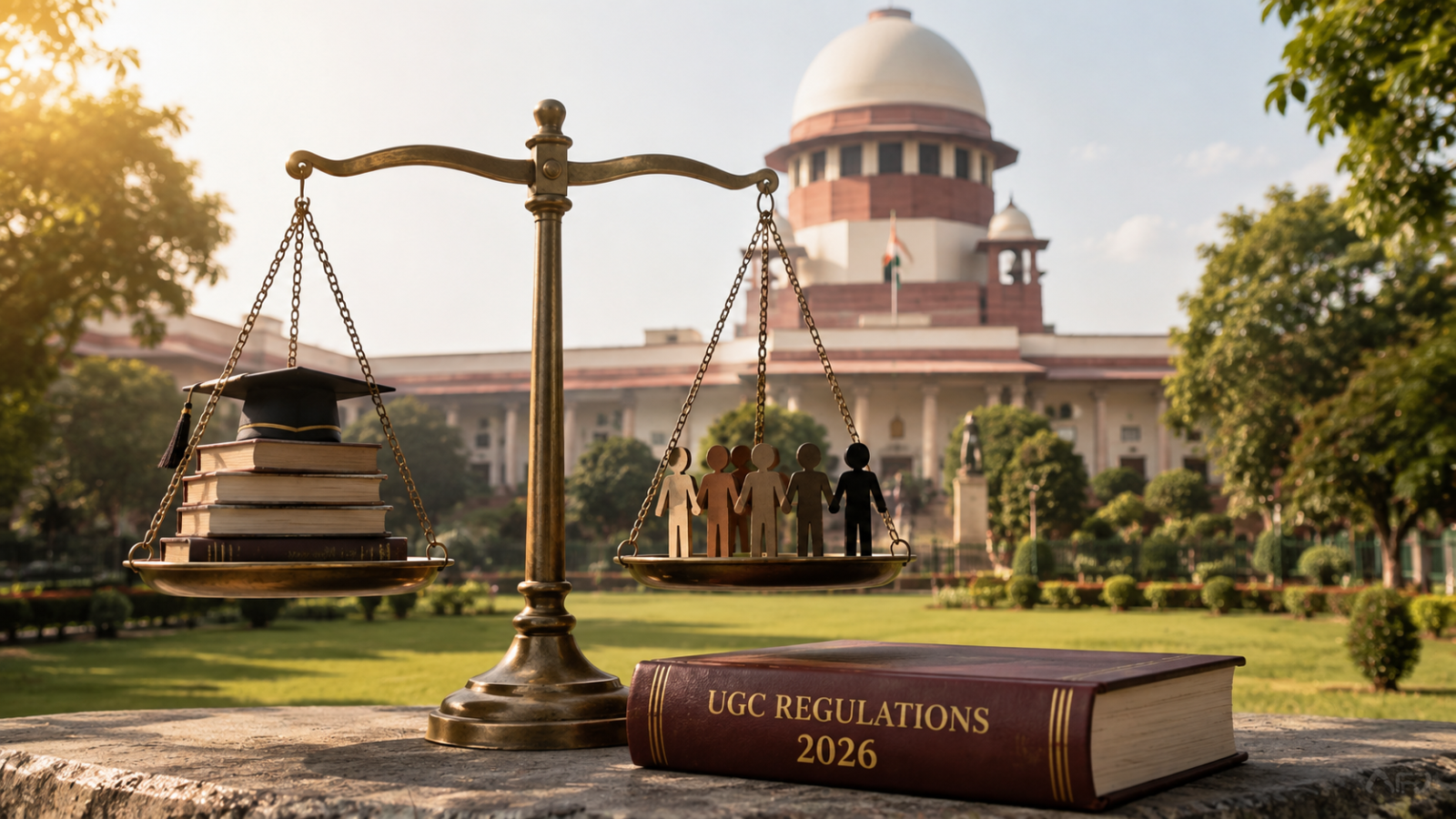
The Central Government has informed the Supreme Court that the controversial 2026 UGC equity regulations regarding caste-based discrimination are currently being reconsidered. The apex court had previously stayed these regulations due to concerns over vagueness and social impact.
- The Centre is reconsidering the UGC (Promotion of Equity in Higher Education Institutions) Regulations, 2026.
- The Supreme Court had previously stayed the regulations, calling them 'prima facie vague'.
- UGC has been directed to file a comprehensive counter affidavit within four weeks.
- The 2012 regulations remain in force under Article 142.
New Delhi: In a significant legal development, the Central Government informed the Supreme Court on Thursday that the 2026 University Grants Commission (UGC) equity regulations, aimed at preventing caste-based discrimination on campuses, are now under reconsideration. This move comes following intense judicial scrutiny and widespread protests.
The matter was heard by a bench comprising Chief Justice Surya Kant, Justice Joymalya Bagchi, and Justice V. Mohana. Solicitor General Tushar Mehta informed the bench that the regulatory framework is being reviewed. Consequently, the court has mandated the UGC to submit a detailed counter affidavit within four weeks, allowing petitioners a subsequent two-week window to file rejoinders.
Why This Matters
BozokMedia analysis shows that the tension between implementing social equity and maintaining legal precision is at an all-time high in India's higher education sector. The 2026 regulations were seen by many as a progressive step, but the judiciary flagged them as potentially destabilizing.
Vague legal frameworks in sensitive social matters can inadvertently create loopholes that lead to systemic misuse rather than justice.
The Supreme Court's initial stay on January 29, 2026, was rooted in the concern that the framework was "prima facie vague" and could have "very sweeping consequences." The court specifically questioned why certain forms of harassment, such as ragging, were omitted from the scope, and why the definition of caste-based discrimination was perceived as too narrow or overlapping with existing definitions of discrimination.
Historical Background
The controversy erupted when the 2026 regulations were introduced, triggering massive protests from student organizations demanding an immediate rollback. In its previous intervention, the Supreme Court invoked its extraordinary powers under Article 142 of the Constitution to ensure that the 2012 UGC Regulations continue to operate, preventing a legal vacuum while the new framework is debated.
Frequently Asked Questions
1. What was the main criticism of the 2026 UGC regulations?
The Supreme Court found them to be vague, capable of misuse, and potentially divisive to society.
2. Which regulations are currently active in universities?
The 2012 UGC (Promotion of Equity in Higher Education Institutions) Regulations remain in force.