A startling Niti Aayog report highlights a massive disconnect between India's higher education and the job market, revealing that most graduates are unfit for professional roles.
- Only 8.25% of graduates are employed in roles aligned with their academic qualifications.
- A fundamental mismatch exists between university curricula and industry skill requirements.
- 80% of learners cite a lack of practical industry exposure as a critical gap.
India is churning out graduates at an unprecedented rate, yet a profound crisis is brewing within its workforce. A recent paper published by Niti Aayog, titled 'Reimagining Skilling for Viksit Bharat @2047', has sounded the alarm on the widening chasm between academic degrees and employability. The report suggests that the nation is struggling to translate educational attainment into meaningful, skill-aligned employment.
Degrees Without a Destination
The statistics presented in the Niti Aayog report are sobering. According to the data, only 8.25% of graduates are finding jobs that actually utilize what they studied. This implies that the vast majority of the educated youth are either underemployed or working in sectors entirely unrelated to their field of study, leading to a massive wastage of human potential.
Union Finance Minister Nirmala Sitharaman has echoed these concerns, noting that current academic courses often fail to prepare students for the realities of the professional world. She emphasized that traditional degrees frequently lack the practical depth required for both corporate roles and entrepreneurship, leaving students in a loop of acquiring more degrees without gaining more competence.
Why This Matters
BozokMedia analysis shows that this 'skill gap' is not merely an educational issue but a systemic economic threat. As India aims for a $5 trillion economy and a 'Viksit Bharat' by 2047, the inability to deploy a skilled workforce could turn the country's demographic dividend into a demographic disaster.
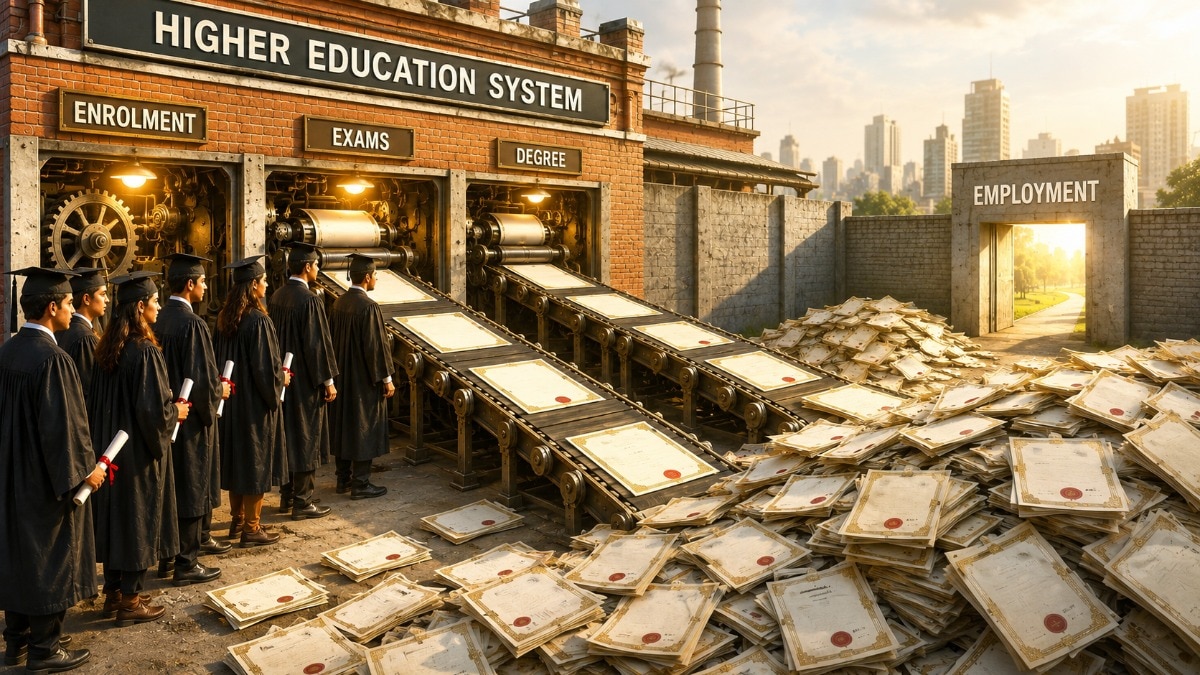
The current education model prioritizes enrollment and examinations over the actual capability to perform in a modern workplace.
The scale of the problem is immense. With over 3.4 crore students enrolled in undergraduate programs—including a massive cohort of over 2 crore students in BA, BSc, and BCom courses—the 'generic degree' ecosystem is failing to provide direct employment pathways. Many students pursue these degrees primarily to gain eligibility for government jobs, rather than for professional skill acquisition.
The Skills Gap Breakdown
The report highlights that the crisis is driven by a lack of practical application. While a student might master the theory of economics or accounting, they often lack essential workplace tools like digital proficiency, communication skills, or specific software expertise like Tally and Office applications.
| Metric | Current Trend | Industry Requirement |
|---|---|---|
| Focus Area | Theoretical Knowledge | Practical Application |
| Skill Alignment | Low (8.25% match) | High (Industry-ready) |
| Student Feedback | Lack of exposure (80%) | Hands-on experience |
Frequently Asked Questions
1. What is the core issue identified by Niti Aayog?
The core issue is the 'fundamental disconnect' between what is taught in colleges and the actual skills demanded by the modern labor market.
2. Why are BA, BSc, and BCom degrees criticized in the report?
These generic degrees are criticized because they often lack strong job linkages and rarely translate into direct employment without additional vocational training.