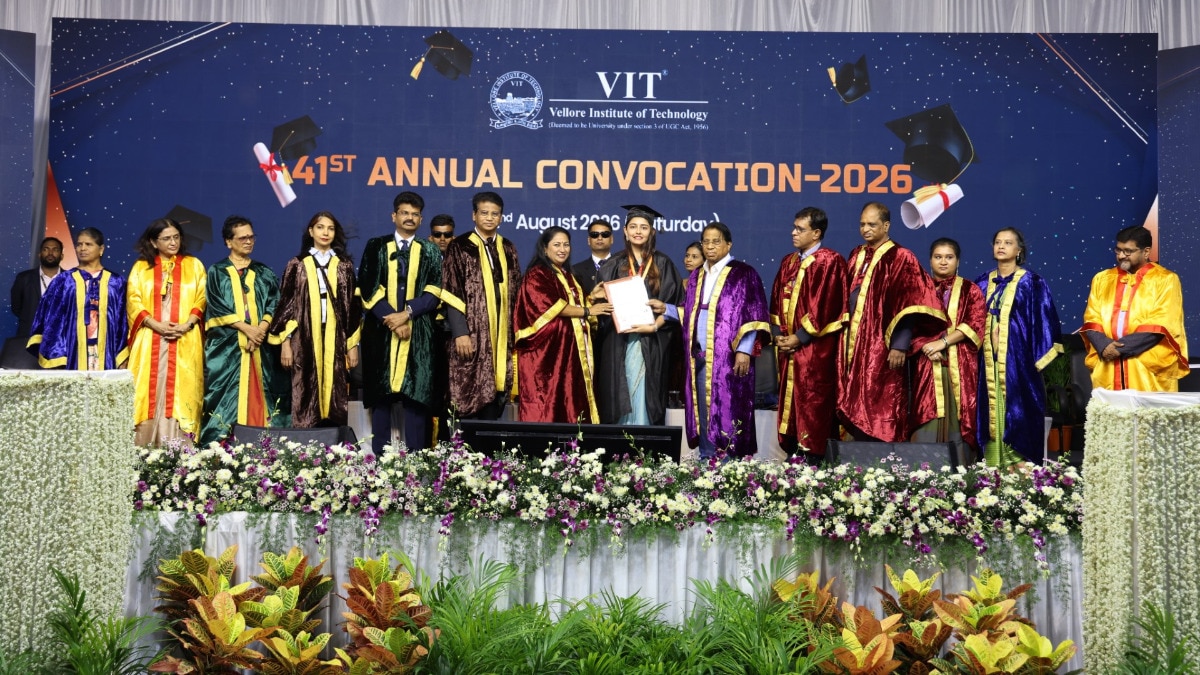
At the VIT Vellore convocation, Delhi CM Rekha Gupta urged graduates to transition from being mere consumers of Artificial Intelligence to becoming creators of indigenous AI technologies to solve national challenges.
- India needs to shift from being a consumer of AI to a creator of AI technologies.
- The 'India AI Mission' is driving investment in semiconductors, robotics, and space tech.
- India's Higher Education Gross Enrolment Ratio (GER) is currently ~30%, aiming for 50%.
- A severe shortage of medical seats leads nearly 1 lakh students to study abroad annually.
Speaking at the 41st convocation of VIT University, Vellore, Delhi Chief Minister Rekha Gupta delivered a powerful message to the graduating class. She emphasized that for India to thrive in the digital age, it must move beyond the consumption of Artificial Intelligence and focus on building its own indigenous AI ecosystem. Gupta urged the youth to leverage innovation to solve pressing public problems.
The Chief Minister highlighted the strategic importance of the 'India AI Mission' led by Prime Minister Narendra Modi. This mission encompasses critical sectors such as semiconductors, computing infrastructure, defense, space, drones, robotics, and biotechnology. She noted that the transition from using technology to designing and manufacturing it is the most significant contribution graduates can make to the nation.
Why This Matters
BozokMedia analysis shows that the global race for AI supremacy is defining the next century of geopolitics. For India to avoid technological dependency, it must transition from a service-oriented economy to a product-driven innovation hub. Embracing the 'Design in India' philosophy is no longer optional; it is a necessity for strategic autonomy.
"Don't just be users of artificial intelligence, build India's own AI."
While discussing the vision for the nation, Gupta cited Delhi's success in tackling pollution and traffic through partnerships with IIT institutions. She encouraged students to bring that same collaborative spirit to their future workplaces to drive national innovation.
Adding a critical perspective on the educational landscape, VIT Chancellor G Viswanathan pointed out the disparity in global higher education. He noted that while India's Gross Enrolment Ratio (GER) stands at approximately 30%, countries like South Korea (90%) and Japan (60%) are far ahead. He emphasized that the new education policy aims to bridge this gap by targeting a 50% GER.
Viswanathan also raised alarms regarding the medical education crisis. He revealed a staggering imbalance: while over 50 lakh engineering seats exist, the medical sector struggles to accommodate the 22 lakh students appearing for the NEET exam. With only about 1.3 lakh seats available, nearly 1 lakh Indian students are forced to seek medical education in countries like China, Russia, and the Philippines every year.
Global Enrollment & Medical Seat Comparison
| Region/Country | Higher Ed GER | Medical Education Context |
|---|---|---|
| India | ~30% | High demand, extreme seat scarcity |
| South Korea | ~90% | Highly developed infrastructure |
| China | >60% | Large-scale institutional capacity |
| Japan | ~60% | High academic standards |
Finally, the Chancellor addressed the administrative hurdles in academia, specifically the friction between governors and state governments regarding Vice-Chancellor appointments. He called upon the Union Education Minister to facilitate better coordination to protect student interests and ensure institutional stability.
Frequently Asked Questions
1. What is the main goal of the 'India AI Mission'?
The mission aims to boost India's capabilities in semiconductors, robotics, space, and AI technology to make the country a creator rather than just a user.
2. Why are so many Indian students going abroad for medical studies?
Due to the massive gap between the 22 lakh NEET applicants and the approximately 1.3 lakh available medical seats in India.