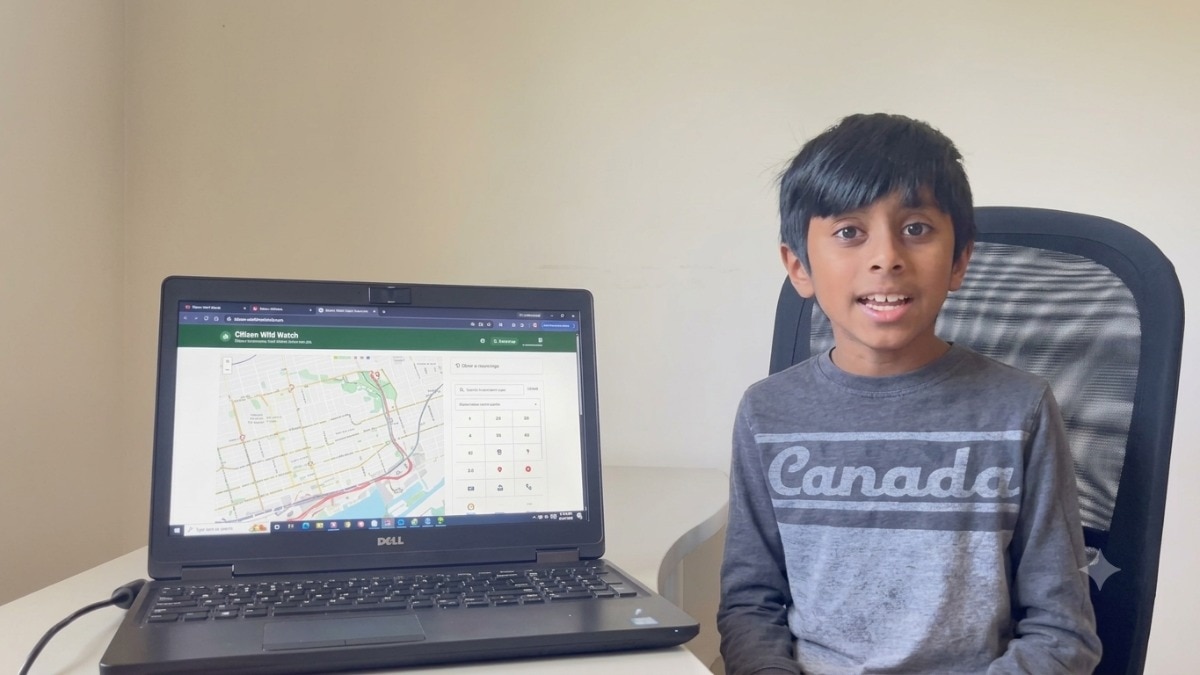
Viyoohan Sayooran, an 8-year-old from Canada, has leveraged AI tools to create 'Urban Wild Watch,' an app designed to warn neighbors about wildlife sightings while protecting the animals.
- 8-year-old Viyoohan Sayooran created the 'Urban Wild Watch' app.
- Developed using AI tools Claude and Lovable to bypass traditional coding hurdles.
- Prioritizes animal safety by showing general areas instead of exact coordinates.
In the quiet suburbs of Markham, Canada, Viyoohan Sayooran noticed a growing trend: coyotes and bears were becoming frequent visitors in his neighborhood. While most would see this as a cause for fear, the eight-year-old saw it as a problem requiring a technological solution. He envisioned a system where community members could warn one another without endangering the animals involved.
The result is Urban Wild Watch, a free application that allows users to report sightings of foxes, deer, bears, and coyotes. Beyond simple sightings, the app serves as a critical resource for reporting injured or orphaned wildlife and provides guidelines on how to interact with these animals safely.
Why This Matters
BozokMedia analysis shows that this project signifies a paradigm shift in software development. The barrier to entry for creating functional technology has collapsed; the focus has shifted from 'knowing how to code' to 'knowing how to prompt.' Viyoohan's success proves that AI can empower the youngest minds to tackle complex ecological and safety issues.
"The democratization of AI tools is turning children from passive consumers of technology into active creators of social solutions."
What truly sets this app apart is Viyoohan's ethical approach to data. He intentionally designed the app to avoid revealing the exact location of animals. By providing only a general area, he prevents 'social media tourism'—the dangerous tendency of people to rush to a location to take photos, which often stresses the animals and puts humans at risk.
To bring his vision to life, Viyoohan utilized Claude for conceptual organization and Lovable to translate his plain-English instructions into a functioning web application. This process eliminated the need for months of manual coding, allowing for rapid prototyping and deployment.
The necessity for such a tool is backed by alarming statistics. In Toronto alone, 2024 saw 2,584 reported coyote sightings and over 300 public-safety encounters. In an era of increasing urban sprawl, the friction between human habitats and wildlife is intensifying, making community-led monitoring tools essential.
Frequently Asked Questions
Q1: Why doesn't the app show the exact location of the animals?
To prevent crowds from gathering for social media photos, which could frighten the animals and create dangerous situations.
Q2: Which AI tools were used to build the app?
Viyoohan used Claude for organizing ideas and Lovable for developing the functional web app.