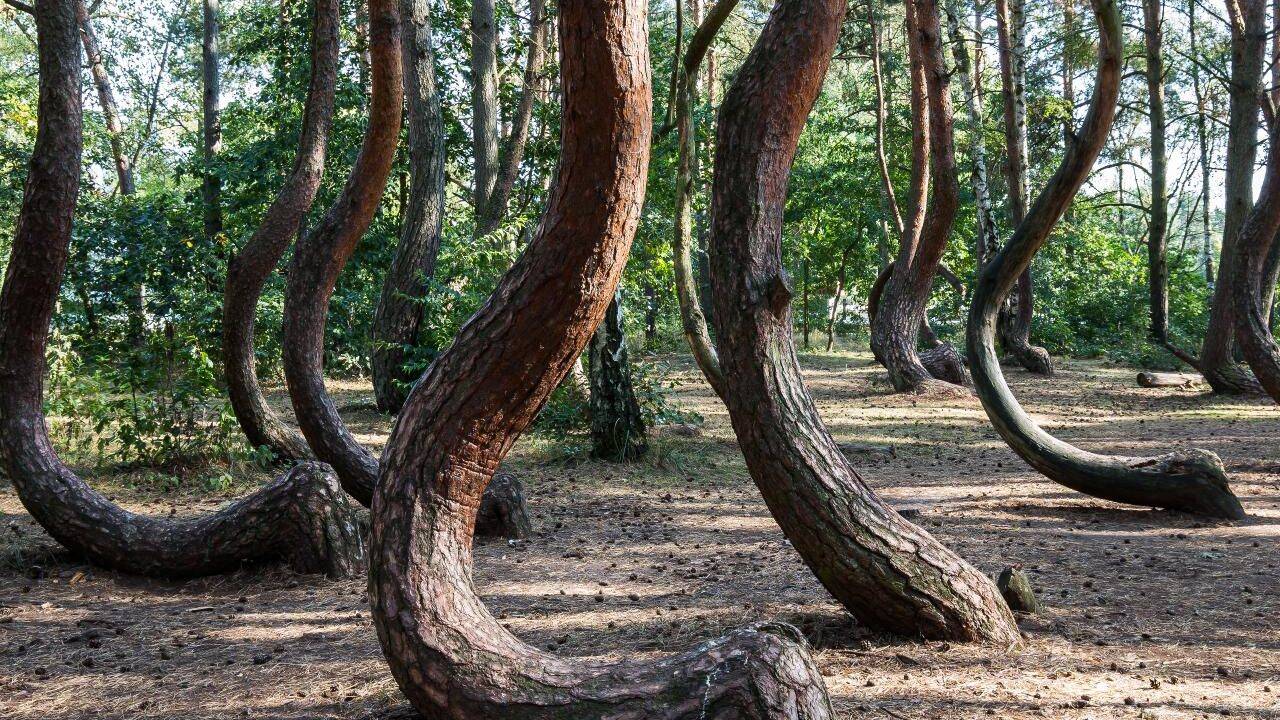
In western Poland, a grove of about 400 pine trees bends sharply near the ground, forming a distinctive C‑shaped silhouette. Researchers are scrambling to determine whether human shaping or natural forces caused the anomaly before the trees reach the end of their lifespan.
Key Takeaways (मुख्य बिंदु)
- Human manipulation of young saplings is the leading explanation for the curved trunks.
- World War II halted planned harvesting, leaving the grove as an unfinished experiment.
- The forest is now a protected site and a focal point for interdisciplinary scientific study.
The Crooked Forest (Krzywy Las) in western Poland houses roughly 400 pine trees whose lower trunks bend almost 90 degrees before resuming vertical growth. At first glance the grove appears ordinary, but the uniform, north‑ward curvature of each tree suggests a deliberate, localized intervention rather than a random natural event.
Historical Context
Archival records indicate the pines were planted in the late 1920s, a period when forestry was a vital local industry. The onset of World War II in 1939 abruptly disrupted any ongoing forestry projects, displacing the local workforce and erasing much of the documentation that might have explained the grove’s purpose.
Human‑Driven Theory
Forestry historians argue the bends were intentionally created while the saplings were still flexible—typically around a decade old. By holding the young trunks in a curved position, foresters could produce naturally curved timber for furniture, boat building, or specialized construction where straight wood was less valuable. The war likely prevented the completion of the harvest, leaving the bent trees as an unintended living record.
Natural Explanations
Alternative hypotheses point to heavy snowfall or unusual gravitational forces. A massive snow load in the early years could have forced saplings toward the ground, after which they resumed upward growth. However, the remarkable consistency of the bends—while neighboring, unaffected pines grew straight—makes a purely climatic cause difficult to accept.
Conservation Efforts Today
As the trees approach the end of their natural lifespan, Polish scientists and conservationists are accelerating preservation measures. The goals are twofold: safeguard the remaining trees and conduct detailed anatomical and genetic analyses that could finally resolve the century‑old mystery. The site also offers educational and eco‑tourism opportunities that highlight the intersection of human history and natural resilience.
Beyond its visual intrigue, the Crooked Forest stands as a vivid illustration of how early‑life stress—whether human‑imposed or environmental—can be survived and even celebrated by nature. Its ongoing study promises insights into tree biomechanics, historical land‑use practices, and the broader narrative of human impact on ecosystems.