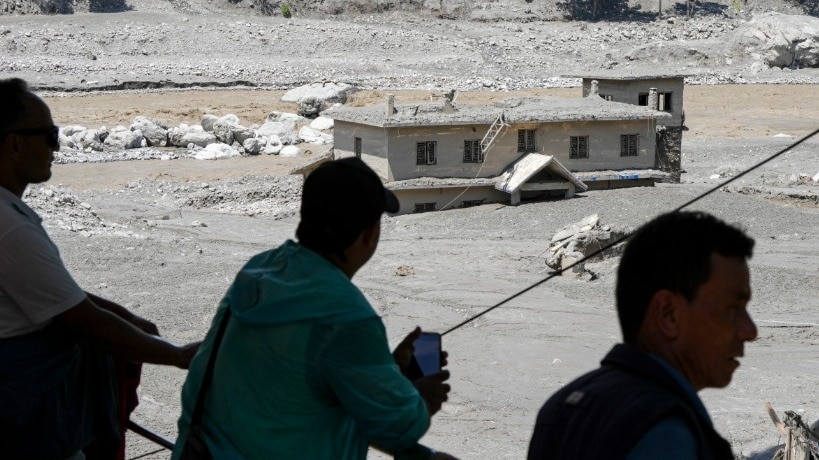
New scientific evidence reveals that a massive ice-rock avalanche near Langtang Lirung, rather than heavy rainfall or an earthquake, triggered the devastating Nepal flash floods. The disaster has claimed hundreds of lives and displaced thousands across the Bhote Koshi–Trishuli river system.
- A massive ice-rock avalanche at 5,200 meters near Langtang Lirung triggered the Nepal floods.
- Seismic signals initially mistaken for a 4.4 magnitude earthquake were actually generated by the sheer force of the collapse.
- The disaster highlights the growing threat of high-altitude hazards in the warming Himalayan region.
A devastating flash flood in the Bhote Koshi–Trishuli river system has claimed at least 389 lives in Nepal and three in Tibet, with more than 1,400 people still reported missing. Hundreds of families have been displaced across several districts, including Rasuwa, Nuwakot, Dhading, Gorkha, and Chitwan. While no casualties have been reported in India, nearly 288 Indian nationals in Nepal remain uncontactable, prompting rescue operations and downstream monitoring by authorities in Bihar and Uttar Pradesh.
Initial reports suggested that a magnitude-4.4 earthquake or heavy rainfall had triggered the landslide. However, a comprehensive analysis by the U.S. Geological Survey (USGS) and the National Remote Sensing Centre (NRSC) of ISRO has disproved this theory. Satellite imagery from Sentinel-2 and Resourcesat-2A confirmed a massive physical shift on the north side of Langtang Lirung, where a colossal mass of glacier ice and rock detached at approximately 5,200 meters and plunged 1,200 meters into the Lhende Khola river system.
Why This Matters
BozokMedia analysis shows that as global temperatures rise, the degradation of permafrost and glacial stability in the Himalayas is accelerating, turning pristine peaks into ticking ecological time bombs. This event proves that non-tectonic structural failures at high altitudes can generate seismic energy comparable to moderate earthquakes, necessitating a complete re-evaluation of regional early-warning infrastructure.
"The sheer kinetic energy of the Langtang Lirung collapse shows that high-altitude structural failures can mimic tectonic events, demanding a complete overhaul of our early-warning systems." - Himalayan Geohazard Specialist
Historical Background
The Himalayan region has increasingly become a hotspot for high-altitude mass wasting events. In 2021, a similar ice-rock avalanche in Chamoli, Uttarakhand, India, caused a catastrophic flood in the Rishi Ganga and Dhauliganga rivers, destroying downstream hydropower projects and claiming over 200 lives. These disasters emphasize that climate change is actively destabilizing steep mountain slopes, transforming frozen peaks into highly mobile debris flows.
| Feature | Nepal Ice-Rock Avalanche (2026) | South Lhonak GLOF (2023) |
|---|---|---|
| Primary Trigger | Sudden collapse of ice and rock from steep mountain slope | Breaching of a natural moraine dam holding a glacial lake |
| Water Source | River temporarily blocked by debris, creating a sudden surge | 105 hectares of stored glacial lake water released instantly |
| Seismic Footprint | Generated strong seismic waves equivalent to a 4.4 magnitude earthquake | No significant pre-event seismic wave generated by the breach itself |
Frequently Asked Questions
Q1: Why did scientists initially think an earthquake caused the Nepal flood?
Answer: Seismometers recorded ground vibrations equivalent to a magnitude-4.4 earthquake at the exact time of the flood. It was later discovered that the vibration was not tectonic, but rather the result of the massive kinetic energy released by the collapsing ice and rock mass hitting the valley floor.
Q2: What is the difference between an ice-rock avalanche and a Glacial Lake Outburst Flood (GLOF)?
Answer: A GLOF occurs when a natural dam holding a glacial lake fails, releasing stored water. An ice-rock avalanche, however, involves the sudden collapse of solid ice and rock from a mountain cliff, which can temporarily dam a running river and cause a catastrophic surge downstream when the debris dam breaches.