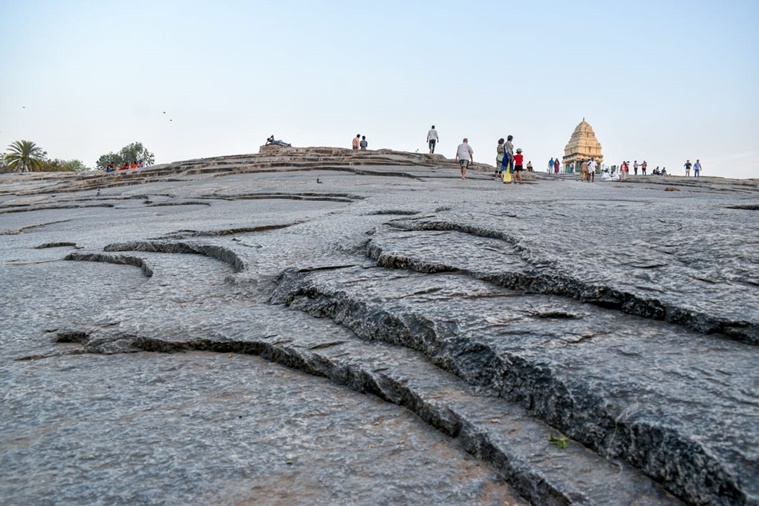
The Geological Survey of India (GSI) has alerted the Karnataka High Court that the proposed Hebbal underground tunnel could damage the ancient Peninsular Gneiss rock in Lalbagh Botanical Garden. The report highlights risks of rock fracturing and groundwater depletion.
- GSI submitted a 27-page report to the Karnataka High Court.
- The 16.7-km Hebbal tunnel threatens 3-billion-year-old geological monuments.
- Risks include rock fractures, vibration damage, and lowering groundwater levels.
In a significant environmental warning, the Geological Survey of India (GSI) has informed the Karnataka High Court that the proposed 16.7-km-long Hebbal underground tunnel project poses a direct threat to the 3-billion-year-old Peninsular Gneiss rock formation located within the Lalbagh Botanical Garden in Bengaluru.
The warning comes in response to a Public Interest Litigation (PIL) filed by actor-activist Prakash Belawadi. According to the GSI's 27-page report, the shafts required for Tunnel Boring Machines (TBM) are slated to be excavated in close proximity to this ancient geological monument.
Geological and Hydrological Implications
The GSI analysis suggests that the mechanical vibrations and the redistribution of stress caused by heavy construction could trigger new fractures or expand existing ones within the ancient rock mass. This rock is not just a stone; it is a classified Geological Monument representing billions of years of Earth's history.
Beyond the physical integrity of the rock, the report raises alarms regarding the local water table. The construction could potentially lower the groundwater table or alter natural flow paths, which may adversely impact the Lalbagh Lake and the fracture-controlled aquifers that sustain the area's ecology.
Why This Matters
BozokMedia analysis shows that this conflict highlights the growing tension between rapid urban infrastructure expansion and the preservation of irreplaceable natural heritage. The stability of the ground near ramp zones is also at stake, potentially leading to long-term geological instability.
The structural integrity of billion-year-old geological formations cannot be compromised for short-term transit solutions.
The controversy follows a previous attempt by the state government to amend the Karnataka Government Parks (Preservation) Act, 1975, which sought to allow 5% of park land for public utilities—an amendment that was ultimately withdrawn following intense public outcry.
Frequently Asked Questions
1. What is the Peninsular Gneiss?
It is an ancient rock formation over 3 billion years old, recognized as a geological monument due to its historical significance.
2. How will the tunnel affect the groundwater?
The GSI warns that construction activities and shaft excavation could alter underground water flow paths and lower the water table in the Lalbagh area.
