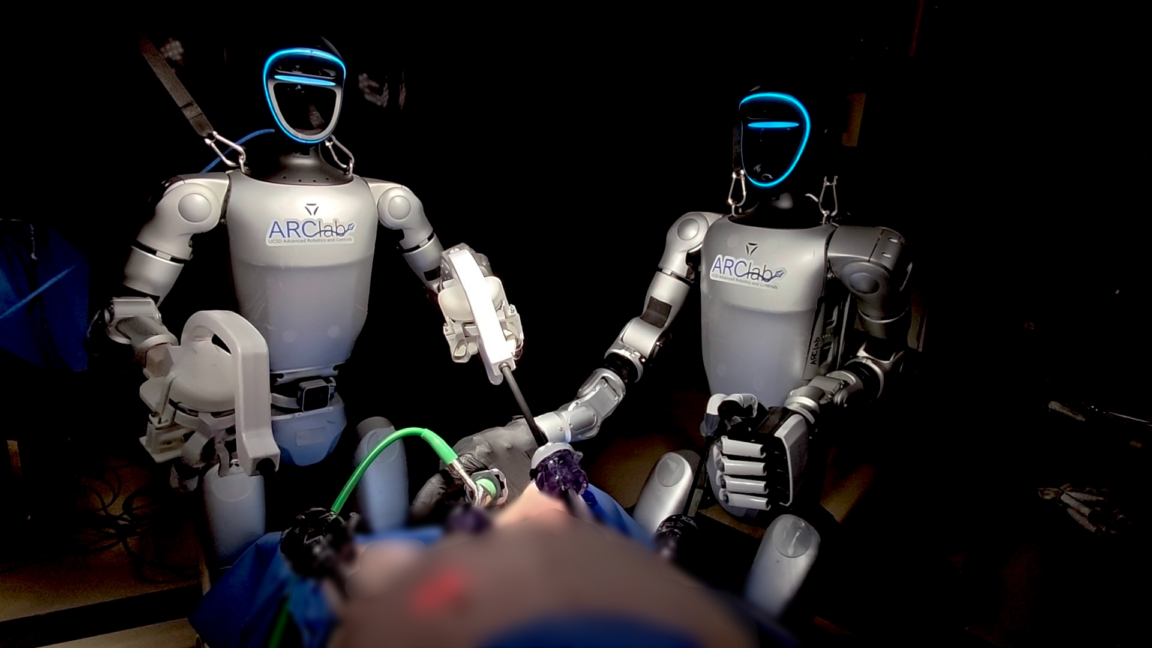
In a preclinical trial, surgeons remotely piloted humanoid robots to remove gallbladders from live pigs, marking the first human‑robot collaborative minimally invasive surgery. The breakthrough hints at affordable robotic surgery for smaller hospitals and remote settings.
Researchers at the University of California, San Diego (UCSD) have demonstrated a world‑first: a pair of humanoid robots, guided entirely by human surgeons, successfully removed gallbladders from living pigs. The results, published in Nature, represent a landmark in tele‑operated, human‑robot team surgery.
Study Design and Execution
The robots were built with a human‑like torso, articulated arms, and a full range of motion, but they were not autonomous. Experienced surgeons used a high‑definition tele‑operation console to control every movement in real time. Two separate minimally invasive (laparoscopic) procedures were performed on two pigs, each culminating in a safe gallbladder excision.
Technical Advantages Over Conventional Systems
Traditional surgical robots such as the Da Vinci system demand substantial capital investment and occupy large operating‑room footprints. By contrast, the new humanoid platform is compact, lightweight, and considerably cheaper. UCSD assistant professor of surgery Shanglei Liu emphasized, "It’s a fraction of the cost and it takes a fraction of the space in an operating room. So it’s easy to deploy, anywhere from rural areas, to the battlefield, and even to space."
Potential Clinical Impact
If subsequent human trials confirm safety and efficacy, these robots could democratize access to high‑precision surgery. Remote specialists could assist underserved clinics, disaster zones, or mobile field hospitals, narrowing the gap between urban tertiary centers and peripheral health facilities.
Regulatory and Ethical Considerations
Scaling tele‑operated robotic surgery raises questions about data security, patient consent, and liability. Regulators will need to define the boundary between acceptable remote control and prohibited autonomy, ensuring that human oversight remains paramount.
Overall, the experiment validates not only the cost‑effectiveness of a new robotic class but also the feasibility of seamless human‑robot collaboration in the operating theatre. Further clinical studies will determine whether this approach can transition from animal models to routine human care.