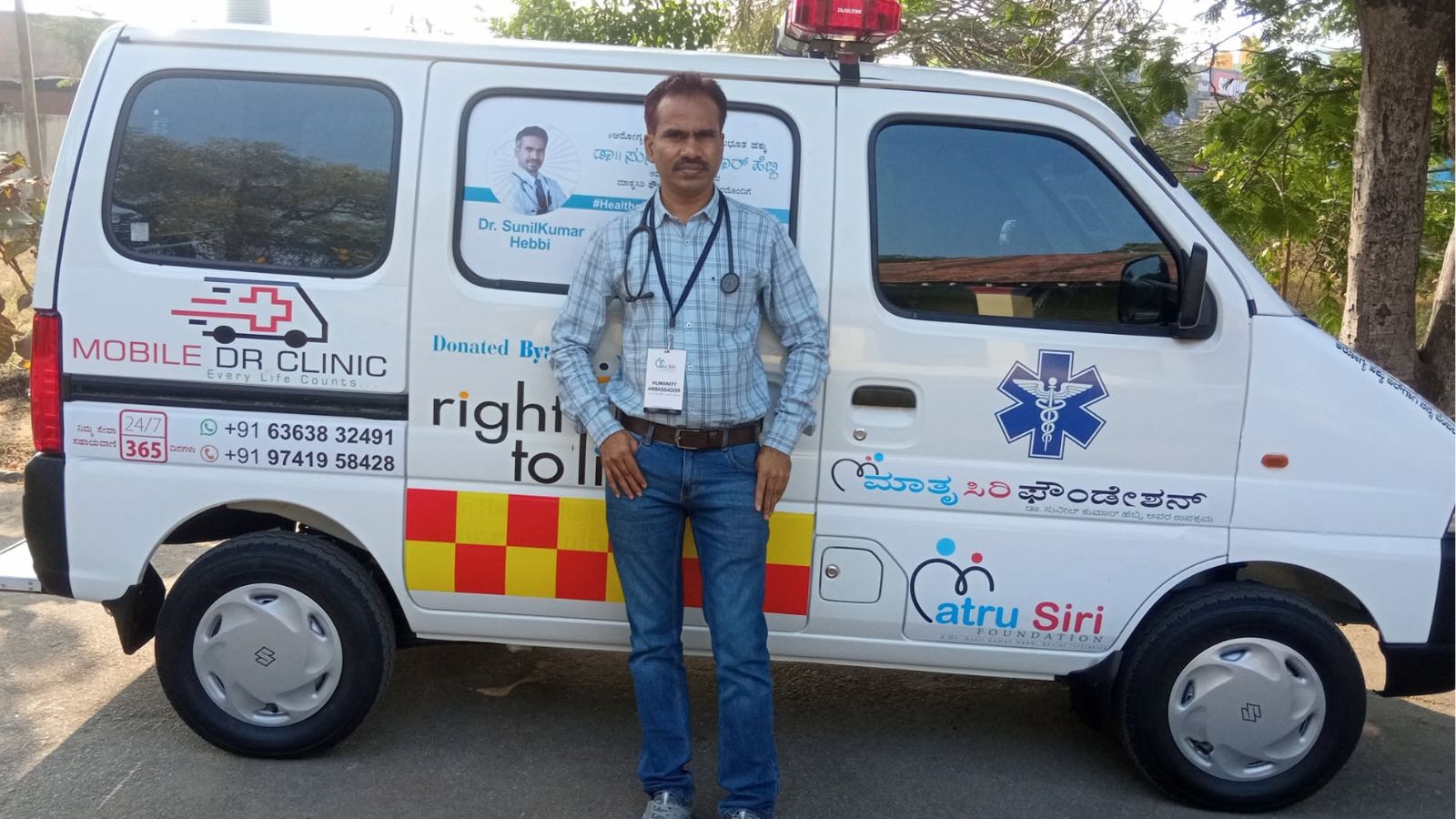
Driven by a desire to fight medical corruption, Dr. Sunil Kumar Hebbi transformed his car into a mobile clinic, providing life-saving healthcare to over 1.5 lakh underprivileged patients.
- Dr. Sunil Kumar Hebbi transitioned from private hospitals to a mobile clinic model to fight medical commercialization.
- He has treated over 1.5 lakh patients in slums, rural areas, and during natural disasters.
- His Matru Siri Foundation now operates with a massive network of 700+ volunteers.
- The mission was sparked by witnessing unethical practices and a life-changing road accident in 2010.
In the bustling streets of Bengaluru, a specialized van occasionally pulls up near a construction site or a slum settlement. Inside, equipped with an ECG machine, oxygen tanks, and essential diagnostic tools, is Dr. Sunil Kumar Hebbi—a man who chose compassion over corporate profits.
After completing his MBBS in 2007, Dr. Hebbi entered the world of private healthcare. However, the experience was disillusioning. He witnessed hospitals exploiting government schemes like the 'Yashaswini' card to push unnecessary surgeries and admissions. For Dr. Hebbi, the healthcare sector had shifted from a noble calling to a profit-driven industry.
Why This Matters
BozokMedia analysis shows that the gap between urban medical infrastructure and rural accessibility remains a critical crisis in India. While private hospitals flourish, the most vulnerable populations are often left behind or exploited by rising costs. Dr. Hebbi’s model provides a grassroots solution to this systemic failure.
"I saw more business and less healthcare in the private hospitals. I did not want to be part of that cheating system," Dr. Hebbi recalls.
A turning point occurred in 2010 during a late-night road accident on Hosur Road. After providing emergency aid to a victim, the gratitude expressed by the victim's mother deeply moved him. This emotional catalyst led him to convert his personal vehicle into a mobile clinic, eventually evolving into the Matru Siri Foundation.
Over the last decade, Dr. Hebbi has become a lifeline during crises, providing medical aid during the Chennai floods and the Kerala landslides. His mobile clinic has now expanded into a massive network, supported by over 200 medical volunteers and 500 non-medical staff members.
Historical Background
The struggle for affordable healthcare in India has long been marked by the tension between private profitability and public necessity. While government-backed insurance schemes were designed to protect the poor, the lack of stringent oversight allowed for the very exploitation Dr. Hebbi fought against, necessitating independent grassroots movements.
Frequently Asked Questions
Question 1: How does the Matru Siri Foundation operate?
Answer: The foundation runs mobile clinics and free health camps in slums, old-age homes, and rural areas, funded largely by Dr. Hebbi's regular practice and anonymous donors.
Question 2: What equipment does the mobile clinic carry?
Answer: The van is equipped with essential tools including a glucometer, oxygen tanks, BP monitors, and an ECG machine to provide immediate care.