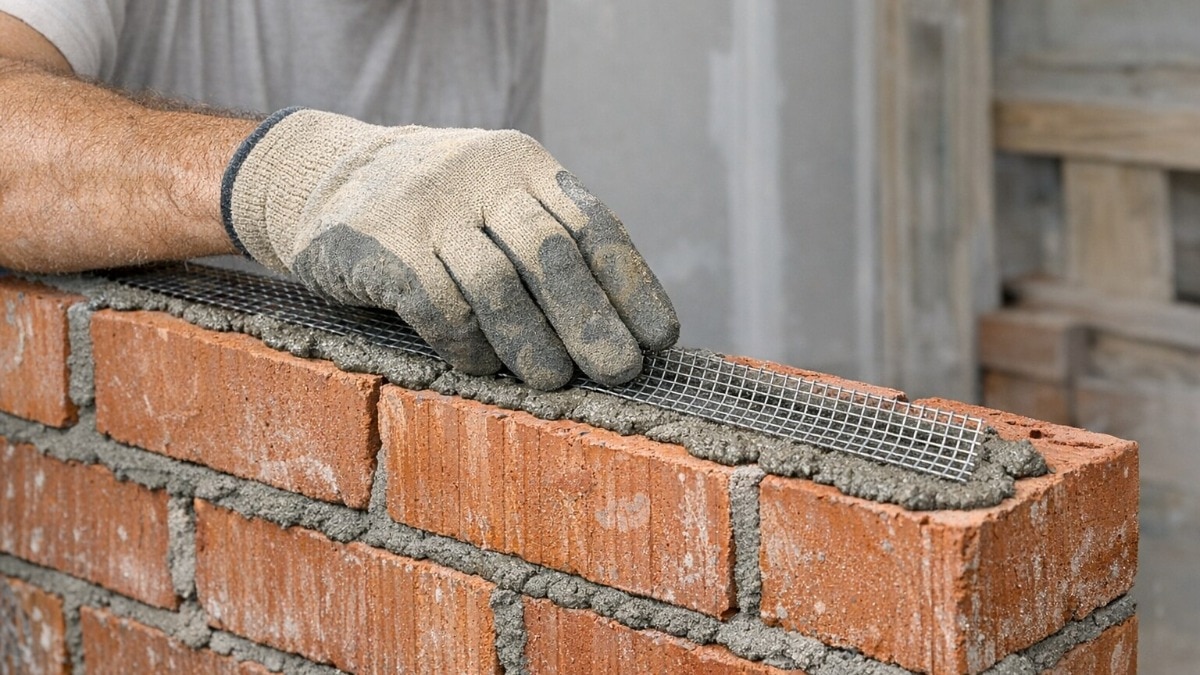
In modern construction, metal mesh strips are being integrated into 4-inch partition walls to enhance structural integrity. Learn how these strips prevent cracks and withstand vibrations.
- Mesh strips (Ladder Wire) provide structural reinforcement to thin 4-inch walls.
- They act as a stabilizing framework to prevent cracks caused by thermal expansion.
- Chicken mesh is essential at the junction of columns and brick walls to prevent plaster cracks.
In contemporary home construction, to maximize living space and reduce costs, many homeowners opt for 4-inch single-brick partition walls. However, these thin walls lack the inherent stability of thicker masonry. To address this vulnerability, skilled builders are increasingly incorporating metal mesh strips—also known as 'Mesh Strips' or 'Ladder Wire'—between the layers of bricks during the masonry process.
The Engineering Behind Mesh Strips
A thin wall, by its very nature, has a significantly lower self-supporting capacity compared to a standard 9-inch wall. BozokMedia analysis shows that the primary function of these metal strips is to bind the brick layers together. By embedding these strips within the mortar, the bricks are effectively 'locked' into a single, cohesive unit, transforming a series of individual bricks into a reinforced structural framework.
Metal mesh strips act as the 'backbone' of thin partition walls, ensuring structural continuity.
Mitigating Thermal Stress and Vibrations
Environmental factors play a massive role in the degradation of masonry. During seasonal shifts, materials like cement, brick, and concrete expand and contract at different rates. This differential movement often leads to unsightly and dangerous cracks. The metal mesh serves as a stabilizing framework that distributes these internal stresses evenly across the wall, neutralizing the potential for cracking.
Furthermore, thin walls are highly susceptible to external vibrations, such as heavy traffic passing nearby or minor seismic activities. The inclusion of metal strips provides the wall with a degree of flexibility and toughness, preventing the structure from snapping or collapsing under sudden kinetic energy.
Managing the Column-Wall Interface
One of the most common failure points in a building is the junction where a concrete column meets a brick wall. Because concrete and brick react differently to temperature and stress, vertical cracks frequently appear at these joints. To prevent this, professionals use 'Chicken Mesh' or fiber mesh over the joint before plastering. This ensures a seamless transition and prevents the plaster from separating from the substrate.
Frequently Asked Questions
1. Is it safe to build a 4-inch wall without metal mesh?
While possible, it is highly discouraged for load-bearing or high-traffic areas as the risk of cracking and structural failure increases significantly.
2. What is the difference between Mesh Strips and Chicken Mesh?
Mesh strips are used within the brickwork for structural reinforcement, whereas chicken mesh is applied over joints (like columns) to prevent plaster cracks.