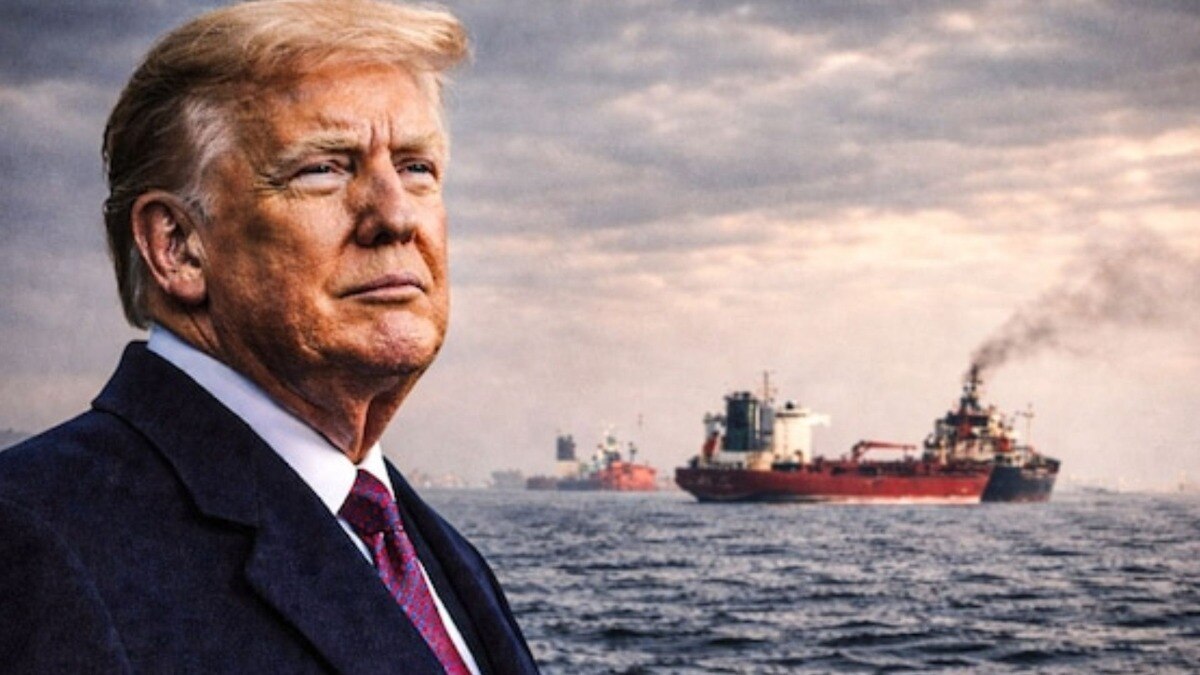
U.S. President Donald Trump announced the re‑imposition of a blockade on the Strait of Hormuz and will seek a 20% reimbursement from all cargo passing through the waterway. The move escalates tensions with Iran and could ripple through global energy markets.
मुख्य बिंदु (Key Takeaways)
- Trump reinstates a so‑called “Iranian blockade” on the Hormuz Strait.
- U.S. seeks a 20% reimbursement from all cargo using the lane.
- The policy may heighten U.S.–Iran tensions and affect world oil prices.
On July 13, 2026, President Donald Trump declared that the United States would once again enforce what he termed an “Iranian blockade” on the strategically vital Strait of Hormuz and would demand a 20% reimbursement on every container that traverses the channel. The announcement followed a Fox News interview in which Trump asserted that America would “take control” of the strait and act as its “guardian.” He later posted the same message on Truth Social, signaling a sharp escalation in U.S. rhetoric amid ongoing Gulf‑region skirmishes.
Historical Context
The Hormuz Strait, linking the Persian Gulf with the Gulf of Oman, carries roughly one‑fifth of the world’s oil and liquefied natural gas shipments. Since the 1970s, the narrow waterway has been a flashpoint for geopolitical confrontations, ranging from the 1979 Iranian Revolution to the 1991 Gulf War and the 2019 tanker seizures. Repeated U.S.–Iran naval incidents—most notably the 2022 drone clash—have kept the strait under constant scrutiny.
Implications of a 20% Reimbursement Demand
Trump’s 20% reimbursement proposal effectively places the cost of securing the strait on commercial shippers. If implemented, shipping firms would see a direct increase in operating expenses, potentially driving up freight rates and, by extension, global oil prices. Moreover, Iran is likely to view the measure as an illegal restriction, raising the prospect of retaliatory actions that could jeopardize the free flow of trade.
International Legal and Diplomatic Repercussions
Under the United Nations Convention on the Law of the Sea (UNCLOS), no single nation may unilaterally block a strait used for international navigation without a UN Security Council mandate. Consequently, Washington’s unilateral “blockade” could face legal challenges in international courts. European Union capitals, China, and several Gulf states have already urged restraint, warning that any disruption could spark a broader economic shock.
Market Outlook
Energy analysts warn that even a brief interruption in Hormuz traffic can trigger a sharp spike in crude prices, echoing the market dynamics seen after the 2020 oil price war. As the U.S. positions itself as the “Guardian of the Hormuz Strait,” the policy may force a re‑evaluation of supply chains, insurance premiums, and geopolitical risk assessments across the energy sector.