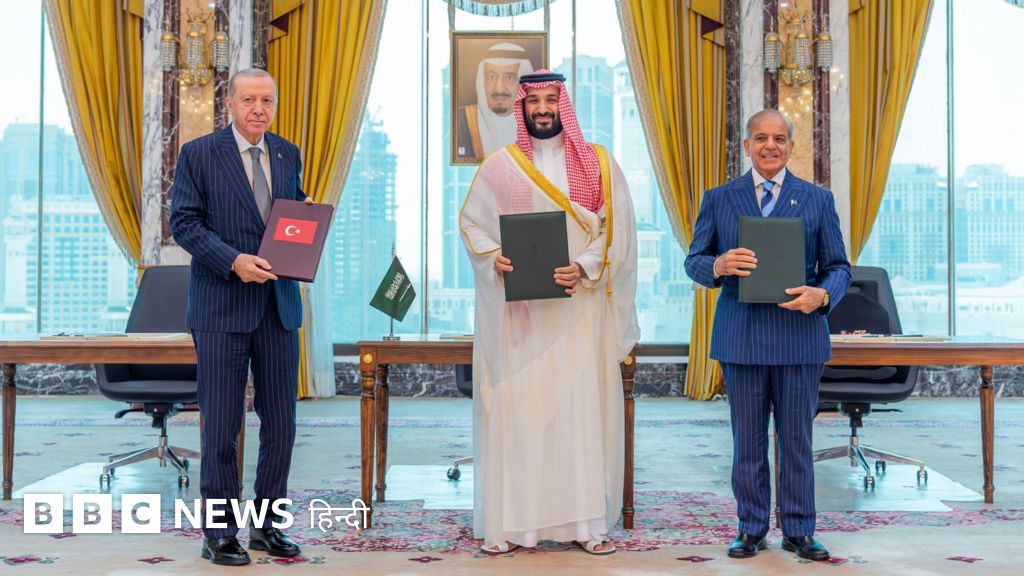
A landmark defense agreement signed between Saudi Arabia, Turkey, and Pakistan in Mecca has sparked global debate. The pact, which treats an attack on one as an attack on all, raises critical questions about regional stability and India's security.
Key Takeaways
- Saudi Arabia, Turkey, and Pakistan signed a trilateral defense pact in Mecca.
- The treaty stipulates that an attack on one member is considered an attack on all three.
- The pact combines Saudi wealth, Pakistani nuclear capability, and Turkish military expertise.
- Analysts suggest this is a move toward a regional security architecture rather than an explicit anti-India alliance.
In a significant shift in Middle Eastern and South Asian geopolitics, Saudi Arabia, Turkey, and Pakistan signed a joint defense agreement in the holy city of Mecca on Friday. The core of this agreement is a mutual defense clause: an attack on any one of the signatories will be treated as an attack on all three. This development has sent ripples through diplomatic circles, prompting questions about the future of regional alliances.
Tanvi Madan, a senior fellow at the Brookings Institution, noted that Pakistan is entering a new military alliance decades after the era of CENTO and SEATO. While the pact aims to bolster collective deterrence, critics and observers like Yair Netanyahu have raised pointed questions: if a conflict arises between India and Pakistan, will Turkey and Saudi Arabia be compelled to intervene?
Why This Matters
BozokMedia analysis shows that this 'triad' creates a formidable synergy of resources. Saudi Arabia provides the financial muscle, Pakistan offers nuclear deterrence and manpower, and Turkey brings advanced defense technology and combat experience. This combination could fundamentally alter the strategic calculus in the Indo-Pacific and Middle East regions.
"This agreement is in accordance with Article 51 of the UN Charter, which includes the right to self-defense; it is not intended to target any specific country." - Recep Tayyip Erdoğan, President of Turkey
For India, the strategic implication is nuanced. India maintains a robust economic relationship with Saudi Arabia, boasting over $43 billion in bilateral trade. With Saudi Arabia's Aramco involved in major Indian infrastructure projects and millions of Indians working in the Kingdom, New Delhi must navigate this new defense pact without jeopardizing its vital energy and economic security.
| Country | Primary Strategic Contribution |
|---|---|
| Saudi Arabia | Financial Capital & Energy Resources |
| Pakistan | Nuclear Capability & Manpower |
| Turkey | Military Technology & Defense Industry |
Frequently Asked Questions
1. Is this a 'Sunni NATO'?
While some call it that, analysts suggest it is more about creating a regional security framework owned by regional players.
2. How will the US react?
The US views its allies (Saudi, Turkey, Pakistan) managing regional security as a way to share the burden, though it won't replace US leadership.