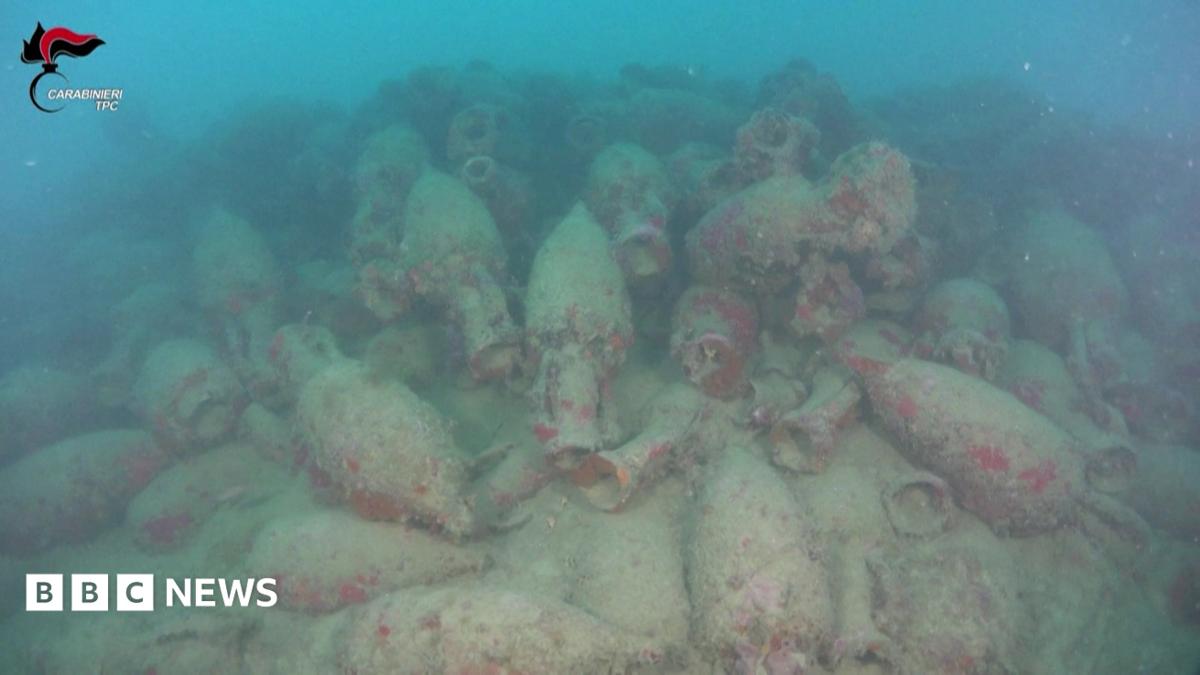
Italian divers have discovered an exceptionally well-preserved Roman shipwreck dating back over 2,000 years off the coast of Sicily. Piled high with hundreds of ancient pottery jars (amphorae), the vessel offers a rare, intact window into ancient Mediterranean trade routes.
Key Takeaways
- A 2,000-year-old Roman shipwreck has been discovered off the coast of Sicily at a depth of 46 meters.
- The vessel is loaded with hundreds of well-preserved amphorae used for transporting wine and olive oil.
- Italy's Culture Ministry has hailed it as one of the most significant underwater archaeological finds in recent years.
Italian divers have discovered an ancient Roman shipwreck off the coast of Sicily, believed to be more than 2,000 years old. The vessel was found piled high with hundreds of well-preserved containers, which were used to transport goods such as wine and olive oil. Specialist police divers from the Carabinieri Art Squad found the ship around 46m (150ft) deep, after a tip-off from a fisherman.
The wreckage is 21m (69ft) long and 6m (20ft) wide, according to reports in local media. The culture ministry says it dates from the second or 1st Century BC. Fisherman and free-diver Giacomo De Mola described stumbling across the historic vessel while surveying the seabed near Mazara del Vallo, noting that his heart stopped when he realized it was not a mere rock formation.
Why This Matters
BozokMedia analysis shows that this discovery does not merely represent a treasure trove of ancient ceramics, but serves as a vital piece of economic data. It map-points the exact maritime trade routes utilized by the Roman Empire during the 2nd and 1st Century BC, showing how commodities like olive oil, wine, and grain flowed across the Mediterranean to fuel the empire's expansion.
"This is, without a doubt, the most incredible discovery of my life. It's hard to describe what it feels like to be among the first humans, in nearly 20 centuries, to see that place again," remarked free-diver Giacomo De Mola.
Historical Background of Mediterranean Trade
During the late Roman Republic, Sicily was a crucial agricultural hub, often referred to as the "granary of Rome." The Mediterranean Sea was the superhighway of the ancient world, teeming with merchant vessels carrying goods from Egypt, North Africa, and Greece. Amphorae were the standard shipping containers of antiquity, designed with a pointed bottom to be packed tightly into the holds of wooden ships.
Comparison of Recent Ancient Shipwreck Discoveries
| Shipwreck Location | Estimated Era | Primary Cargo Found | Depth / Condition |
|---|---|---|---|
| Sicily Coast (2026 Find) | 2nd - 1st Century BC | Hundreds of Amphorae (Wine/Oil) | 46m deep, Highly Intact |
| North-west of Rome (2023 Find) | 1st - 2nd Century BC | Amphorae | Deep water, Well-preserved |
| Bulgarian Coast (2018 Find) | Over 2,400 years old | Greek Merchant Cargo | Black Sea anoxic zone, Intact |
Frequently Asked Questions
Q1: Who discovered the Sicily shipwreck?
A1: The wreck was initially spotted by fisherman and free-diver Giacomo De Mola, who alerted the authorities, leading to an official investigation by the Carabinieri Art Squad.
Q2: What will happen to the artifacts now?
A2: Italian cultural authorities are implementing strict security measures to safeguard the site while marine archaeologists conduct further research and conservation efforts.