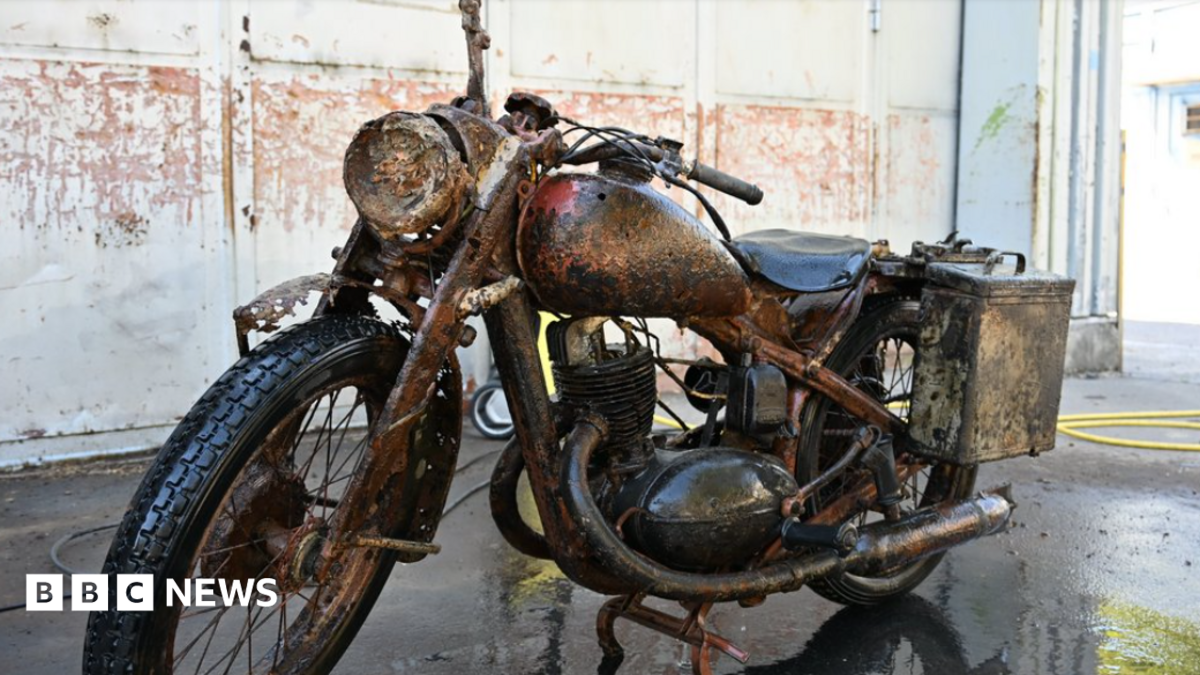
Due to record-low water levels in Budapest's Danube river caused by intense drought, the remains of two WWII German soldiers and a vintage motorcycle have been discovered.
Key Takeaways
- WWII German soldier remains and a Wehrmacht motorcycle found in the Danube.
- Discovery prompted by extreme drought and record-low river levels in Budapest.
- The German War Graves Commission is leading the identification process.
In a startling discovery driven by environmental crisis, the receding waters of the Danube River in Budapest have unveiled remnants of the Second World War. Following an intense period of drought, the remains of two German soldiers, along with a largely intact Wehrmacht motorcycle, have emerged from the riverbed.
The German War Graves Commission reported that the find included identification tags, a wedding ring, and a Kuban shield—a combat badge. The motorcycle is believed to be a DKW NZ 350-1 model, specifically manufactured for wartime use starting in 1944. The items remained remarkably well-preserved due to a mixture of harbor sludge and oil on the riverbed.
Why This Matters
BozokMedia analysis shows that while the drought is an ecological disaster, it has inadvertently acted as a time capsule for historical truth. For many families whose ancestors vanished during the conflict, this discovery offers a long-awaited chance at closure and a dignified burial for the fallen.
"Now begins a puzzle, in which we will try to determine the identity of the two dead," said Arne Schrader of the German War Graves Commission.
The discovery was not without danger; the team also encountered anti-tank mines, necessitating the deployment of a bomb disposal unit and the temporary closure of the riverbank. One identification tag belonged to a Wehrmacht soldier, while the other belonged to a member of the Waffen-SS, an organization declared criminal during the Nuremberg Trials.
Historical Background
During WWII, German identification tags were split into two parts: one remained with the soldier, and the other was sent to military authorities to track casualties. The fierce fighting in Budapest between the Soviet Red Army and the German Wehrmacht remains one of the most intense chapters of the war's final stages.
Frequently Asked Questions
Question 1: Where will the soldiers be laid to rest?
Answer: The soldiers are scheduled to be buried at the German war cemetery in Budaörs, located just outside Budapest.
Question 2: How will they identify the specific individuals?
Answer: The commission will use bone analysis and cross-reference the recovered identification tags with their extensive database.