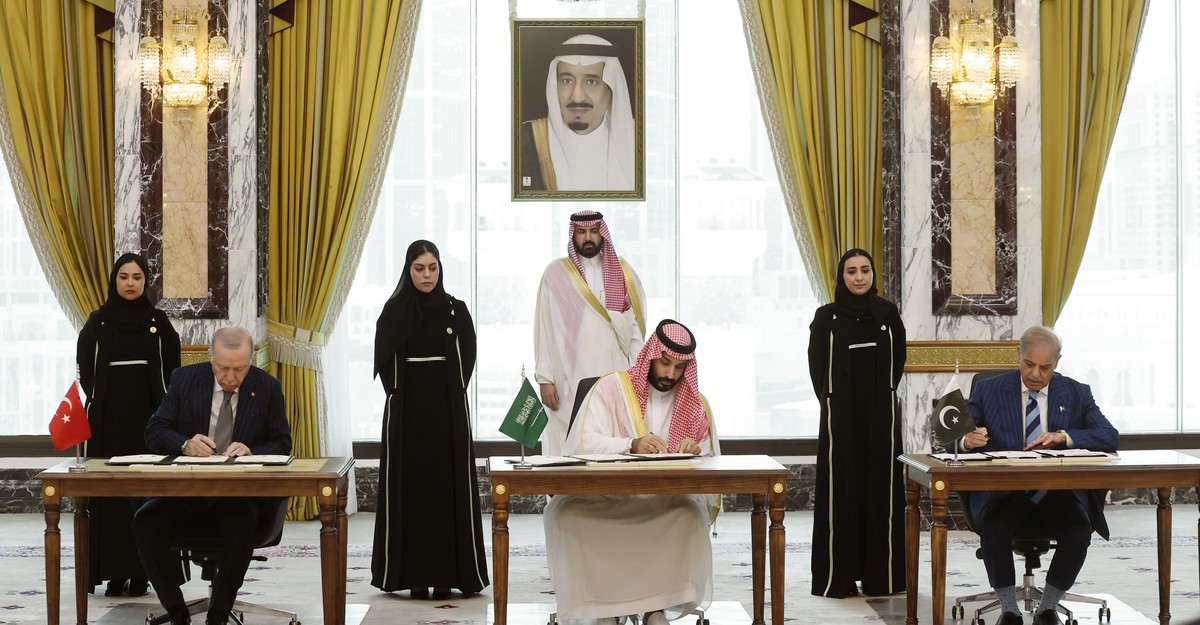
A landmark defense agreement between Saudi Arabia, Turkey, and Pakistan is reshaping regional security, leaving Iran facing unprecedented diplomatic isolation.
Key Takeaways
- Saudi Arabia, Turkey, and Pakistan have forged a new defense pact named the 'Mecca Pact'.
- The agreement establishes a collective defense mechanism: an attack on one is an attack on all.
- The pact signals a major shift in regional power, potentially isolating Iran and defining a new security architecture.
When the leaders of Saudi Arabia, Pakistan, and Turkey convened last week to finalize a new defense agreement, the geopolitical implications were immediate. While the signatories maintained that the pact was not aimed at any specific nation, the shadow of the Islamic Republic of Iran looms large over the proceedings. This new alliance brings together the region's economic heavyweights and its sole nuclear-armed Muslim power, creating a formidable bloc.
Why This Matters
The symbolism of naming the accord after the holy city of Mecca cannot be overstated. BozokMedia analysis shows that this is more than a mere military treaty; it is a structural realignment of the Muslim world. By aligning the military might of Turkey and Saudi Arabia with the nuclear deterrent of Pakistan, the pact creates a 'NATO-style' security umbrella that directly counters Iran's regional militia-based influence.
The Mecca Pact represents a shift from individual state defense to a collective regional security paradigm.
Iran has long utilized proxy militias in Yemen, Iraq, and Syria to project power. However, the recent shifting tides—including the fall of the Assad regime in Syria and increased tension with neighbors—have left Tehran increasingly isolated. The language of the Mecca accord is uncompromising: "Any armed attack against any of the three States shall be regarded as an attack against them all."
Historical Context: From Allies to Adversaries
The current friction is a stark departure from the pre-1979 era. During the Cold War, Iran and Saudi Arabia often found common ground in stabilizing the region against radicalism and communism. The 1979 Revolution fundamentally altered this trajectory, turning Iran into a revolutionary state that often clashes with the official orientations of its neighbors. The new pact attempts to restore a sense of predictable regional order that has been missing for decades.
The Choice for Tehran
Tehran now faces a pivotal crossroads. It can continue its current path of supporting non-state actors and destabilizing regional norms, which will only deepen its isolation. Alternatively, it can pivot toward the regional consensus of economic development and diplomatic reconciliation. The choice is between revolutionary ambition and regional integration.
Frequently Asked Questions
1. What is the primary goal of the Mecca Pact?
The pact aims to create a collective defense mechanism among Saudi Arabia, Turkey, and Pakistan to ensure regional stability.
2. How does this affect Iran?
While not explicitly targeting Iran, the pact creates a unified front that limits Iran's ability to influence the region through proxy warfare.