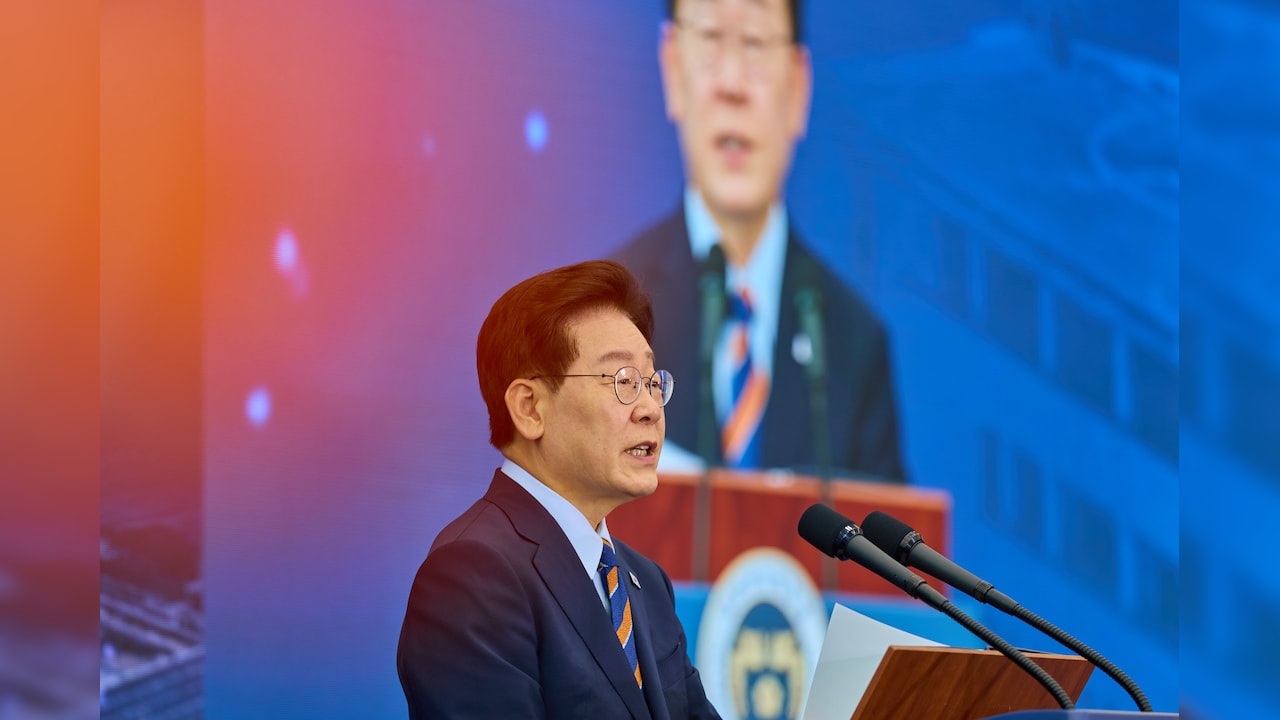
South Korean opposition leader Lee Jae-myung has called for immediate talks with North Korea to replace the long-standing armistice with a permanent peace treaty. His proposal aims to formally end the Korean War, which technically remains ongoing, and foster stability on the peninsula. This move highlights a renewed push for diplomatic engagement amidst persistent tensions.
Key Takeaways
- South Korean opposition leader Lee Jae-myung proposes talks with North Korea to replace the 1953 armistice with a permanent peace treaty.
- The Korean War technically remains ongoing, making a peace treaty a critical step towards formal reconciliation and stability.
- Lee's call comes amidst persistent inter-Korean tensions and complex geopolitical dynamics in the region.
SEOUL, South Korea – South Korean opposition leader Lee Jae-myung has issued a significant call for immediate diplomatic engagement with North Korea, urging both nations to commence discussions aimed at replacing the current armistice with a permanent peace treaty. This proposal, coming from the leader of the Democratic Party, underscores a renewed push to formally end the Korean War, which concluded with a ceasefire in 1953 but never a definitive peace agreement.
Lee emphasized the historical imperative of such a move during a recent public statement, highlighting that the absence of a formal peace treaty leaves the Korean Peninsula in a perpetual state of technical conflict. "The time has come to move beyond the provisional state of an armistice and build a foundation for genuine peace," Lee stated, advocating for a pragmatic approach to inter-Korean relations.
Historical Background: The Korean War and Its Aftermath
The Korean War, fought from 1950 to 1953, pitted the communist North, supported by China and the Soviet Union, against the capitalist South, backed by the United Nations, primarily the United States. The conflict ended with the Korean Armistice Agreement, signed on July 27, 1953. This agreement established a demilitarized zone (DMZ) but was strictly a military ceasefire, not a political peace treaty. Consequently, the two Koreas remain technically at war, leading to decades of fluctuating tensions, occasional skirmishes, and a persistent arms race.
Various attempts at peace talks and reconciliation have been made over the years, notably during the "Sunshine Policy" era in the late 1990s and early 2000s, and more recently with summits between former South Korean President Moon Jae-in and North Korean leader Kim Jong Un. However, these efforts have largely failed to achieve a lasting peace framework, often collapsing due to disagreements over denuclearization and sanctions.
Why This Matters
BozokMedia analysis shows that Lee Jae-myung's proposal, while not from the incumbent government, injects a critical new perspective into the stalled inter-Korean dialogue. A formal peace treaty would not only de-escalate military tensions but could also pave the way for increased economic cooperation, cultural exchange, and ultimately, a more stable and prosperous Korean Peninsula. It would also fundamentally alter the geopolitical landscape of Northeast Asia, impacting major powers like China, the United States, and Japan. The lack of a peace treaty has been a constant source of instability, justifying military build-ups and maintaining a high state of alert.
"Replacing the armistice with a peace treaty is the foundational step towards truly normalizing relations on the Korean Peninsula, but it requires unprecedented political will from both sides and robust international guarantees," says Dr. Ahn Se-young, a leading expert on inter-Korean affairs.
The path to peace, however, is fraught with challenges. North Korea's continued nuclear weapons program, its ballistic missile tests, and its demand for the lifting of international sanctions remain significant hurdles. Any meaningful dialogue would require addressing these complex issues, alongside ensuring the security concerns of all parties involved.
Frequently Asked Questions
- What is the difference between an armistice and a peace treaty? An armistice is a temporary cessation of hostilities, a ceasefire, while a peace treaty is a formal agreement that permanently ends a war and establishes new relations between the belligerent parties.
- Why is a peace treaty so difficult to achieve on the Korean Peninsula? The primary obstacles include North Korea's nuclear weapons program, its demand for sanctions relief, deep-seated mistrust, and the complex involvement of international powers like the United States and China.