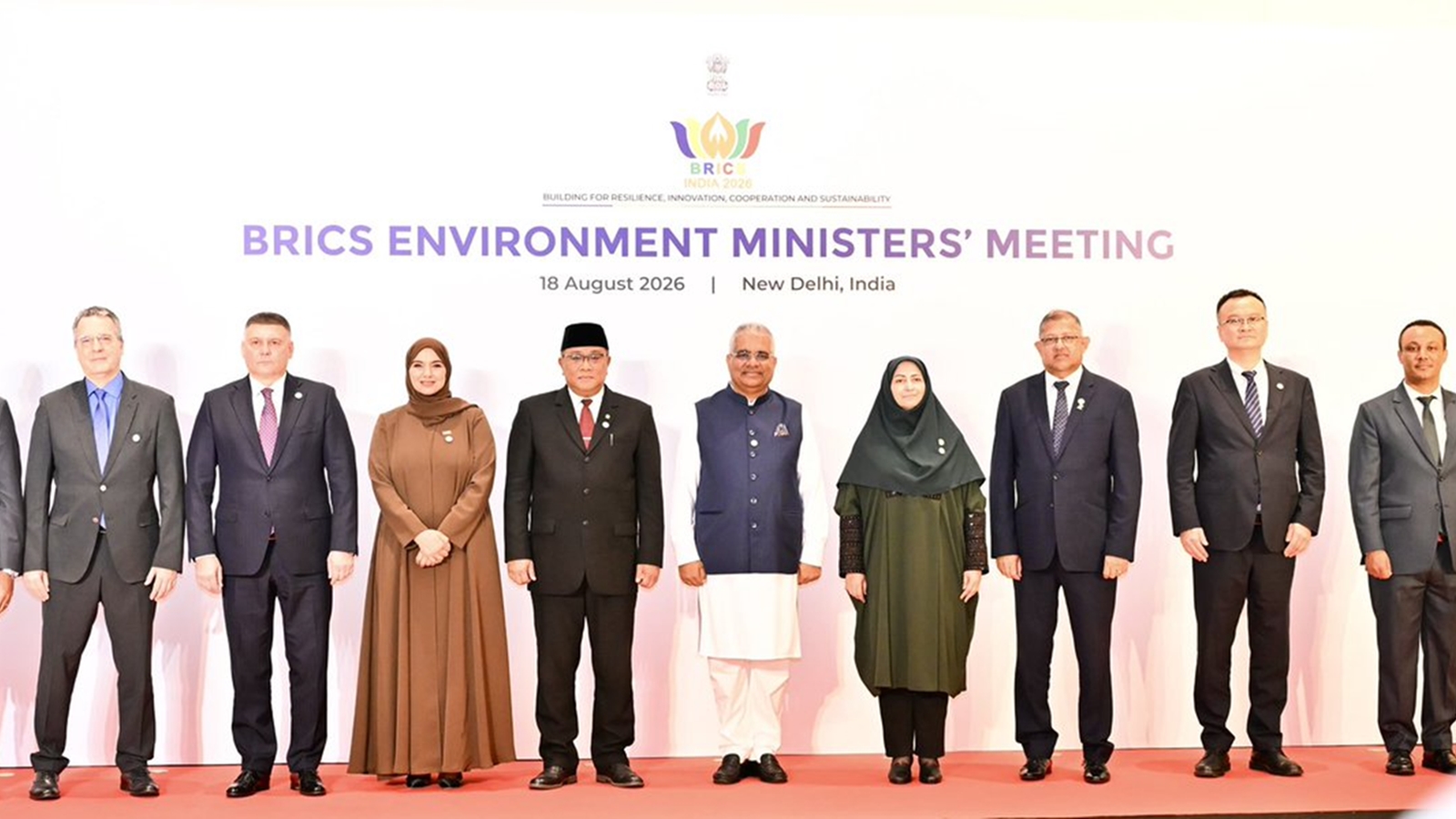
During the BRICS summit in New Delhi, environment ministers collectively denounced the EU's Carbon Border Adjustment Mechanism (CBAM) as a protectionist trade barrier. The bloc also demanded urgent climate finance from wealthy nations.
- BRICS ministers labeled the EU's CBAM as unilateral, punitive, and discriminatory.
- The bloc urged developed nations to fulfill climate finance commitments via NCQG.
- The meeting, chaired by India, emphasized the principle of 'Common but Differentiated Responsibilities'.
In a significant diplomatic development, the 12th BRICS Environment Ministers' meeting held in New Delhi saw a unified stance against the European Union’s (EU) Carbon Border Adjustment Mechanism (CBAM). The member nations characterized the tax as a protectionist measure that deviates from international legal standards and undermines the economic stability of developing economies.
The CBAM is an import levy targeting carbon-intensive sectors such as steel, iron, fertilizers, aluminum, and cement. While the EU presents it as a tool to mitigate global carbon footprints, BRICS nations view it as a sophisticated trade barrier. Since its full implementation on January 1, 2026, importers have been required to purchase certificates corresponding to the embedded carbon emissions in their goods, creating significant financial hurdles for emerging markets.
Why This Matters
BozokMedia analysis shows that this confrontation marks a deepening rift between the Global North and the Global South regarding climate justice. As developed nations implement unilateral environmental taxes, they risk triggering trade wars and alienating key economic partners in the developing world.
The imposition of unilateral carbon taxes without adequate financial support for adaptation is effectively penalizing developing nations for their industrial growth.
The meeting included high-level officials from Brazil, Russia, India, China, South Africa, UAE, Indonesia, Iran, Saudi Arabia, Egypt, and Ethiopia. A central theme of the discussion was the principle of “Common but Differentiated Responsibilities and Respective Capabilities” (CBDR-RC), asserting that climate action must be calibrated to each nation's specific economic circumstances.
Furthermore, the bloc pressed wealthy nations to honor the New Collective Quantified Goal (NCQG) established at COP 30 in Brazil. The ministers demanded a massive scale-up in climate adaptation finance, aiming to triple the support provided to developing countries by 2035.
| Feature | EU's CBAM Perspective | BRICS Perspective |
|---|---|---|
| Primary Goal | Reduce global carbon footprint | Trade protectionism/Barrier |
| Economic Impact | Environmental accountability | Discriminatory financial burden |
| Legal Stance | Climate mitigation tool | Violation of international equity |
Frequently Asked Questions
1. What sectors are affected by the EU Carbon Tax? Industries like steel, cement, aluminum, and fertilizers are the primary targets.
2. What is the role of India in this meeting? India chaired the 12th meeting in New Delhi and formally handed over the hosting duties to China for 2027.