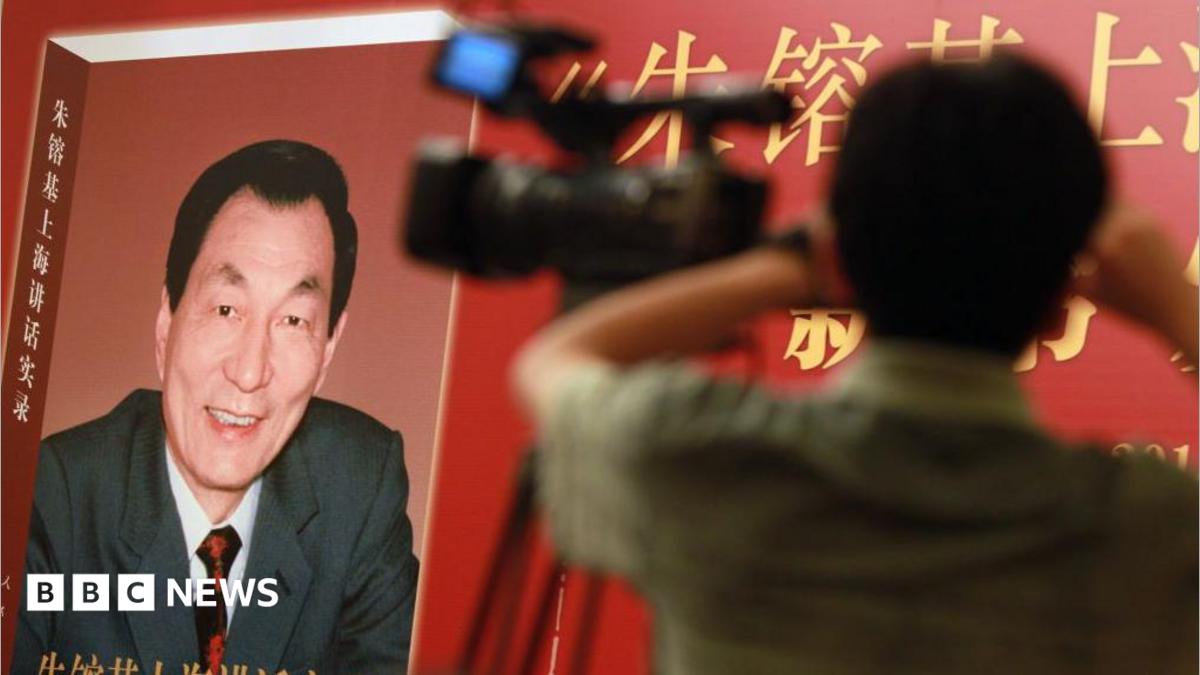
As China bids farewell to economic reformer Zhu Rongji, the state is aggressively scrubbing the internet to prevent nostalgia for his era from turning into criticism of Xi Jinping's rule.
- Former Premier Zhu Rongji passed away at 97; cremated at Babaoshan Revolutionary Cemetery.
- Authorities are censoring online tributes that contrast Zhu's era with current restrictions.
- Zhu is credited with pivotal economic reforms and China's entry into the WTO.
- The CCP fears that public mourning could trigger widespread political unrest.
In a scene marked by somber formality, flags at government sites across Beijing are flying at half-mast. The city's center is heavily guarded as China mourns the passing of former Premier Zhu Rongji, who died last week at the age of 97. A low-key funeral ceremony was held on Tuesday, attended by President Xi Jinping, incumbent premier Li Qiang, and former president Hu Jintao. Notably, the state has released no footage of the proceedings, maintaining a tight grip on the narrative.
Zhu Rongji, who served as premier from 1998 to 2003, is revered as one of China's most consequential economic architects. While official state media has lauded him as a "loyal Communist fighter," there is a palpable tension beneath the surface. The authorities are wary that public nostalgia for the reformist era of the late 90s could easily morph into veiled criticisms of the current administration's rigid control.
Why This Matters
BozokMedia analysis shows that the Chinese Communist Party (CCP) has a long-standing trauma regarding the deaths of high-ranking officials. Historically, the passing of figures like Zhou Enlai in 1976 and Hu Yaobang in 1989 served as catalysts for massive public grief that quickly evolved into anti-government protests. In the current climate, the combined memory of Zhu Rongji and the late Jiang Zemin represents a period of perceived openness and candor that contrasts sharply with the current era of surveillance.
"The censorship of Zhu Rongji's legacy is not about the man himself, but about the ideology of openness he represented, which is now viewed as a threat to centralized power."
The digital crackdown has already begun. An essay by economist Zhao Jian, which described Zhu's era as a time when people were "properly poor" but could "say what they really thought," was swiftly scrubbed from WeChat. Zhao's observation that the "sky was blue" and life moved slowly without the "purveyors of anxiety" found in today's digital landscape struck a chord with many, prompting immediate state intervention.
Zhu's tenure was characterized by a rare blend of toughness and authenticity. He was known for calling rogue bankers "half-wits" and describing failing infrastructure as "tofu dregs." This deadpan humor and willingness to speak truth to power—even within the party—stood in stark contrast to the carefully choreographed and sterile image of today's leadership.
| Feature | Zhu Rongji Era (1998-2003) | Xi Jinping Era (Current) |
|---|---|---|
| Economic Focus | Private growth & Global integration | State control & Tech autonomy |
| Leadership Style | Candid, blunt, and human | Highly choreographed & Formal |
| Global Stance | WTO entry, Opening up | Strategic competition, Vigilance |
Frequently Asked Questions
1. Who was Zhu Rongji and why is he remembered?
He was China's Premier from 1998-2003, known for dismantling unprofitable state firms and leading China's successful entry into the World Trade Organization (WTO).
2. Why is the Chinese government censoring posts about him?
The government fears that praising the relative freedom and transparency of the Zhu/Jiang era will encourage citizens to question the current restrictive policies of President Xi Jinping.


