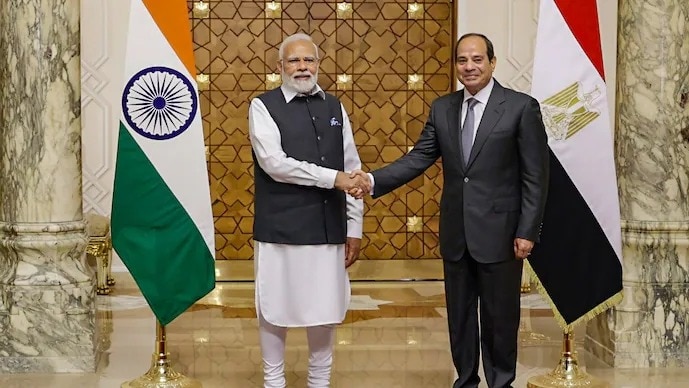
Egypt's decision to distance itself from the Mecca Pact—a collective defense alliance between Turkey, Pakistan, and Saudi Arabia—highlights a complex interplay of regional rivalry and strategic ties with India.
- Egypt has refrained from joining the 'Mecca Pact' formed by Turkey, Pakistan, and Saudi Arabia.
- Deep-rooted historical and economic ties with India serve as a significant deterrent.
- Internal frictions with Saudi Arabia and relations with the UAE and Israel further complicate the decision.
The geopolitical landscape of West Asia shifted on August 7 with the signing of the Mecca Pact between Turkey, Pakistan, and Saudi Arabia. Viewed by many as a nascent 'Islamic NATO,' this alliance seeks to establish a collective defense mechanism. While Turkey explicitly labeled Egypt as a 'natural partner' for this group, Cairo has remained conspicuously absent.
A critical factor in this hesitation is Egypt's enduring relationship with India. The bond between the two nations spans decades, rooted in mutual support during pivotal moments. During the 1956 Suez Crisis, India stood firmly with Egypt against military action by Britain, France, and Israel. Conversely, in 1961, Egypt blocked Portuguese aid to Goa, supporting India's liberation efforts.
Why This Matters
BozokMedia analysis shows that Egypt is prioritizing its 'Strategic Partnership' with India, which was formally upgraded in 2023. With over 700 Indian companies registered in Egypt and bilateral trade hitting approximately $6.5 billion in 2025-26, Egypt is wary of joining a bloc that includes Pakistan, given the severe diplomatic friction between New Delhi and Islamabad.
"India is a reason for Egypt's decision, but not the only one; it is more about maintaining strategic independence." - Indrani Bagchi, International Affairs Expert.
Beyond the India factor, internal Arab dynamics play a role. Reports suggest that Saudi Arabia harbors resentment toward President Abdel Fattah el-Sisi's government, citing a lack of expected cooperation on issues like the Yemen conflict. Furthermore, Egypt maintains delicate balances with the UAE, Israel, Greece, and Cyprus—partnerships that could be jeopardized by the specific agendas of the Mecca Pact.
| Factor | Mecca Pact (KSA-Turkey-Pak) | Egypt's Position |
|---|---|---|
| Strategic Goal | Collective Islamic Defense | Strategic Autonomy |
| India Relations | Tense (due to Pakistan) | Strong and Strategic |
| Regional Reach | Bloc Formation | Multi-polar (UAE, Israel, Greece) |
Historically, such alliances have often struggled with internal coherence. Analysts draw parallels to the defunct 'Baghdad Pact,' which eventually collapsed. Egypt's current stance suggests a preference for playing the role of a neutral mediator rather than a member of a rigid military bloc.
Frequently Asked Questions
1. What is the Mecca Pact?
It is a collective defense and strategic agreement between Saudi Arabia, Turkey, and Pakistan, often referred to as an 'Islamic NATO'.
2. How does India influence Egypt's decision?
Strong economic ties and a strategic partnership make Egypt reluctant to join an alliance that includes Pakistan, to avoid straining relations with New Delhi.