Under India's leadership, BRICS is shifting the global paradigm toward a people-centric and planet-first approach. By integrating sustainable lifestyles with economic growth, the bloc aims to lead the Global South in climate resilience.
- BRICS nations represent 49.5% of the world's population and 40% of global GDP.
- India's chairship focused on four pillars: Sustainable Lifestyles, Afforestation, Circular Economy, and Climate Adaptation.
- Emphasis on integrating indigenous knowledge with modern science.
- India has successfully reduced emissions intensity by 37.38% since 2005.
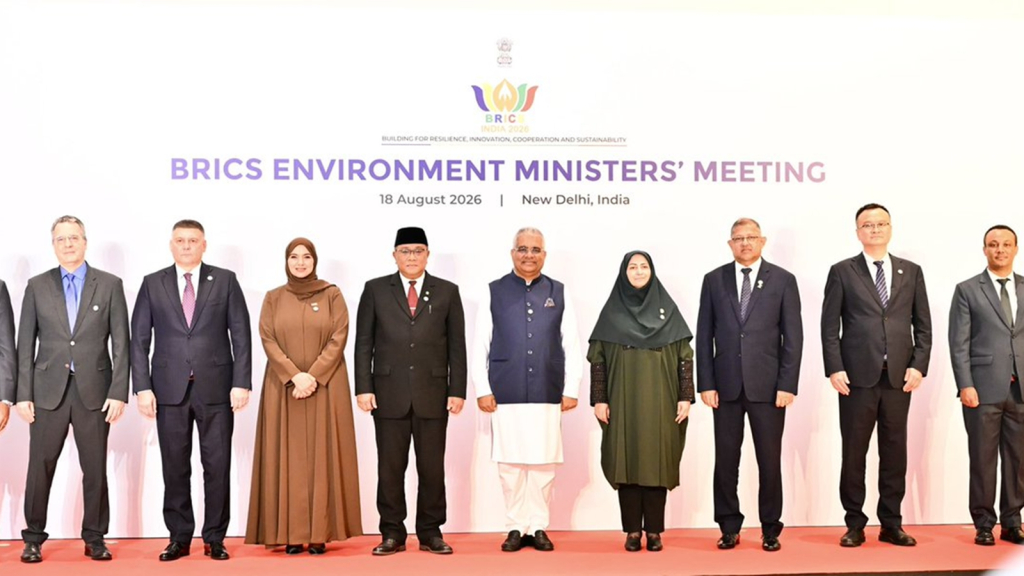
During the 12th BRICS Environment Ministers’ Meeting hosted in New Delhi, India demonstrated a profound sense of responsibility toward the global ecological crisis. Representing nearly half of the world's population and a massive portion of global trade, the BRICS bloc is no longer just an economic powerhouse; it is emerging as a decisive leader in the global environmental agenda.
Guided by the vision of Prime Minister Narendra Modi, the current BRICS chairship emphasizes a 'Humanity First' approach. Initiatives like 'Mission LiFE' (Lifestyle for Environment) and 'Ek Ped Maa Ke Naam' serve as blueprints for how community ownership and ecological restoration can drive large-scale climate action.
Why This Matters
BozokMedia analysis shows that the strategic pivot of BRICS toward sustainable development is a direct response to the vulnerabilities faced by the Global South. By championing the principle of 'Common but Differentiated Responsibilities' (CBDR-RC), BRICS is ensuring that the transition to a green economy does not come at the cost of the developmental needs of emerging nations.
The BRICS approach signals a transition from purely economic multilateralism to a holistic model that integrates social equity with environmental stewardship.
The framework established under India's leadership focuses on four interconnected priorities. First, Promoting Sustainable Lifestyles seeks to change consumer behavior globally. Second, Afforestation and Disaster Resilience utilizes AI and remote sensing to combat wildfires and land degradation. Third, the Circular Economy priority aims to replace the 'take-make-dispose' model with sustainable resource loops. Finally, Climate Adaptation focuses on blending traditional indigenous knowledge with cutting-edge science.
India’s own track record reinforces this commitment. Between 2005 and 2022, India managed to reduce its emissions intensity by 37.38%, while simultaneously expanding its non-fossil energy capacity to account for over 54% of its installed electricity capacity. This proves that decarbonization and economic expansion can coexist.
Frequently Asked Questions
1. What are the four main priorities of the BRICS Environment Working Group?
The priorities are promoting sustainable lifestyles, managing afforestation and disaster resilience, fostering a circular economy, and advancing community-based climate adaptation.
2. How does India contribute to the BRICS environmental goals?
India leads through initiatives like Mission LiFE and by demonstrating significant reductions in emissions intensity while scaling up renewable energy infrastructure.