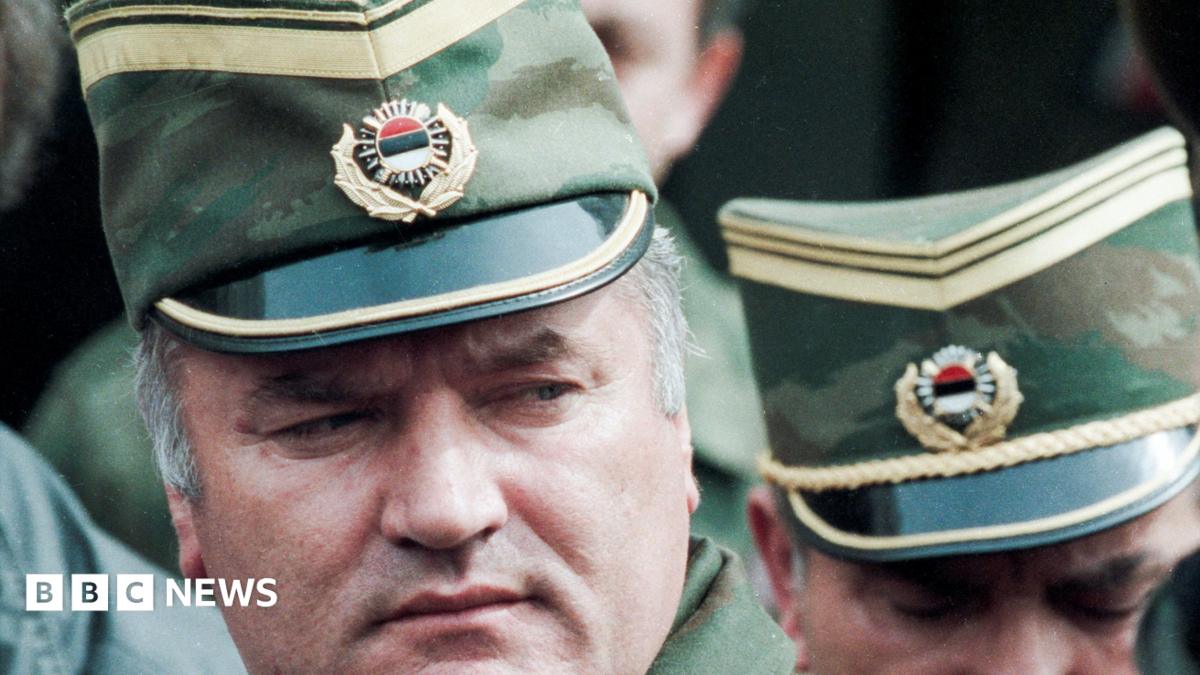
Bosnian Serb commander Ratko Mladić, notorious for war crimes during the Balkan wars, has passed away in prison. BBC correspondent Allan Little recalls his chilling first encounter with the man.
- Bosnian Serb commander Ratko Mladić has died while in custody.
- Known as the 'Butcher of Bosnia' for his role in ethnic cleansing.
- BBC's Allan Little describes meeting a 'dangerously fanatical' Mladić.
- His forces were responsible for the Srebrenica genocide.
Ratko Mladić, the Bosnian Serb commander widely condemned as the "Butcher of Bosnia" for his actions during the 1990s Balkan wars, has died in prison. The news marks the end of a dark chapter in European history, defined by the systematic violence and ethnic cleansing that tore through the former Yugoslavia.
BBC special correspondent Allan Little, who witnessed the disintegration of Yugoslavia firsthand, provided a haunting recollection of his early encounters with Mladić. Little recalls the terrifying atmosphere of the war, where the night sky was often illuminated not by stars, but by the fires of ethnic cleansing ravaging the landscape. He shares a poignant memory of an 80-year-old refugee who, when asked about his ethnicity, simply replied, "I am a musician," highlighting how war strips away human identity to leave only labels of Serb, Croat, or Muslim.
Why This Matters
BozokMedia analysis shows that the legacy of Mladić extends far beyond his death. The psychological and political scars left by the ethnic cleansing he orchestrated continue to influence the geopolitical stability of the Balkan region today.
General Mladić did not pull the trigger, but his command created an atmosphere of wanton permissiveness that cost tens of thousands of lives.
Little’s first meeting with Mladić took place at the Lukavica barracks near Sarajevo. He describes a man who appeared "pumped up" by the proximity of combat. Despite Mladić’s claims of being a defender of unity and a dreamer of a world without war, Little perceived him as "dangerously fanatical." This duality—of a man preaching unity while commanding mass slaughter—was a hallmark of the conflict.
The atrocities committed under Mladić's command were unprecedented on European soil since the Nazi era. His forces engaged in mass murder, systematic rape, and forced expulsions to create an ethnically pure Serbian territory. The zenith of this horror was the Srebrenica genocide, a crime that remains a stain on modern history.
The war also claimed the lives of those documenting it. Little recounts the devastating loss of his cameraman, Tihomir Tunukovic, a talented 25-year-old filmmaker who was killed by a Serb gunner. This personal tragedy underscores the visceral, vengeful nature of the conflict that gripped the entire population.
Historical Background
The Bosnian War (1992–1995) was a complex conflict triggered by the breakup of Yugoslavia. It involved various ethnic groups fighting for territory and independence, leading to one of the most significant humanitarian crises in late 20th-century Europe.
Frequently Asked Questions
Question 1: What were the primary crimes attributed to Ratko Mladić?
Answer: Mladić was convicted of war crimes, crimes against humanity, and genocide, most notably during the Srebrenica massacre.
Question 2: Who is Allan Little?
Answer: Allan Little is a veteran BBC special correspondent known for his extensive coverage of the Yugoslav Wars.