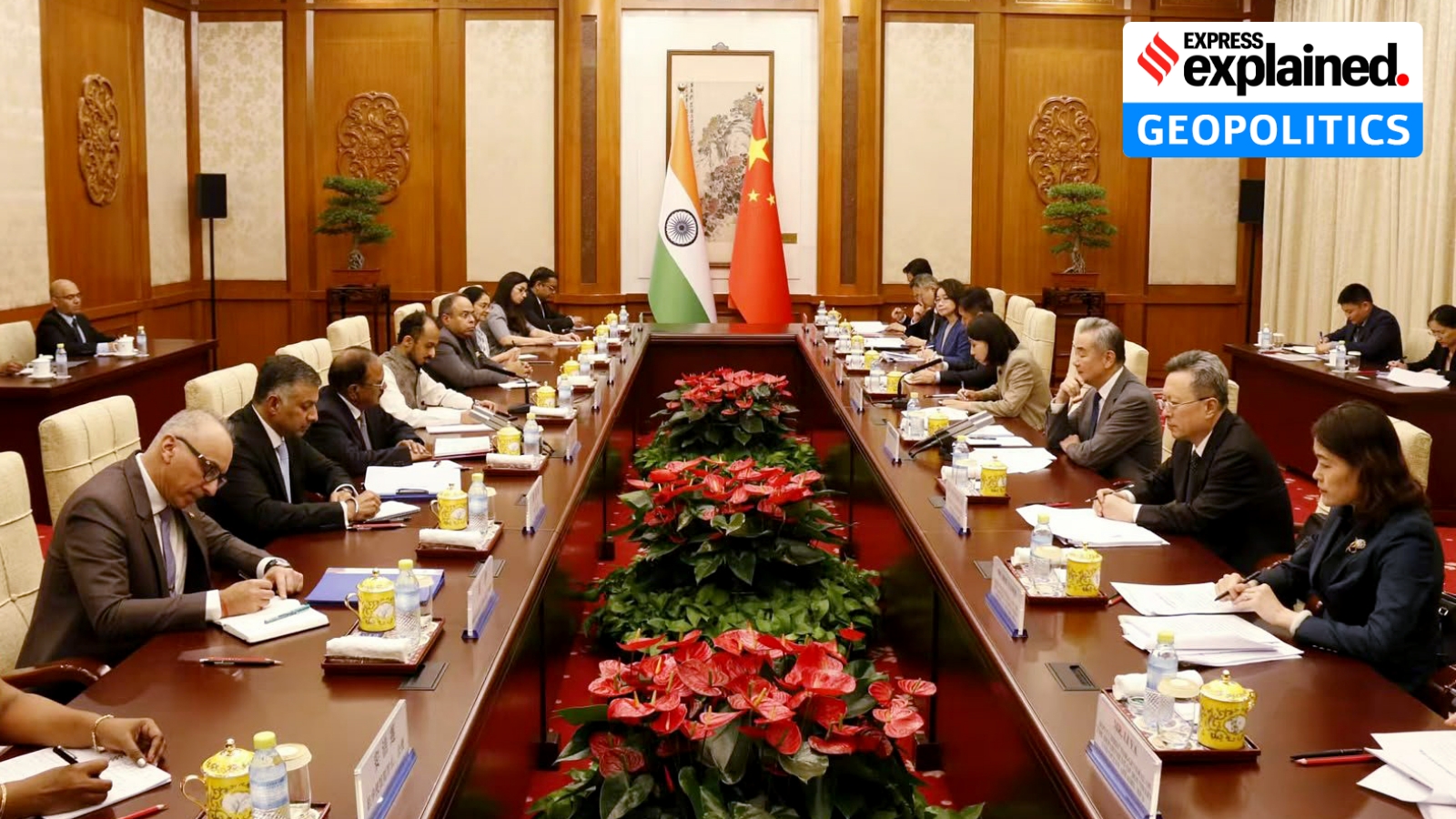
The 25th round of Special Representative talks between India and China in Beijing has resulted in an eight-point consensus focusing on border management and peace. However, experts warn that substantive boundary delimitation is still a distant goal.
- 25th round of Special Representative (SR) talks held in Beijing between Ajit Doval and Wang Yi.
- Agreement reached on establishing two new hotlines in the Eastern and Middle sectors.
- Focus on an 'early harvest' of boundary delimitation through Expert and Working Groups.
- Implementation of General-Level Mechanisms in sectors beyond the Western sector.
The recent 25th round of talks between India's National Security Advisor (NSA) Ajit Doval and Chinese Foreign Minister Wang Yi in Beijing marks a significant diplomatic milestone. Coming ahead of potential high-level visits, such as President Xi Jinping's possible attendance at the BRICS Summit, the meeting has yielded an eight-point consensus aimed at de-escalating tensions along the Line of Actual Control (LAC).
Central to the discussions was the maintenance of peace and tranquility in border areas. Both nations have agreed to advance negotiations through dedicated Expert Groups and Working Groups. The objective is to achieve an "early harvest" in specific sectors regarding boundary delimitation and effective border management, moving away from the prolonged stalemate that has characterized recent years.
Why This Matters
BozokMedia analysis shows that the expansion of communication channels is a strategic move to prevent tactical miscalculations. By establishing two new hotlines in the Eastern and Middle sectors, both militaries are creating a safety net to defuse local tensions before they escalate into larger confrontations.
The transition from managing conflict to negotiating delimitation requires a level of political trust that is still being rebuilt.
Historically, the process of managing the India-China border has seen various iterations of confidence-building measures (CBMs). From the 1992 Joint Working Group to the 2012 establishment of the Working Mechanism for Consultation and Coordination (WMCC), the institutional framework has evolved. However, sites like Sumdorong Chu and the sensitive areas in Arunachal Pradesh have frequently tested these mechanisms.
A major outcome of this latest round is the commitment to implement additional General-Level Mechanisms and Senior Highest Military Commander (SHMC) meetings in the Eastern and Middle sectors. This would mirror the existing successful mechanism in the Western sector at Chushul/Moldo, providing a more uniform approach to border stability.
| Sector | Current Status | New Agreement |
|---|---|---|
| Western Sector | Established SHMC and Hotlines | Operational and Stable |
| Eastern & Middle Sectors | Limited direct military communication | New Hotlines and SHMC meetings to be implemented |
Despite positive signs such as the resumption of the Kailash Mansarovar Yatra and discussions on direct flights, the path to a holistic settlement remains arduous. The current focus on "early harvest" suggests that while both sides are willing to tackle manageable issues, the core issue of boundary delimitation is still in its foundational stage, with groups currently tasked only with finalizing their 'Terms of Reference.'
Frequently Asked Questions
1. What does 'early harvest' mean in the context of these talks?
It refers to achieving quick, small-scale agreements on specific, manageable border issues to build momentum for larger, more complex negotiations.
2. How will the new hotlines help?
The hotlines provide a direct line of communication between military commanders in the Eastern and Middle sectors, helping to prevent accidental skirmishes from escalating.
Editor Comment
Border stability is not merely about the absence of war, but the presence of a predictable framework. While the Beijing talks are a step toward predictability, the true test will be whether these institutional mechanisms can withstand the pressure of ground-level territorial friction.