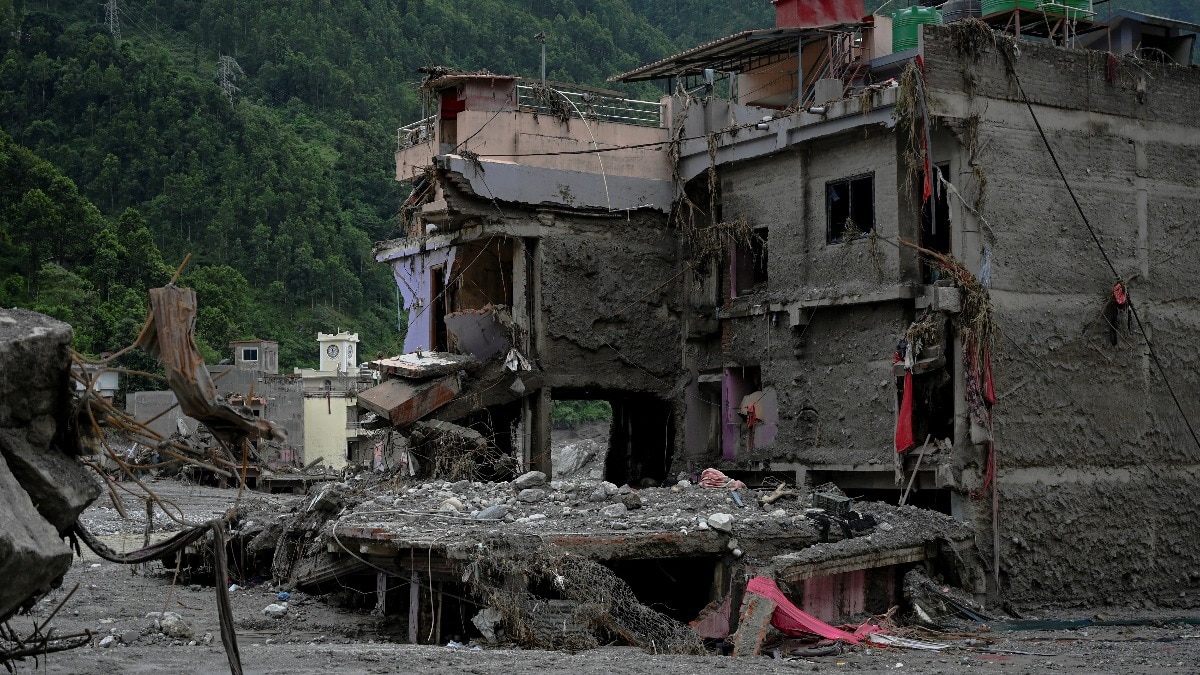
Massive flash floods triggered by a glacial collapse have ravaged Nepal's Nuwakot and Rasuwa districts. Rescue teams are racing against time to clear a blocked hydropower tunnel as thousands remain missing.
- Catastrophic flash floods triggered by a glacial collapse on the Nepal-Tibet border.
- Nepal Army searching for trapped individuals in a blocked hydropower tunnel in Rasuwa.
- Over 4,451 people rescued, but 2,426 remain missing, including foreign nationals.
A catastrophic environmental disaster struck Nepal on August 26, when a high-altitude glacial collapse along the Nepal-Tibet border unleashed torrents of water and debris. The resulting flash floods decimated the Bhotekoshi and Trishuli river corridors, leaving a trail of destruction across the Bidur Municipality in the Nuwakot district. Entire villages have been buried under mud, turning residential areas into wasteland.
The focus of the emergency response has now shifted to the Rasuwa district, where the Nepal Army and the Armed Police Force are engaged in a high-stakes operation. They are attempting to clear a blocked tunnel at a hydropower project, where several individuals are feared trapped. The use of heavy machinery is critical, but the unstable terrain continues to pose a significant risk to the rescuers themselves.
Why This Matters
BozokMedia analysis shows that this event is a stark manifestation of the accelerating climate crisis in the Hindu Kush-Himalayan region. The increasing frequency of Glacial Lake Outburst Floods (GLOFs) indicates that traditional disaster management protocols are no longer sufficient. There is an urgent need for advanced early-warning systems to protect vulnerable downstream communities.
"The fragility of the Himalayan glaciers is no longer a theoretical risk; it is a present-day humanitarian crisis requiring global attention."
At relief camps in Battar, Nuwakot, the atmosphere is one of desperation and hope. Families are constantly scanning the skies for helicopters, which serve as the only lifeline for those stranded in upstream villages. Field hospitals have been established to treat the injured, while officials struggle to compile lists of the missing, which include hundreds of foreign tourists and expatriates.
The situation remained volatile on August 28 when a debris dam burst, triggering further flooding and putting rescue teams on high alert. This secondary disaster underscores the unpredictability of post-flood environments where temporary dams created by mud and rocks can fail without warning.
Historically, Nepal's susceptibility to landslides is well-documented, but the scale of the Bhotekoshi-Trishuli surge is unprecedented in recent years. The collapse of glacial structures at the border highlights the transboundary nature of these climate risks, affecting both Nepal and Tibet.
| Metric | Details / Figures |
|---|---|
| Total Rescued | 4,451 |
| Total Missing | 2,426 |
| Primary Impact Zones | Nuwakot, Rasuwa, Bidur |
| Trigger Event | High-altitude Glacial Collapse |
Frequently Asked Questions
1. Why is the rescue operation in Rasuwa particularly difficult?
The combination of a blocked tunnel, unstable mountain slopes, and limited road access makes the operation dependent on helicopters and heavy machinery.
2. Are there foreign nationals involved in the tragedy?
Yes, official reports indicate that hundreds of foreign nationals are among those currently out of contact.