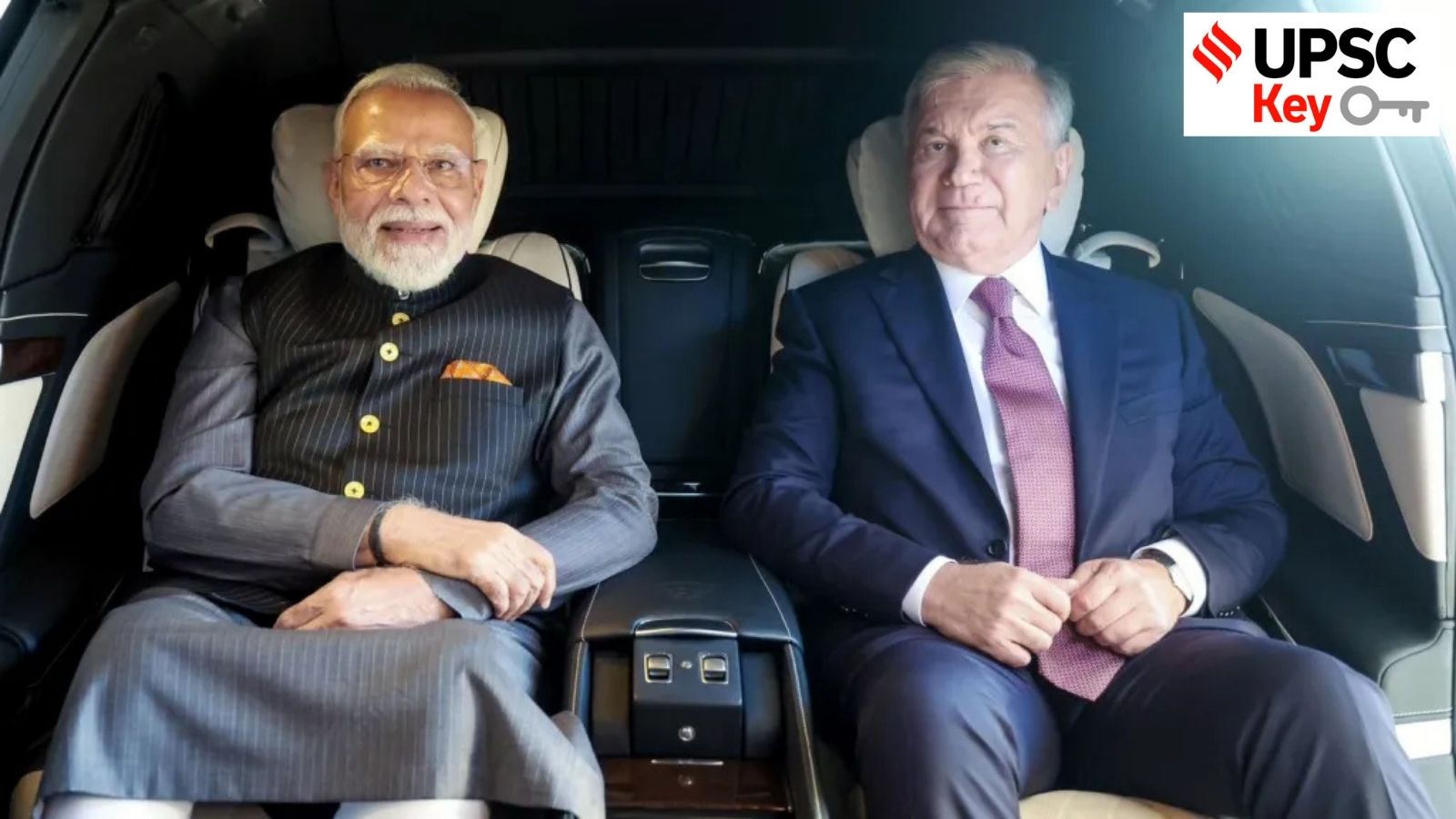
Prime Minister Narendra Modi's state visit to Uzbekistan marks a pivotal moment in India's 'Connect Central Asia' policy, focusing on energy security, defense, and cultural diplomacy.
- PM Modi's state visit to Uzbekistan followed by the 26th SCO Summit in Bishkek.
- Bilateral trade between India and Uzbekistan has reached nearly US$ 1 billion.
- Focus on strategic connectivity via the International North South Transit Corridor (INSTC).
Prime Minister Narendra Modi embarked on a critical four-day tour of Central Asia, beginning with a high-profile dinner meeting with Uzbekistan's President Shavkat Mirziyoyev in Tashkent. The visit is designed to solidify a "shared vision" encompassing trade, tourism, health, energy, and defense, reflecting India's growing ambitions in the Eurasian heartland.
The Soft Power Play: Yoga and Language
India's engagement extends beyond traditional diplomacy. Uzbekistan has become the first Central Asian nation to implement yoga certification examinations under the Ministry of AYUSH's Yoga Certification Board (YCB). Furthermore, the Tashkent State University of Oriental Studies (TSUOS) has been a bastion of Hindi language studies since 1947, translating works of legends like Rabindranath Tagore and Premchand, thereby weaving a deep cultural fabric between the two nations.
Why This Matters
BozokMedia analysis shows that Central Asia is no longer just "Russia's backyard." For India, this region is a strategic necessity to counter China's expanding influence and to ensure security in the wake of the Taliban-led government in Afghanistan. Moreover, the region is vital for India's energy appetite, with Kazakhstan's uranium reserves and the proposed TAPI (Turkmenistan-Afghanistan-Pakistan-Iran) gas pipeline being key focal points.
"India's pivot to Central Asia is a calculated move to diversify its strategic partnerships and secure a corridor to the Eurasian markets."
Economic Synergy and Strategic Connectivity
Economically, India is now among Uzbekistan's top 10 trading partners. With nearly $1 billion in bilateral trade and similar investments in renewables, pharmaceuticals, and IT, the partnership is transitioning from diplomatic courtesy to economic necessity. Medical tourism has also seen a surge, with Uzbekistan ranking as the third-largest source of medical tourists to India.
| Sector | Status/Detail |
|---|---|
| Trade Volume | ~US$ 1 Billion (2025-26) |
| Investment Areas | Renewables, Mining, IT, Healthcare |
| Cultural Link | Hindi Chair at TSUOS & Yoga Certification |
| Key Projects | INSTC & TAPI Pipeline |
Frequently Asked Questions
1. What is the INSTC?
The International North South Transit Corridor is a multi-modal route linking India to Russia and Europe via Iran, bypassing traditional longer sea routes.
2. Why is the SCO Summit important for India?
The Shanghai Cooperation Organisation (SCO) provides a platform for India to collaborate on regional security, combat terrorism, and manage relations with major powers like China and Russia.