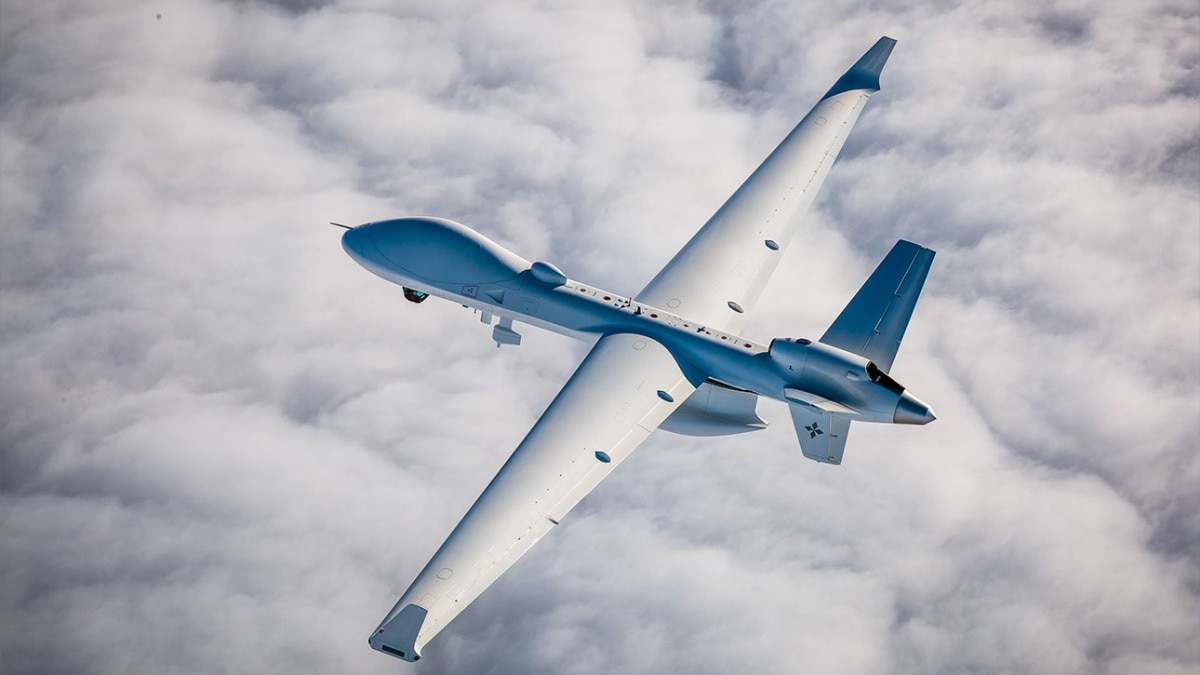
Iran's IRGC claims to have shot down a $50 million US MQ-9 Reaper drone over the Strait of Hormuz. This incident highlights the vulnerabilities of high-cost UAVs and raises questions about the capabilities of the MQ-9B Sea Guardians recently leased by India.
- Iran's IRGC claims to have destroyed a US MQ-9 Reaper drone over the Strait of Hormuz.
- The MQ-9 Reaper costs approximately $50 million, making it more expensive than several conventional fighter jets.
- India operates the MQ-9B Sea Guardian, a maritime-specialized variant with superior endurance and sensor capabilities compared to the Reaper.
The escalating tensions between Tehran and Washington have reached a new peak as the Islamic Revolutionary Guards Corp (IRGC) announced the downing of a US MQ-9 Reaper unmanned aerial vehicle (UAV). According to reports from the Mehr News Agency, the drone was intercepted by missile fire over the Strait of Hormuz and plunged into the Persian Gulf. While the United States has yet to officially confirm the loss, the incident underscores the volatile security environment in one of the world's most critical maritime chokepoints.
The financial stakes of these aerial assets are staggering. An MQ-9 Reaper carries a price tag of roughly $50 million. To put this in perspective, the drone is significantly more expensive than the JF-17 fighter jet used by Pakistan (approx. $25 million) and rivals the cost of the Indian Air Force's HAL Tejas Mk-1A, which ranges between $40 million and $45 million. This high cost reflects the advanced intelligence and strike capabilities integrated into the platform.
Why This Matters
BozokMedia analysis shows that the loss of these drones is not merely a financial blow but a strategic one. The MQ-9 Reaper is designed for intelligence collection and precision strikes, yet it possesses virtually no self-defense mechanisms against sophisticated air-defense systems. The fact that the US has reportedly lost nearly 25% of its Reaper fleet since February indicates a critical gap in UAV survivability when operating in contested airspaces.
The vulnerability of high-altitude long-endurance drones in the face of modern surface-to-air missiles proves that stealth and electronic warfare are now mandatory for UAV survival.
India's strategic interest in the MQ-9 family differs from the US's tactical usage in Iran. India has recently leased two MQ-9B Sea Guardians, with more on order. Unlike the Reaper, which is a multi-role land and sea strike platform, the Sea Guardian is a specialized maritime reconnaissance asset. It features a larger wingspan (79 feet), a higher take-off weight, and an extended endurance of 30 hours, allowing it to monitor vast stretches of the Indian Ocean.
| Feature | MQ-9 Reaper | MQ-9B Sea Guardian |
|---|---|---|
| Primary Role | Precision Strike & Intel | Maritime Reconnaissance |
| Endurance | 27 Hours | 30 Hours |
| Wingspan | Standard | 79 Feet (Extended) |
| Special Capability | Hellfire Missiles | Submarine Detection |
The Sea Guardian is specifically engineered for the maritime domain, equipped with sensors that can track vessels and potentially detect submarines—a rare capability for UAVs. Furthermore, the Sea Guardian is designed to operate from civilian airports, providing greater operational flexibility for the Indian Ministry of Defence in monitoring its borders and the surrounding seas.
Frequently Asked Questions
Q1: Is the drone shot down by Iran the same as the ones India uses?
No, Iran shot down an MQ-9 Reaper, while India uses the MQ-9B Sea Guardian, which is optimized for maritime surveillance rather than land-based precision strikes.
Q2: Why can't the MQ-9 Reaper defend itself?
It is designed to operate in 'permissive environments' where enemy air defenses have already been neutralized; it lacks the agility and countermeasures to evade modern missiles.