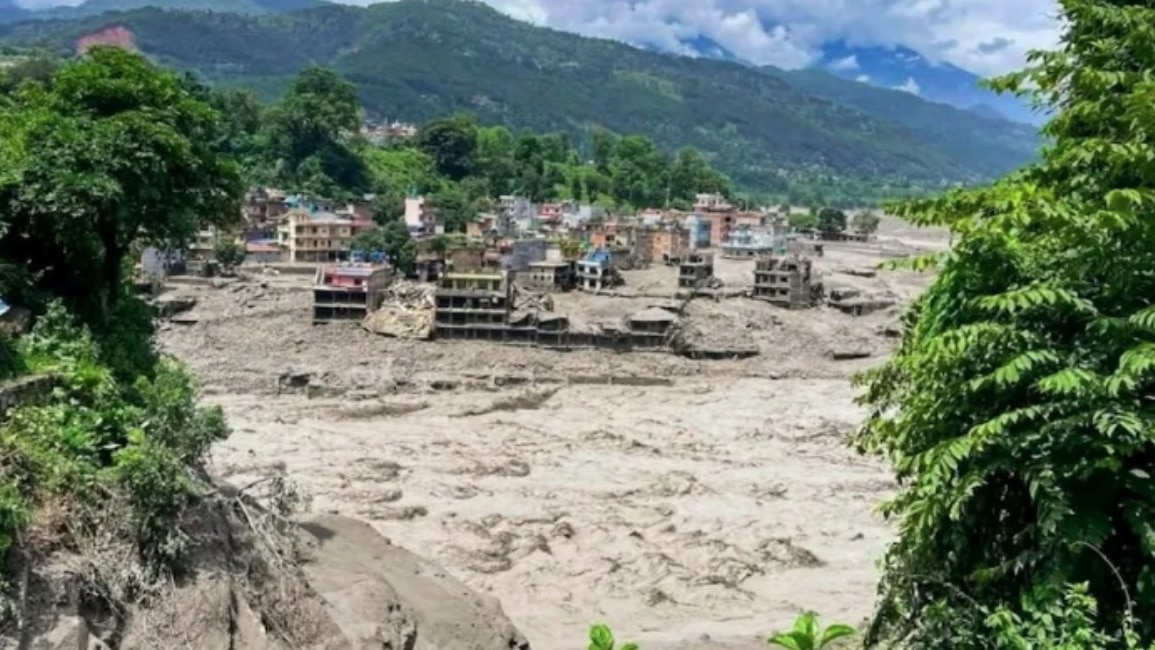
Six days after devastating floods hit Nepal, rescue efforts at the Trishuli-3A hydropower tunnel have hit a deadlock. Despite strategic blasting, the path remains blocked, and rising water levels are threatening the trapped workers.
- Rescue teams failed to clear a path into the Trishuli-3A tunnel despite blasting operations at 3 AM.
- Triple-layered steel ribs and reinforcement bars are obstructing access to the trapped individuals.
- Continuous water ingress is hindering the operation, necessitating the use of heavy-duty pumps and generators.
- The US government has issued a 'Level 4: Do Not Travel' advisory for flood-hit regions of Nepal.
The catastrophic floods that struck Nepal on August 26 have left a trail of destruction, with one of the most critical rescue operations currently unfolding at the Trishuli-3A Hydropower Project. For six days, emergency teams have been fighting against time and nature to reach personnel trapped deep within the project's tunnel.
In a desperate attempt to break through the debris, rescue teams conducted controlled blasting around 3:00 AM. However, the operation proved unsuccessful, as the structural integrity of the tunnel's reinforcement prevented a breakthrough. The rescue team is now forced to manually cut through three layers of steel ribs and reinforcement bars—a painstaking process that is being further slowed by a lack of specialized heavy equipment.
Why This Matters
BozokMedia analysis shows that this crisis highlights a systemic failure in the safety protocols of large-scale infrastructure projects in mountainous terrains. The inability to establish a secondary escape route or an effective drainage system during a flood event transforms these engineering marvels into death traps. This incident serves as a grim reminder for global hydropower developers to prioritize 'fail-safe' mechanisms over rapid construction.
"In reinforced tunnels, conventional blasting often fails due to the distribution of kinetic energy across steel grids; precision hydraulic cutting is the only viable solution."
Parallel to the rescue efforts, the international community is reacting to the volatility of the region. The United States has issued a stringent 'Level 4: Do Not Travel' advisory for specific zones, including Rasuwa Gadhi, Timure, and Syaphrubesi, particularly near the Nepal-China border. Travelers are also warned to exercise extreme caution near the Bhote Koshi, Trishuli, and Narayani rivers.
Beyond the environmental disaster, Nepal is grappling with socio-political instability. The US has maintained a 'Level 2: Exercise Increased Caution' status for the rest of the country, citing potential civil unrest following protests in September 2025. This duality of natural disaster and political instability complicates the logistics of international aid and rescue coordination.
Frequently Asked Questions
Q1: Why did the blasting operation fail to open the tunnel?
A: The tunnel is reinforced with triple-layered steel ribs and bars that absorbed the blast impact, leaving the physical blockage intact.
Q2: Which areas in Nepal are currently under a 'Do Not Travel' advisory?
A: The US has warned against traveling to Rasuwa Gadhi, Timure, Syaphrubesi, and areas along the Nepal-China border.