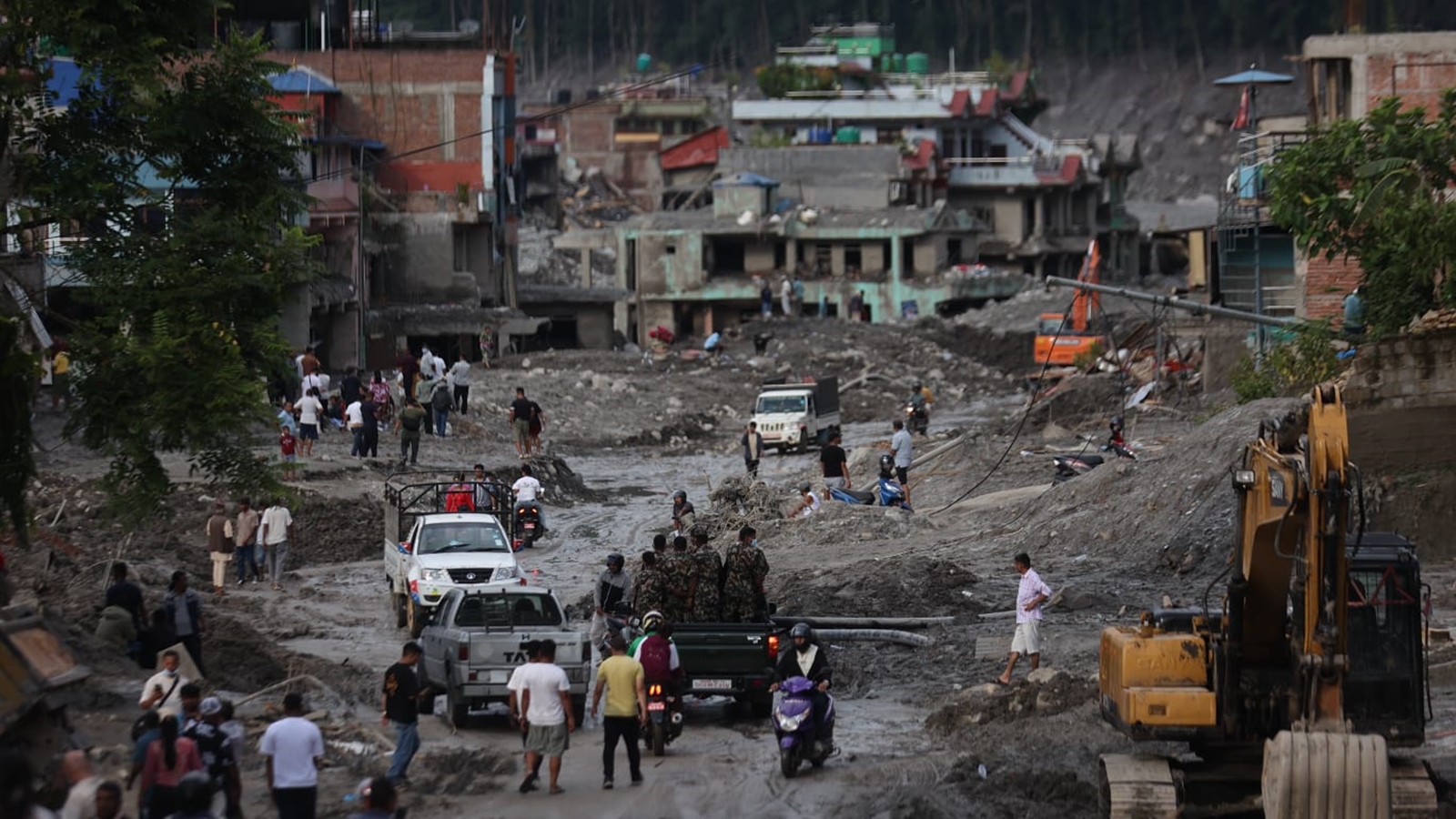
As Nepal's disaster authorities report 639 people missing across 15 hydropower sites, an Austrian firm has set up a private 'war room' in Kathmandu to coordinate a desperate rescue mission for 150 of its colleagues.
- 639 people remain missing across 15 hydropower projects following catastrophic flash floods on August 26.
- Austrian firm Andritz has established a dedicated 'war room' in Kathmandu to lead search efforts for 150 missing Indian and Nepali workers.
- Rescue operations face severe hurdles including heavy rain, lack of real-time satellite imagery, and destroyed infrastructure.
In a tense atmosphere inside a mid-range hotel in central Kathmandu, a makeshift command center has become the last beacon of hope for dozens of families. Coffee tables pushed together to form a conference board and projected maps of the Upper Trishuli-1 Hydroelectric Project define the 'war room' established by Andritz, an Austrian project subcontractor. With approximately 150 of its 250 Indian and Nepali employees still missing, the company is racing against time to locate survivors or recover bodies.
The disaster struck on August 26, when catastrophic flash floods tore through the region, obliterating infrastructure and burying camps under layers of mud and sludge. The Upper Trishuli-1 project, designed to be the largest in the Bhote Koshi river corridor with a 216 MW capacity, has been left in a state of total destruction. According to Nepal’s disaster management authorities, the scale of the tragedy is immense, with 639 people still missing across 15 different hydropower sites, many of which were still under construction.
Why This Matters
BozokMedia analysis shows that this incident highlights a critical gap in disaster preparedness for large-scale infrastructure projects in the fragile Himalayan ecosystem. The reliance of a private firm to set up its own 'war room' suggests that official state rescue mechanisms may be overwhelmed or insufficient for the specialized needs of industrial site rescues. Furthermore, the struggle to access real-time satellite data and the failure of basic communication tools in a crisis underscore the urgent need for better digital infrastructure in disaster-prone zones.
The rescue operation is fraught with logistical nightmares. While the Nepalese army continues its search, Andritz has attempted to supplement these efforts by hiring helicopters for food drops. However, heavy rains have repeatedly grounded these flights. The company's current strategy involves a high-risk mission: a combination of helicopter insertions and a grueling 10-hour drive in 4x4 vehicles, followed by trekking on foot through mud-choked terrain.
The intersection of climate-induced flash floods and high-density industrial construction in the Himalayas creates a 'perfect storm' of risk that current safety protocols are not equipped to handle.
The human toll is compounded by technical frustrations. Inside the war room, team members have struggled with failing hotel Wi-Fi, weak mobile signals, and the inability to access paid Google Earth subscriptions due to international payment restrictions on credit cards. These trivial but critical failures have delayed the identification of high-probability search zones along a 15-km stretch of devastation.
Despite the dwindling window of survival, the team remains focused on five priority spots, including the worker camp and the tunnel inlets. As the one-week mark since the flood approaches, the mood remains a fragile mix of determination and despair.
Frequently Asked Questions
Q1: How many people are missing in total from the Nepal floods?
According to official disaster management authorities, 639 people are missing across 15 different hydropower projects.
Q2: What is the role of the company Andritz in this situation?
Andritz is an Austrian subcontractor providing machinery for the projects; they have set up a private search hub to find 150 of their missing Indian and Nepali staff.