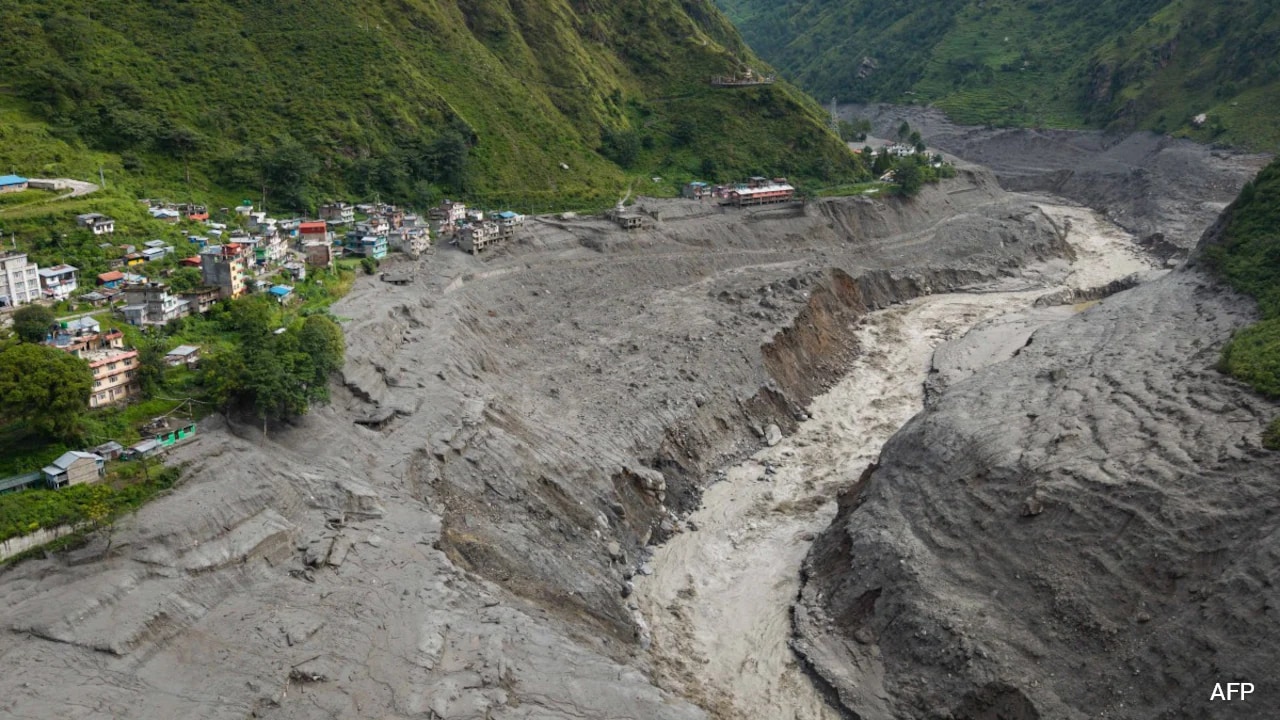
Despite contributing less than 0.1% of global greenhouse gas emissions, Nepal is facing devastating climate-driven disasters, highlighted by recent catastrophic glacial collapses in the Himalayas.
- Nepal contributes less than 0.1% to global greenhouse gas emissions.
- Massive glacial collapse near the Nepal-China border triggered violent surges.
- The Lhende Khola, Bhote Koshi, and Trishuli river systems were severely impacted.
In the high altitudes of the Himalayas, near the volatile Nepal-China border, a catastrophic environmental event has unfolded. A massive glacial collapse sent a violent surge of water and debris through the Lhende Khola, cascading into the Bhote Koshi and Trishuli river systems. This event serves as a grim reminder of the fragility of the mountain ecosystems in the face of global warming.
The tragedy highlights what scientists call the 'Climate Paradox.' Nepal is a nation with a negligible carbon footprint, contributing less than 0.1% of the world's total greenhouse gas emissions. Yet, it stands on the front lines of a climate war it did not start, facing the brunt of rising temperatures that accelerate glacial melting and trigger unpredictable disasters.
Why This Matters
BozokMedia analysis shows that the increasing frequency of Glacial Lake Outburst Floods (GLOFs) is no longer a statistical anomaly but a systemic failure of global climate governance. The geographical vulnerability of the Himalayas means that small increases in global temperature translate into massive physical risks for local populations. This is a clear case of environmental injustice where the least responsible are the most affected.
"Nepal is the canary in the coal mine for the global climate crisis; its suffering is a preview of what happens when ecological tipping points are crossed."
Historically, the Himalayas have acted as the 'Water Tower of Asia.' However, the rapid retreat of glaciers is destabilizing the region. The surge in the Lhende Khola is part of a broader pattern of instability that threatens not only local villages but the downstream water security of millions across South Asia.
| Factor | Industrialized Nations | Nepal (Himalayan) |
|---|---|---|
| Emission Contribution | Very High | Less than 0.1% |
| Primary Climate Risk | Sea-level rise/Heatwaves | GLOFs/Landslides |
| Adaptive Capacity | High Financial Resources | Limited Resources |
Frequently Asked Questions
1. What is a GLOF?
A Glacial Lake Outburst Flood (GLOF) occurs when the dam containing a glacial lake fails, releasing a massive volume of water and debris instantaneously downstream.
2. Why is Nepal so disproportionately affected?
Its extreme topography, high-altitude glacial lakes, and dependence on river systems make it uniquely susceptible to the effects of rapid warming.