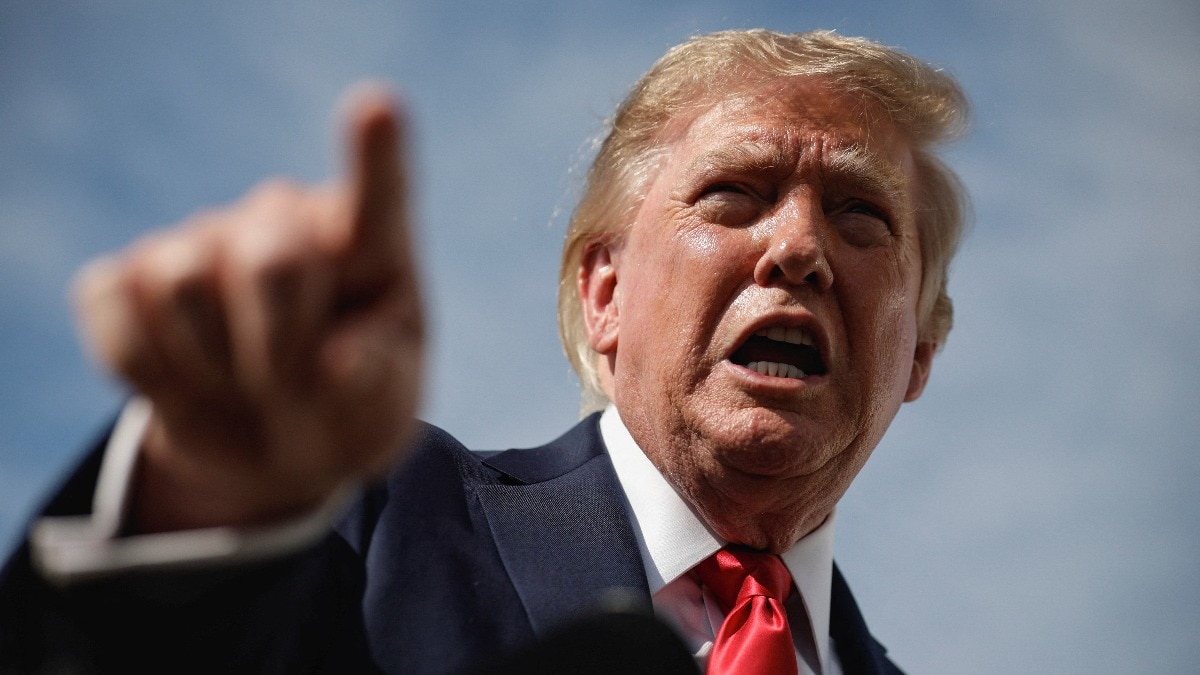
Following Iranian missile strikes on US military installations in Jordan, President Donald Trump has warned Tehran of a devastating military response, risking a full-scale conflict in the Middle East.
- President Trump warns Iran of a 'hard hit' following attacks on US bases in Jordan.
- US air defenses intercepted most Iranian missiles, with one non-threatening missile allowed to pass.
- The escalation began after US strikes on Iranian launchers on Larak Island.
- Economic sanctions are reportedly 'kicking in strongly' according to the White House.
US President Donald Trump has issued a stern warning to Tehran of a fresh military response, marking a dangerous escalation in a conflict that had recently shifted toward economic warfare. The tension reached a boiling point after Iran retaliated against American strikes on Larak Island by targeting US military bases in Jordan.
In a phone conversation reported by Trey Yingst, President Trump asserted that the US would not let these attacks go unanswered. "We're going to hit them hard," Trump stated, emphasizing that a response is inevitable. According to the President, US air defense systems successfully intercepted all but one of the Iranian missiles; the remaining missile was identified as being off-course and posed no significant threat.
The Larak Island Trigger
The current crisis was sparked by a US precision strike on Larak Island in the Strait of Hormuz. American forces targeted two Iranian launchers after the Islamic Revolutionary Guard Corps (IRGC) was observed preparing to deploy sea mines in the critical waterway. The US Central Command characterized the action as a response to an "imminent threat" to global maritime security. Iranian state media reported three casualties from the strike, including members of the Revolutionary Guards Navy.
Why This Matters
BozokMedia analysis shows that this is more than a bilateral skirmish; it is a battle for control over the world's energy arteries. The Strait of Hormuz is the most critical chokepoint for global oil shipments. Any sustained military conflict here would lead to an immediate spike in global energy prices, potentially triggering a worldwide economic recession. Trump's strategy of combining kinetic strikes with secondary sanctions is designed to force a total capitulation from Tehran.
"The shift from economic pressure back to direct kinetic exchange suggests a failure in diplomatic deterrence and a move toward high-stakes brinkmanship."
Parallel to the military threats, Trump claimed that US economic sanctions are "kicking in strongly," targeting third-party nations that trade Iranian oil. However, the administration faced criticism after Trump posted AI-generated videos of explosions on Kharg Island, which Iran dismissed as "laughable." Vice President JD Vance defended the move as a way of "sending a message" to the Iranian regime.
Historically, the relationship has been a cycle of escalation and brief ceasefires. Following the "Operation Epic Fury" in April, an interim framework for talks was established in June, but it collapsed by July. Currently, the US is employing a naval blockade and escalating sanctions, while Iran maintains that the Strait of Hormuz will only reopen under its own supervision.
| Entity | Primary Strategy | Current Posture |
|---|---|---|
| United States | Kinetic Strikes & Economic Sanctions | Aggressive Retaliation |
| Iran | Proxy Attacks & Maritime Blockade | Defensive but Provocative |
Frequently Asked Questions
1. Why is Larak Island strategically important?
Located near Bandar Abbas, it allows Iran to monitor and potentially disrupt all maritime traffic entering or leaving the Persian Gulf.
2. Is there any chance for a diplomatic solution?
Iranian President Masoud Pezeshkian recently expressed a desire for a negotiated end during the SCO Summit, but the gap between US demands and Iranian sovereignty remains wide.