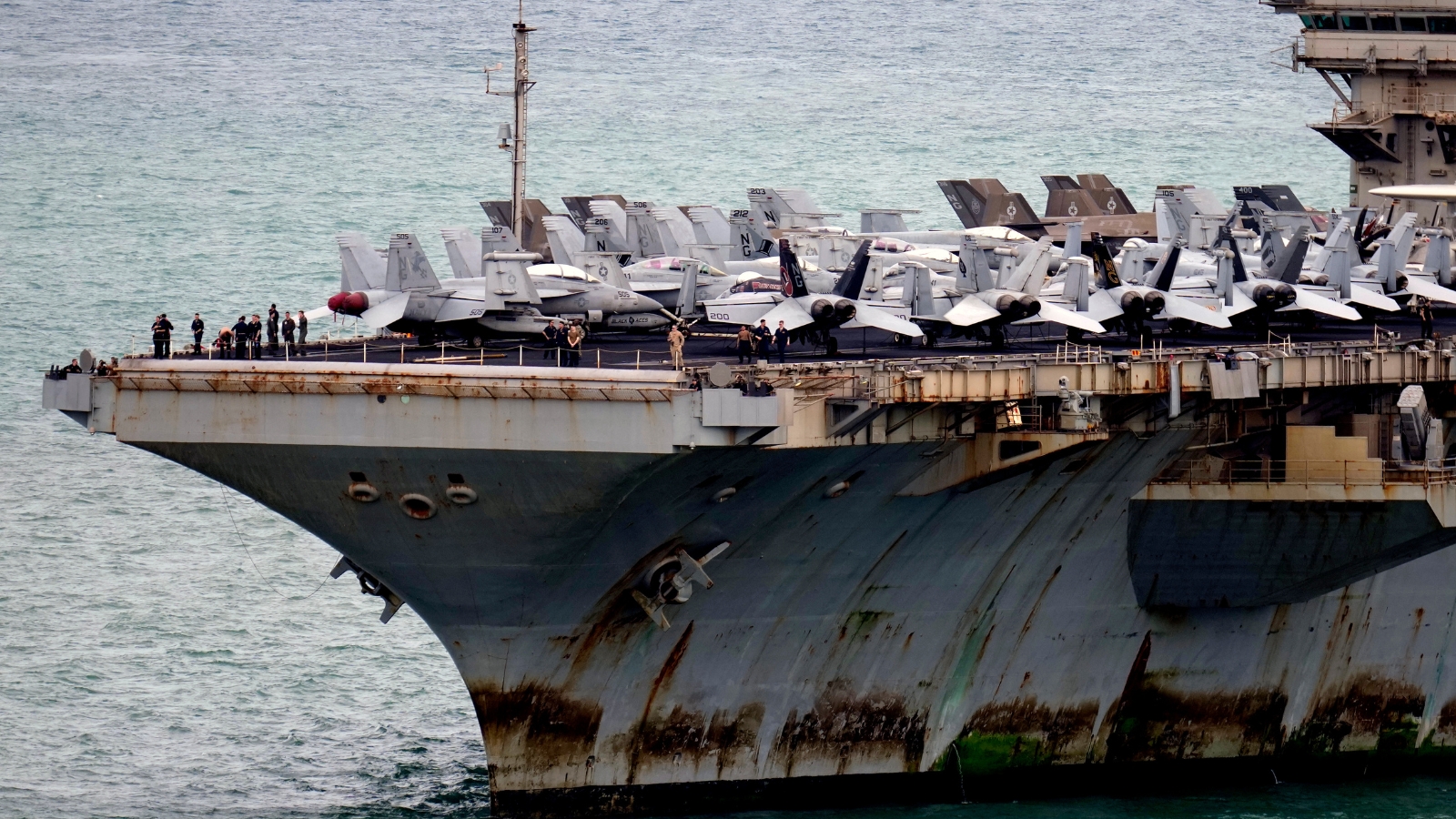
After a grueling 286-day deployment supporting operations against Iran, the USS Abraham Lincoln arrived in Thailand showing significant signs of rust and wear.
- The USS Abraham Lincoln arrived at Thailand's Laem Chabang port after 286 consecutive days at sea.
- Visible rust patches and worn paint were observed on the 1,100-foot carrier's hull.
- The mission involved critical combat and blockade operations against Iran in West Asia.
The massive USS Abraham Lincoln aircraft carrier arrived at the port in Laem Chabang, Chonburi, Thailand, on Wednesday, revealing a weathered appearance that has stunned observers. After a marathon deployment lasting 286 days since leaving San Diego last November, the nuclear-powered vessel shows significant patches of rust and peeling paint along its hull and flight deck.
The Toll of a Marathon Mission
According to reports from the US Embassy, the carrier had spent 264 consecutive days without a full port stop before reaching Thailand. During this period, the Lincoln played a pivotal role in supporting US combat and blockade operations against Iran in West Asia. The visible deterioration serves as a stark visual testament to the intensity of its recent operational tempo.
Why This Matters
BozokMedia analysis shows that the physical condition of the carrier transcends mere maintenance issues; it highlights the potential 'strategic overstretch' facing the US Navy. As geopolitical tensions rise in the Middle East, the demand for continuous deployment is testing the structural and human limits of America's most advanced naval assets.
"It looks like what it is: a ship that’s been continuously at sea for 286 days," noted Euan Graham, a defense expert at the Australian National Security College.
While Captain Dan Keeler, the ship's commanding officer, dismissed the appearance as expected for such a long deployment, experts suggest the visual state could become a symbol of naval fatigue. Former US Navy Captain Carl Schuster explained that while surface rust can be managed, repairing the waterline requires the ship to be stationary and free from wave action—conditions impossible to meet during active combat operations.
Technical Specifications of USS Abraham Lincoln
| Feature | Specification |
|---|---|
| Length | 1,092 Feet |
| Crew Complement | ~5,000 Sailors and Marines |
| Power Source | Nuclear (2 × Westinghouse A4W reactors) |
| Deployment Duration | 286 Days |
Launched in 1988, the Nimitz-class carrier is a cornerstone of US power projection, capable of carrying approximately 90 aircraft including F/A-18 Super Hornets and electronic warfare assets like the EA-18G Growler.
Frequently Asked Questions
1. Why couldn't the rust be repaired at sea?
Answer: Deep repairs, especially near the waterline, require sandblasting and multiple coats of specialized naval paint, which can only be done while the ship is stationary in calm waters.
2. Does the rust affect the ship's combat capability?
Answer: Not necessarily. The commanding officer stated the appearance is a normal result of prolonged deployment and does not imply a failure in operational readiness.