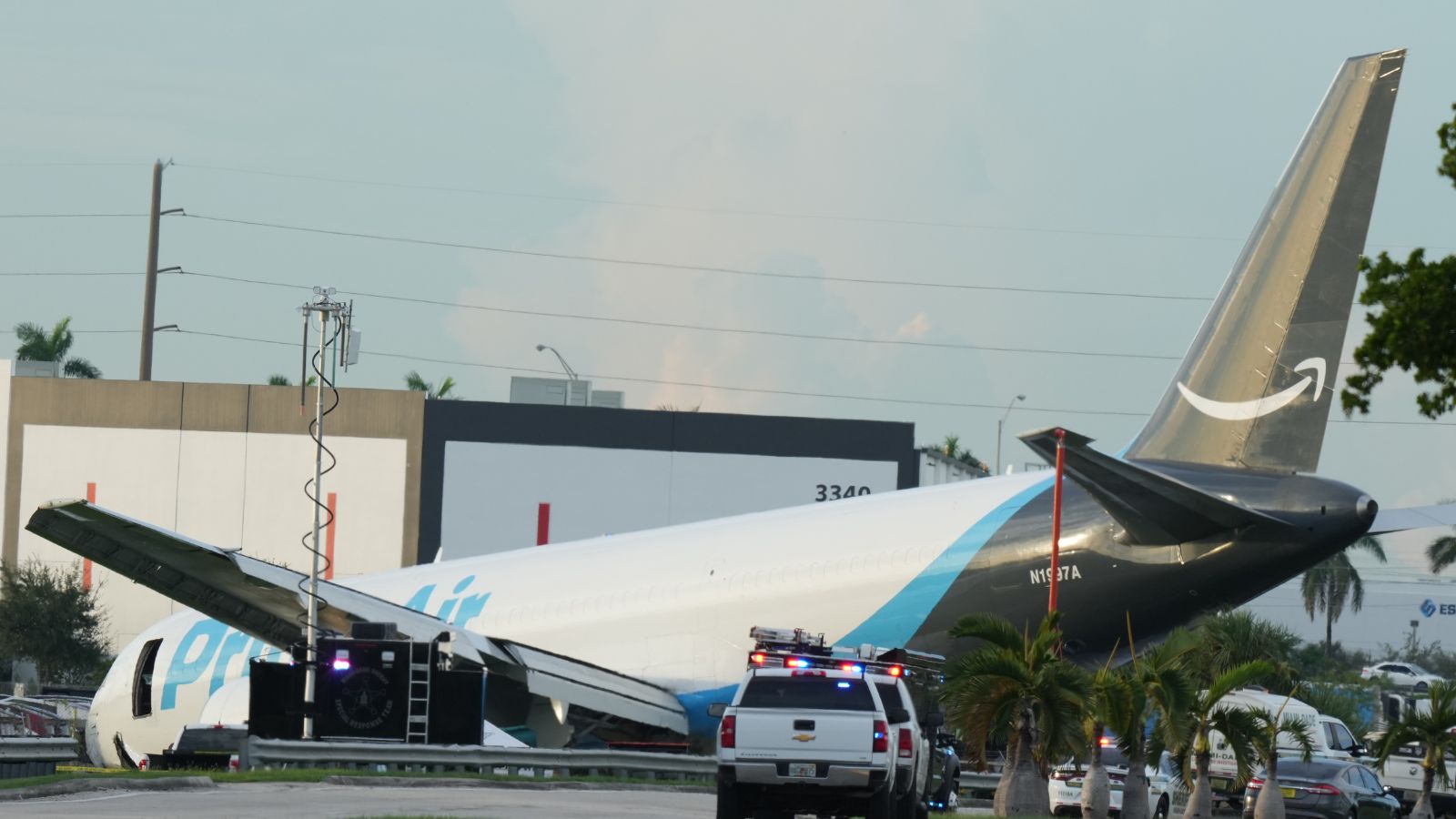
An Amazon Prime Air Boeing 767 cargo jet overran the runway at Miami International Airport, plowing into vehicles and bursting into flames, resulting in five fatalities.
- An Amazon Prime Air Boeing 767-300 overran the runway at Miami International Airport (MIA).
- The crash resulted in at least five deaths and five injuries.
- The aircraft struck vehicles on a nearby road, causing a massive fire.
- The FAA issued a ground stop, causing widespread flight cancellations.
A devastating aviation accident occurred at Miami International Airport (MIA) on Sunday afternoon when an Amazon Prime Air cargo jet, operated by 21 Air, failed to stop on the runway. The Boeing 767-300, arriving from San Juan, Puerto Rico, overshot the usable runway at high speed, veered onto a nearby roadway, and collided with multiple vehicles, triggering a massive fireball that claimed five lives.
According to data from FlightRadar24, the aircraft was traveling at approximately 129 mph (112 knots) when it left the runway. The plane crossed a road used by warehouse staff and local businesses before coming to rest on its nose near an Amazon warehouse. The impact was so severe that the aircraft was engulfed in flames, and firefighters had to battle intense heat and a persistent fuel leak to bring the blaze under control.
Why This Matters
BozokMedia analysis shows that this incident highlights a critical infrastructure gap at Miami International Airport. Unlike over 120 other US airports, Miami lacks the 'crushable-material safety beds' (EMAS) designed to decelerate aircraft that overrun runways. The absence of such technology likely turned a runway excursion into a fatal multi-vehicle collision.
The aircraft appeared to be 'literally still flying' for longer than it should have, failing to touch down in the designated zone and losing critical stopping distance.
Miami-Dade officials confirmed that five people were killed in the incident. While it is currently unclear if the victims were crew members on the Boeing 767 or occupants of the vehicles struck, emergency responders described a chaotic scene. Miami-Dade Rescue Fire Chief Ray Jadallah noted that pilots were initially trapped in the cockpit, and firefighters had to perform daring rescues to free individuals pinned under vehicles.
The National Transportation Safety Board (NTSB) has deployed a 'go team' led by Chair Jennifer Homendy to begin a formal investigation. Early reports suggest that thunderstorms and gusting winds of up to 30 mph were present in the area during landing, though investigators have not yet confirmed if weather was the primary contributing factor.
Historical Background
Runway overruns are a significant concern in global aviation. While modern airports are increasingly equipped with EMAS to mitigate these risks, older or high-traffic airports often face challenges in retrofitting such expensive safety systems. The Boeing 767 remains a workhorse for global cargo operations, but incidents like this underscore the need for stringent landing protocols and advanced runway safety technology.
Frequently Asked Questions
Question 1: How many people were affected by the crash?
Answer: Five people were killed, and five others sustained injuries, with some in critical condition.
Question 2: What was the impact on airport operations?
Answer: The crash caused over 160 flight cancellations and hundreds of delays, with some flights diverted to Orlando.
| Metric | Details |
|---|---|
| Fatalities | 5 |
| Injuries | 5 |
| Flight Cancellations | 160+ |
| Emergency Responders | 200+ |