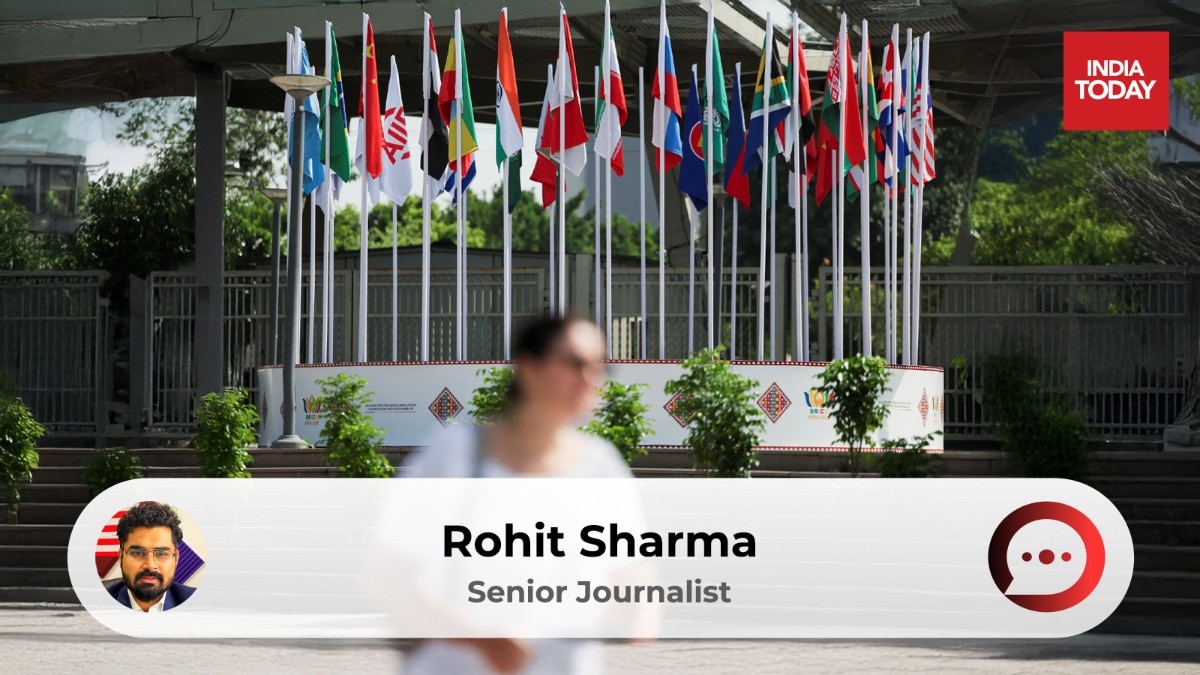
While BRICS has expanded its membership to project power against Western hegemony, it lacks the institutional 'cement'—binding treaties and strategic coherence—to function as a true geopolitical bloc.
- BRICS has expanded from 5 to 11 members, increasing its global demographic and economic weight.
- The group lacks a binding founding treaty or a permanent institutional architecture.
- Strategic distrust between India and China remains a critical vulnerability.
- Efforts to reduce dollar dependency are hampered by structural asymmetry and China's dominance.
BRICS stands as one of the most consequential symbols of a shifting international order. Its recent expansion from five members to eleven has given the grouping immense demographic and economic weight, while its rhetoric—demanding reform of global institutions and a louder voice for the Global South—resonates far beyond its own borders. Yet, a profound paradox sits at the heart of BRICS: the larger it grows, the harder it is to define what it actually is.
Crucially, BRICS is not an alliance in the traditional sense. It holds no mutual-defense obligations, nor is it a free-trade bloc with a common currency. Unlike the European Union or NATO, it is not anchored by a binding treaty capable of subordinating national interests to collective decisions. It is, instead, an ambitious coordination mechanism whose political weight is undeniable, but whose institutional capacity remains severely limited.
The Institutional Void
BRICS defines itself as an informal coordination mechanism governed by consensus and a rotating presidency. While this informality was an asset for a small group with a narrow agenda, it has become a liability for a broader coalition tasked with aligning on climate finance, AI, and counter-terrorism. Without an executive commission to enforce rules, consensus becomes the objective of policy rather than its byproduct.
Why This Matters
BozokMedia analysis shows that the world often mistakes expanding symbolism for emerging strategic coherence. The danger is not the collapse of BRICS, but the illusion of its unity. For the group to move from a 'discussion forum' to a 'power bloc,' it must transition from informal consensus to institutionalized commitment—a leap that current geopolitical tensions make nearly impossible.
"BRICS possesses the diplomatic vocabulary for peace, but none of the machinery to enforce it."
Security and Economic Asymmetry
The bloc’s deepest contradiction lies in international security. India and China, the two most critical pillars, remain active strategic competitors. Their 2020 border clash exposed a baseline of profound distrust that undermines any claim of a cohesive geopolitical pole. Furthermore, while the New Development Bank is a success, the push for 'de-dollarization' faces a structural hurdle: China's economic dominance. Nations like India and Brazil seek to reduce reliance on the US dollar without accidentally replacing it with a systemic dependence on Beijing.
| Feature | EU / NATO | BRICS |
|---|---|---|
| Institutional Framework | Binding Treaties & Permanent Organs | Informal Coordination Mechanism |
| Security Commitment | Collective Defense (e.g., Article 5) | No Shared Security Guarantee |
| Economic Integration | Common Currency & Single Market | Local Currency Trade Explorations |
Frequently Asked Questions
1. Can BRICS realistically replace the US Dollar?
Replacing the dollar is unlikely in the short term due to its deep liquidity; however, the bloc is successfully creating alternative payment systems to bypass Western sanctions.
2. How does the India-China rivalry affect the group?
It prevents the bloc from forming a unified security architecture and often leads to vague declarations that avoid naming specific state sponsors of instability.


