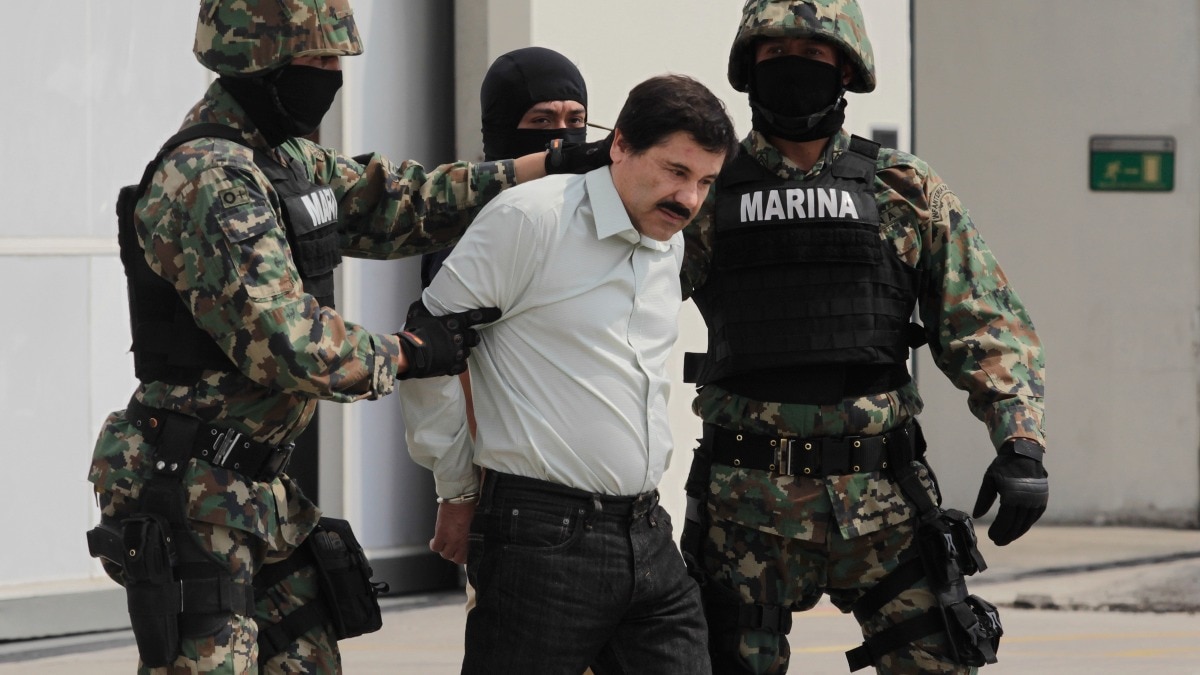
Former US Special Agent Eric Balliet reveals the gripping details of the operation to capture Joaquin 'El Chapo' Guzman, including the secret bathtub escape and the digital trail that led to his downfall.
- El Chapo is linked to the murders of 2,000 to 3,000 people.
- US agents used signal interception of messenger apps to track his movements.
- He famously escaped a raid via a hidden trapdoor beneath a bathtub.
- His final capture took place in a hotel in Mazatlán, Mexico.
Joaquin 'El Chapo' Guzman, one of the most notorious drug traffickers in history, built an empire on blood and powder. With a network of sophisticated tunnels and a web of corrupted officials, he remained a ghost for years. However, the release of the book 'Kingpins and Coyotes' by former US Special Agent Eric Balliet has shed light on the intricate intelligence operation that finally brought him to justice.
Balliet, who was instrumental in intercepting the communication of the Sinaloa Cartel, recalls the surreal experience of seeing El Chapo in a New York courtroom in 2017. Despite his reputation as a 'criminal genius' and a mass murderer, Balliet notes that he looked like an ordinary middle-aged man, a stark contrast to the brutality of his crimes.
The Digital Trail and Psychological Profiling
Starting his career with Homeland Security Investigations (HSI) in 2012, Balliet focused on the money laundering networks between the US and Mexico. The investigation eventually led to El Chapo's personal communications. The breakthrough occurred in late 2013 when agents intercepted messages between El Chapo and his wife, Griselda, providing a direct line to the kingpin's location and habits.
El Chapo's reliance on digital communication was his Achilles' heel; he managed a global empire of terror while simultaneously texting loving messages to his grandchildren.
Analysis reveals that El Chapo sent nearly 100 messages a day. These texts provided a glimpse into his personal life—from his love for Chinese food to his role as a doting father. This duality of being a cold-blooded killer and a loving family man remains one of the most chilling aspects of his personality.
The Great Escape and Final Fall
On February 17, 2014, Mexican Marines raided a safehouse in Culiacán. In a scene straight out of a movie, El Chapo vanished just as the forces breached the door. It was later discovered that he had escaped through a secret hatch hidden under a bathtub, which led into the city's sewer system.
Why This Matters
BozokMedia analysis shows that the capture of El Chapo represents a pivotal shift in global narcotics warfare. The transition from physical surveillance to advanced signal intelligence (SIGINT) allowed authorities to penetrate the most secretive cartels, proving that digital footprints are more permanent than any underground tunnel.
The chase ended on February 22, 2014, in a hotel in Mazatlán. Cornered on the fourth floor with his wife and daughters, El Chapo attempted to reach for an AK-47 but surrendered after his wife pleaded with the soldiers not to kill him in front of their children.
Frequently Asked Questions
Q1: How did the US agents track El Chapo?
A: They intercepted his encrypted messenger communications, allowing them to monitor his daily routines and personal connections.
Q2: Why did El Chapo surrender in the final raid?
A: He was cornered in a hotel room with his family, and his wife pleaded with the military to spare his life for the sake of their children.


