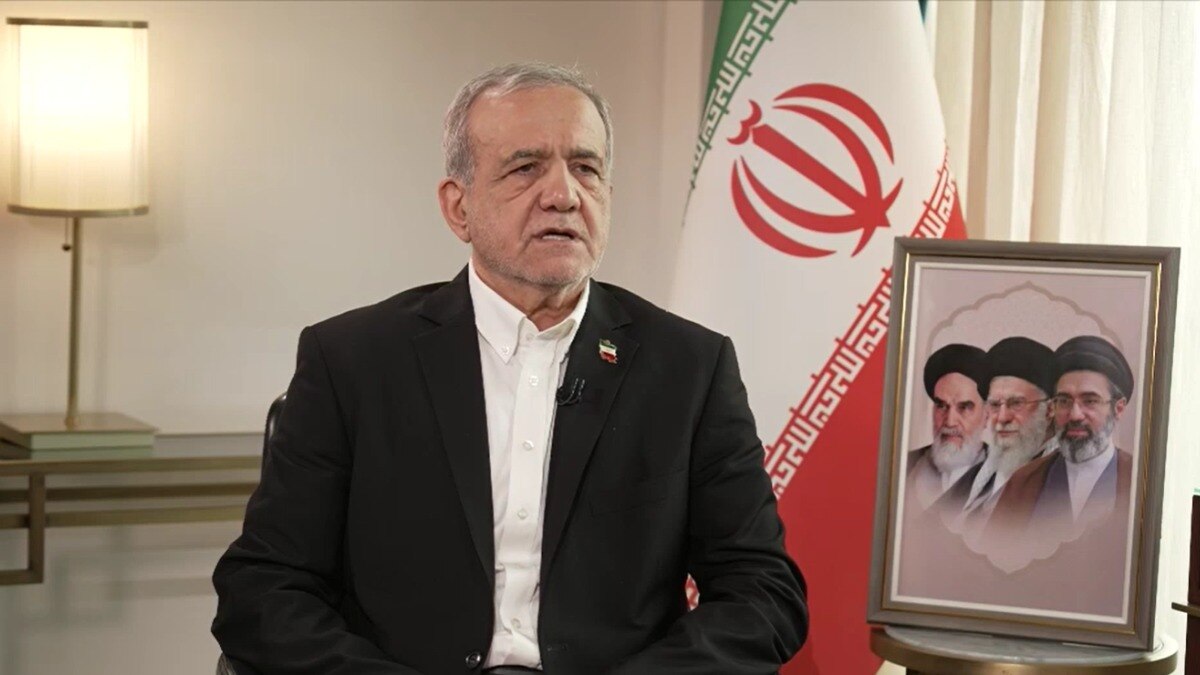
Iranian President Masoud Pezeshkian told India Today that the recent diplomatic efforts involving Pakistan and Oman did not collapse because of Tehran. He reiterated Iran’s willingness to resume talks with the United States if sanctions are lifted and aggression ends, and highlighted ongoing negotiations with Oman over the Strait of Hormuz.
- Tehran denies responsibility for the failure of Pakistan-Oman talks.
- Iran is ready to negotiate nuclear issues under the NPT if sanctions end.
- Negotiations with Oman aim to reopen the Strait of Hormuz under international principles.
Iranian President Masoud Pezeshkian said on Saturday in an exclusive interview with India Today’s Group Editor of Foreign Affairs, Geeta Mohan, that the diplomatic attempts involving Pakistan and Oman did not fail because of Tehran. He stressed that Iran will engage in dialogue only if the United States ends its sanctions and aggressive actions.
When asked whether the Pakistan‑mediated talks collapsed after an earlier memorandum of understanding expired, Pezeshkian replied, “I don’t know what the problem was with what we wrote down in Islamabad.” He emphasized that Tehran never initiated the conflict and would cease any attacks if Washington stopped its aggression.
Tehran’s core demands remain straightforward: the United States must lift all sanctions and halt hostile actions against Iran. “They have to terminate the sanctions,” Pezeshkian asserted, noting that trust can only be rebuilt once these conditions are met.
On the nuclear front, Iran expressed willingness to negotiate within the framework of the Nuclear Non‑Proliferation Treaty (NPT) and other internationally recognised principles. He lamented that previous negotiations often resulted in written agreements that were later abandoned, eroding Tehran’s confidence.
Regarding direct talks with U.S. President Donald Trump, Pezeshkian said it is “not easy” for Iran to make such a decision, citing the assassination of Iran’s leader and the resulting public sentiment. “The atmosphere of trust should be established again before we consider direct talks,” he added.
Separately, Pezeshkian disclosed that Iran is negotiating with Oman on a maritime framework for the Strait of Hormuz. He indicated that the waterway could be reopened under internationally established principles if the United States ends its blockade and related activities.
Historical Background
Iran‑U.S. tensions have persisted since the 1979 Islamic Revolution. The 2015 Joint Comprehensive Plan of Action (JCPOA) temporarily eased hostilities, but the U.S. withdrawal in 2018 and re‑imposition of sanctions reignited friction. The Strait of Hormuz, a chokepoint for over 20% of the world’s oil, has repeatedly become a flashpoint for military posturing.
Why This Matters
BozokMedia analysis shows that a successful maritime framework between Iran and Oman could stabilize regional energy flows and curb volatility in global oil markets. Moreover, the prospect of lifting sanctions may open a new diplomatic pathway for Tehran and Washington, potentially reshaping Middle‑East geopolitics.
"The security and reopening of the Strait of Hormuz is a bellwether for regional peace," said international relations expert Dr. Anita Sharma.
Frequently Asked Questions
Question 1: Is Iran truly prepared for direct talks with the United States?
Answer: Iran says it will consider direct negotiations only after the U.S. lifts sanctions and a trust‑building atmosphere is restored.
Question 2: What could be the outcome of the Iran‑Oman maritime talks?
Answer: If successful, the Strait of Hormuz could be reopened under international norms, ensuring smoother global oil shipments.