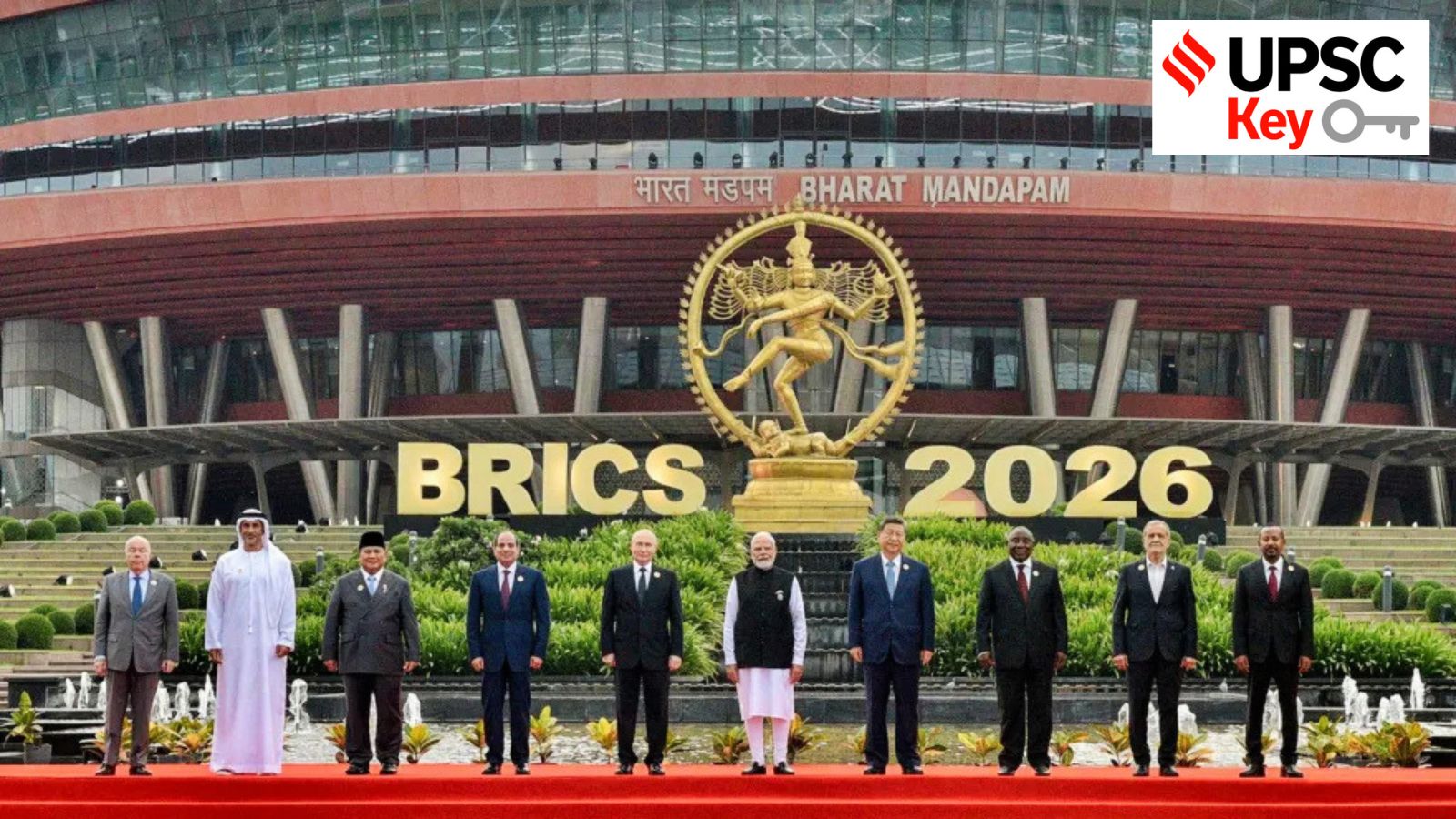
The 18th BRICS Summit concluded with the adoption of the New Delhi Declaration, addressing trade, sanctions, and Middle East stability. A critical update for UPSC aspirants.
- The 45-page New Delhi Declaration was adopted at the 18th BRICS Summit.
- The document avoids mention of the Ukraine conflict but strongly condemns unilateral sanctions.
- A significant consensus was reached between Iran and UAE regarding West Asian tensions.
- China and Russia reiterated support for India's aspirations in the UNSC.
The 18th BRICS Summit held in New Delhi has marked a pivotal moment in contemporary global diplomacy. The adoption of the 45-page New Delhi Declaration signifies a shift toward a more cooperative multilateralism, focusing on trade, health, AI, and tourism. Rather than a confrontational document, the declaration aims to create a space where diverse interests—from the Global South to major emerging economies—can find common ground.
Economic Sovereignty vs. Unilateral Sanctions
A defining feature of this summit is the subtle yet pointed critique of Western economic policies. While avoiding direct naming of the United States, the declaration uses diplomatic shorthand to condemn "unilateral coercive measures" and "secondary sanctions." This is a strategic move to protect members like Russia and Iran, who are frequently targeted by Western economic regimes. Furthermore, the mention of "indiscriminate rising of tariffs" serves as an oblique nod to protectionist trade policies.
The New Delhi Declaration represents a collective push by the Global South to reclaim economic agency against unilateral Western sanctions.
Why This Matters
BozokMedia analysis shows that the BRICS grouping is evolving from a mere economic bloc into a sophisticated geopolitical actor. By addressing issues like the 'carbon border adjustment mechanisms' and trade-restrictive actions, BRICS is positioning itself as a defender of equitable global trade, directly challenging the current dominance of G7-led economic frameworks.
Middle East Consensus and UNSC Reforms
One of India's most significant diplomatic achievements at the summit was facilitating a consensus between Iran and the UAE. Amidst the escalating tensions in West Asia, the joint declaration calls for maximum restraint and the protection of civilian infrastructure, providing a much-needed de-escalation signal. Additionally, the declaration provides a boost to India's global standing, as China and Russia reaffirmed their support for India and Brazil to play a greater role in the UN Security Council.
Frequently Asked Questions
1. Does the New Delhi Declaration mention the war in Ukraine?
No, the 2026 declaration notably omits any mention of the Ukraine conflict or Russia's invasion.
2. How does this impact India's role in global politics?
It reinforces India's position as a bridge-builder, particularly in mediating between conflicting powers like Iran and the UAE.
| Issue | BRICS Stance | Western/G7 Stance |
|---|---|---|
| Economic Sanctions | Opposes unilateral measures | Uses sanctions as a tool |
| Trade Policy | Favors open, non-discriminatory trade | Increasingly protectionist |


