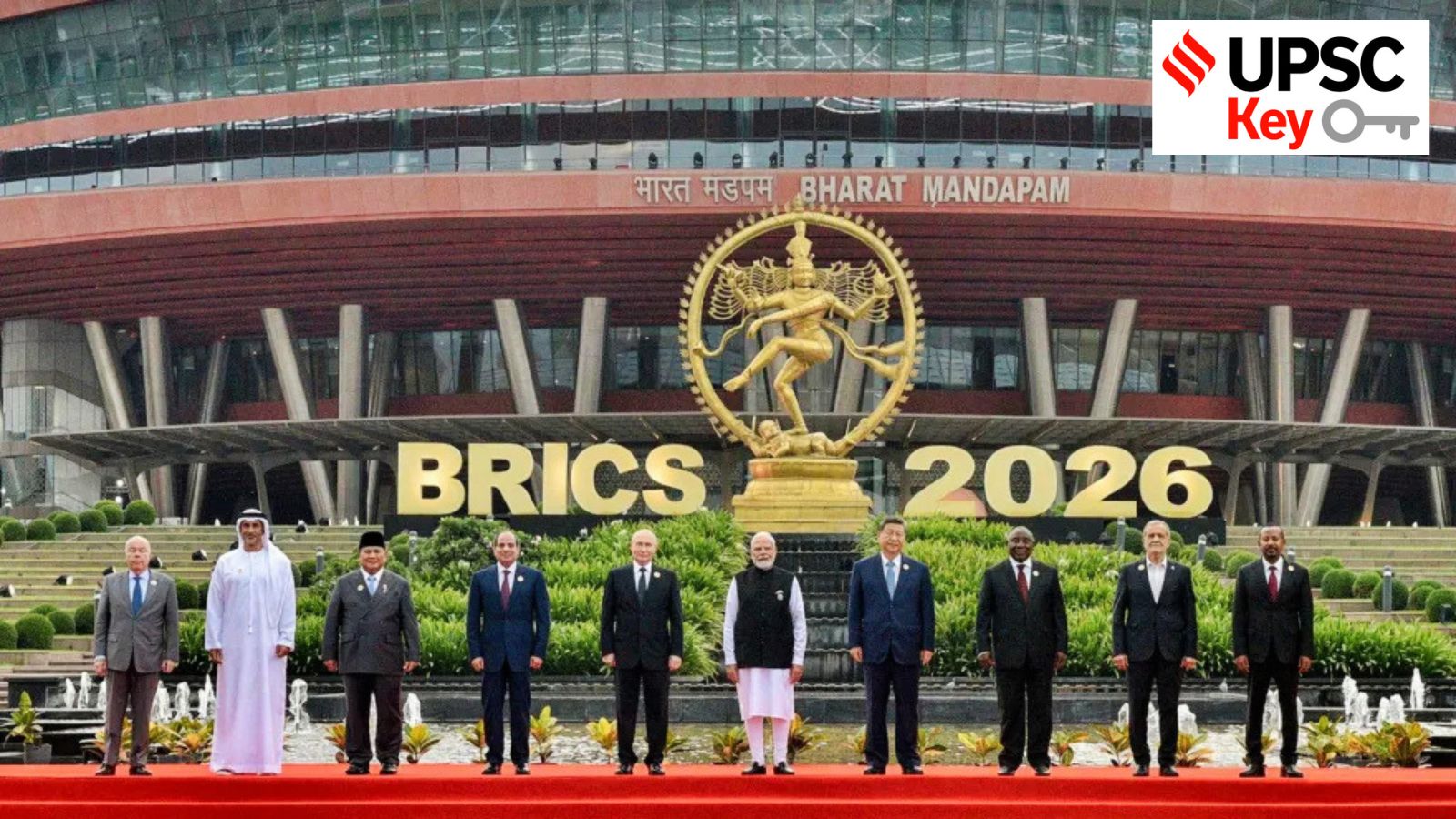
The recent BRICS summit in New Delhi highlights the bloc's struggle to convert economic influence into geopolitical unity, especially regarding the conflict in Iran. This analysis explores why internal diversity remains the group's greatest hurdle.
- The BRICS summit concluded without a unified stance on the US-Israel conflict in Iran.
- Expansion has introduced regional rivalries, such as between Iran and the UAE, into the bloc.
- Major players like India view BRICS as a tool for strategic autonomy rather than an anti-Western alliance.
- BRICS is evolving into a powerful bargaining coalition rather than a unified geopolitical bloc.
The recent BRICS summit in New Delhi concluded with the customary promises of deepened economic cooperation and expanded ties. However, a glaring omission stood out: the silence regarding the US-Israel war on Iran. Despite the conflict affecting numerous BRICS members and partner nations, the official declaration failed to address the aggression directly or condemn the United States, revealing the immense difficulty the bloc faces in translating shared dissatisfaction with the Western order into coordinated action.
The Cost of Expansion
While the enlargement of BRICS has significantly increased its global reach, it has also imported complex regional rivalries into the organization. The tension between Iran and the United Arab Emirates (UAE) serves as a prime example. Both are part of the BRICS framework, yet their strategic interests in the Middle East are fundamentally at odds. This internal friction creates a natural ceiling on how much political weight the group can exert during active conflicts.
Why This Matters
BozokMedia analysis shows that BRICS is currently caught in a 'polycentric trap.' Its greatest strength—its immense diversity—is also its primary strategic weakness. While this diversity provides legitimacy across the Global South, it prevents the formation of a single, cohesive geopolitical instrument. Instead of acting as a unified front, the bloc functions more as a platform for managing disagreements among diverse national interests.
The true test for BRICS is not its economic aggregate, but its ability to act as a singular political entity during global crises.
India exemplifies the strategic dilemma facing the bloc. New Delhi views BRICS as a vehicle for maintaining strategic autonomy, not as an anti-American alliance. India continues to deepen its ties with Washington through the Quad while simultaneously maintaining robust engagement with Russia and China. For India, the value of BRICS lies in preserving maneuvering room between competing global power centers.
Similarly, China and Russia have calculated interests. Russia seeks to mitigate Western economic pressure but avoids direct military confrontation with NATO. China desires a multipolar world and greater influence for the Global South, yet it remains deeply integrated into the global trade system dominated by the US. For Beijing, turning every dispute into a binary confrontation with Washington would be economically self-defeating.
The inclusion of nations like Brazil and Indonesia adds further layers of complexity. These nations seek a more representative international system and greater development finance, but they have little incentive to serve as instruments for the geopolitical strategies of China or Russia.
A Bargaining Coalition, Not a Bloc
Ultimately, the Iran episode suggests that BRICS is more likely to emerge as a powerful bargaining coalition than a coherent geopolitical bloc. The group can find common ground on reforming international institutions, strengthening South-South trade, and enhancing food and energy security. However, when cooperation requires members to take sides in an actual military confrontation, the cracks in the foundation become impossible to ignore.
Frequently Asked Questions
1. Is BRICS an alternative to the G7?
While BRICS aims to represent the Global South and challenge Western dominance, it is an economic and diplomatic forum rather than a direct structural replacement for the G7.
2. Why couldn't BRICS agree on the Iran issue?
Conflicting national interests, specifically between members like Iran and the UAE, prevented a unified diplomatic stance.