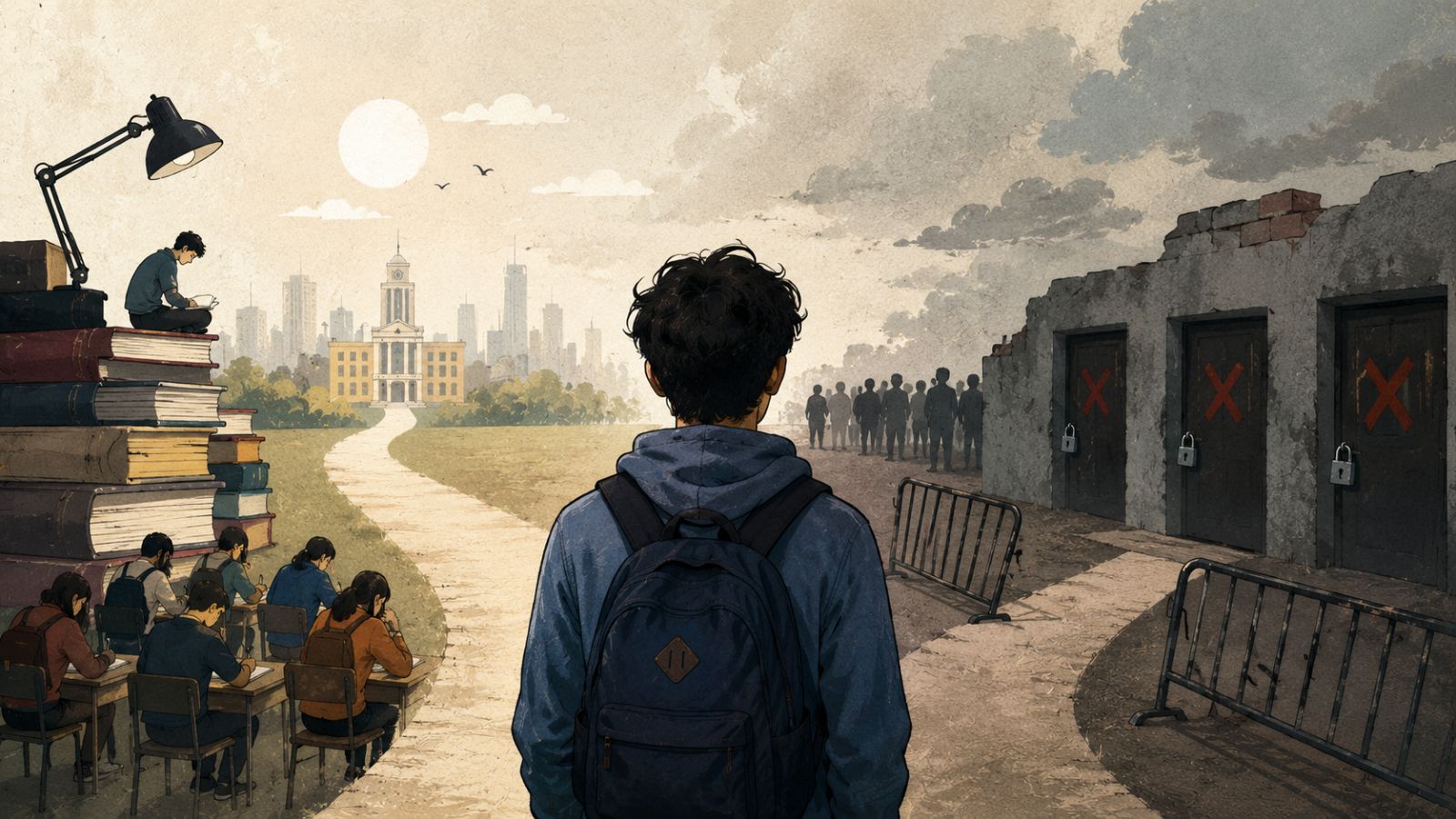
Moving beyond the era of 'upskilling' as a catch-all solution, India's youth are identifying institutional collapses, paper leaks, and recruitment delays as the true culprits of their setbacks.
Key Takeaways
- Young Indians are shifting the blame from individual 'skill issues' to systemic institutional failures.
- Recurring paper leaks and delayed recruitment cycles are undermining the concept of meritocracy.
- The gap between educational output and actual job creation is widening.
- Social media is becoming a tool for youth to demand accountability rather than just seeking motivation.
For generations, the Indian social contract has been deceptively simple: study hard, secure a degree, and a stable career will follow. In this narrative, success is the reward for perseverance, and failure is framed as a personal deficiency—a lack of 'skill' or 'grit.' However, a profound psychological shift is occurring among India's youth. They are no longer willing to internalize failures that are clearly manufactured by broken institutions.
The Myth of the Level Playing Field
Competitive examinations like NEET, JEE, and UPSC are often presented as the ultimate arbiters of merit. Yet, the assumption that every candidate starts from the same baseline is a fallacy. While an elite student in a metropolitan hub enjoys high-speed internet, specialized coaching, and financial security, a student from a rural background may struggle with outdated textbooks and erratic electricity. When we ignore these structural inequalities, we transform 'merit' into a privilege rather than a measure of talent.
Institutional Negligence and the Crisis of Trust
The recurring nightmare of paper leaks and the indefinite postponement of government recruitments have fundamentally altered the youth's perspective. These are not merely administrative hiccups; they are life-altering disruptions. When candidates spend their most productive years in a perpetual state of waiting, it is not a lack of competence that holds them back, but a lack of institutional reliability. The frustration seen in recent youth-led social media movements reflects a generation that is tired of being told to 'be patient' while the systems meant to serve them crumble.
The Fallacy of Constant 'Upskilling'
Public discourse frequently suggests that unemployment is a byproduct of a skills gap, urging graduates to 'upskill' to meet market demands. While continuous learning is vital, using it as a universal remedy for systemic job scarcity is a deflection of responsibility. This rhetoric subtly shifts the burden of economic stability from the state and corporations onto the individual. A student can be infinitely skilled, but no amount of training can overcome a recruitment pipeline that is stalled by corruption or a job market that cannot absorb its massive graduate population.
Ultimately, Young India is not asking for handouts; they are demanding accountability. They are transitioning from a culture of self-doubt to a culture of questioning the structures that govern their futures.