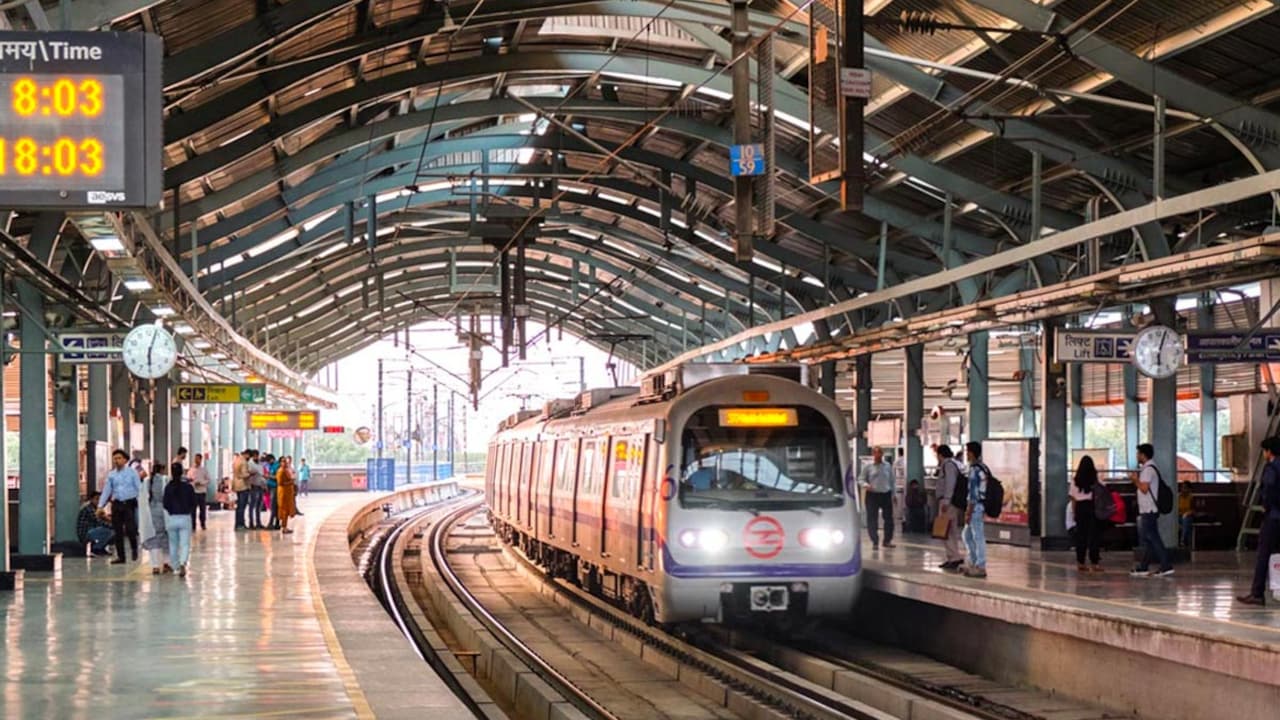
In response to security concerns stemming from the ongoing Cockroach Janta Party (CJP) protest at Jantar Mantar, the Delhi Metro Rail Corporation (DMRC) has closed 16 key stations. Commuters can still access interchange facilities at major hubs like Rajiv Chowk, Mandi House, and Central Secretariat.
Key Takeaways
- 16 Delhi Metro stations closed temporarily due to security measures.
- Interchange facilities remain operational at Rajiv Chowk, Mandi House, and Central Secretariat.
- The shutdown is linked to the ongoing Cockroach Janta Party (CJP) protest at Jantar Mantar.
The Delhi Metro Rail Corporation (DMRC) has announced the temporary closure of 16 metro stations across the national capital. This precautionary measure comes in response to escalating security concerns surrounding the ongoing protest organized by the Cockroach Janta Party (CJP) at the historic Jantar Mantar. Police authorities recommended the closures to prevent large gatherings and maintain law and order in highly sensitive government zones.
Despite the widespread closures, the DMRC has assured commuters that transit disruption is being minimized where possible. Key interchange stations, including Rajiv Chowk, Mandi House, and Central Secretariat, remain open exclusively for passengers needing to change lines. However, entry and exit gates at these stations have been heavily restricted or entirely shut to regulate pedestrian flow near the protest site.
| Metric / Feature | Affected Stations (16 Closed) | Major Interchange Hubs (Open) |
|---|---|---|
| Entry/Exit Access | Completely Suspended | Restricted / Closed |
| Line Transfer | Not Available | Fully Functional |
| Security Level | High Alert / Police Deployment | Enhanced Monitoring |
Why This Matters (इसके मायने क्या हैं)
The sudden closure of crucial transport arteries in a bustling metropolis like Delhi highlights the fragile balance between public order and democratic expression. For hundreds of thousands of daily commuters, metro shutdowns translate to massive traffic gridlocks on roads, delayed work hours, and economic friction. BozokMedia analysis shows that sudden transit closures of this scale can cause a temporary 15-20% drop in local commercial activities near the affected corridors, showcasing how civic protests directly impact urban economic health.
Furthermore, this situation underscores the growing challenges faced by urban security agencies in managing large-scale demonstrations. By utilizing metro stations as strategic choke points, authorities can control crowd density, but it raises critical questions about public convenience. BozokMedia analysis shows that integrating smarter crowd-control technologies could mitigate the need for complete station shutdowns in the future, preserving both public safety and commuter rights.
"Metropolitan transit systems are the lifelines of modern cities; shutting them down is a double-edged sword that controls crowds but paralyzes urban mobility." — Transit Security Expert
Historical Background (तथ्यात्मक पृष्ठभूमि)
Jantar Mantar, an astronomical observatory built in the 18th century by Maharaja Sawai Jai Singh II, has evolved into India's premier protest site. Following a National Green Tribunal ruling that banned protests at Ramlila Maidan and Boat Club due to environmental and logistical issues, Jantar Mantar became the designated zone for democratic demonstrations in New Delhi. Over the decades, the Delhi Metro has frequently been used as a tool for crowd management during major political rallies, adapting its operations to assist local police forces in maintaining metropolitan security.
Frequently Asked Questions (अक्सर पूछे जाने वाले प्रश्न)
Q1: Can I still change lines at Rajiv Chowk during the shutdown?
A1: Yes, interchange facilities remain fully operational at Rajiv Chowk, Mandi House, and Central Secretariat, though you cannot exit or enter the stations through these hubs.
Q2: Why were these specific 16 metro stations closed?
A2: The stations were closed as a precautionary security measure advised by Delhi Police to prevent protesters from gathering near Jantar Mantar and other high-security government zones.

:max_bytes(150000):strip_icc():focal(749x0:751x2)/nic-olandria-1-05dc781dea064d04a695f58e1b32c464.jpg)