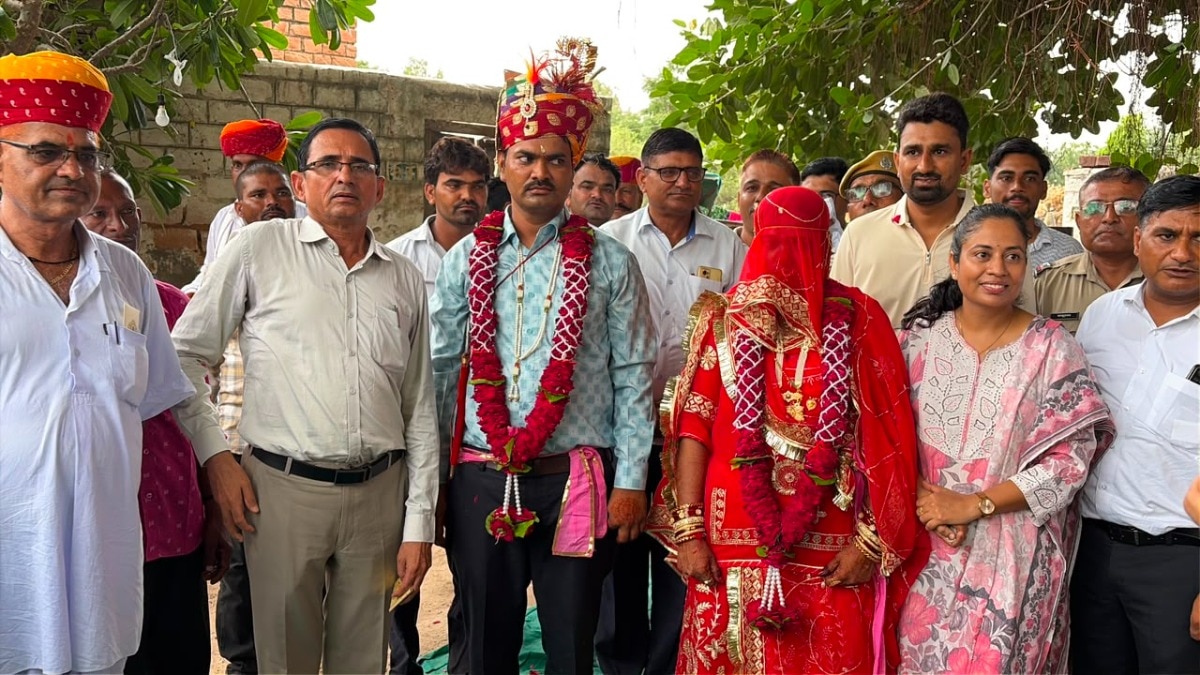
In a landmark ruling, the Rajasthan High Court permitted two life convicts to solemnize their marriage within the Mandore Open Jail in Jodhpur, citing marriage as a fundamental right.
In a profound moment for the Indian judicial system, two life convicts celebrated their wedding inside the Mandore Open Jail in Jodhpur, following a landmark permission from the Rajasthan High Court. The couple, 33-year-old Moolaram Bhati from Nagaur and 31-year-old Seema Ghadse from Mumbai, exchanged garlands and took the sacred seven pheras in the presence of prison officials and family members.
The decision was delivered by a Division Bench comprising Justice PS Bhati and Justice Praveer Bhatnagar. The court emphasized that the right of two consenting adults to marry is an integral part of the fundamental right to life and personal liberty under Article 21 of the Indian Constitution. The bench ruled that being a prisoner does not strip an individual of their basic human rights and social entitlements.
Why This Matters (इसके मायने क्या हैं)
BozokMedia analysis shows that this ruling marks a significant shift from a purely punitive justice system to a reformative one. By recognizing the social rights of inmates, the judiciary is acknowledging that rehabilitation is more effective when prisoners are allowed to maintain or build human connections. This psychological stability can significantly reduce recidivism rates once inmates are released.
Furthermore, this sets a legal precedent for human rights within correctional facilities across India. It challenges the notion that incarceration equals a total loss of personhood. For the legal community and policymakers, this case serves as a blueprint for how constitutional protections must extend even behind bars, ensuring that the state's power to punish does not infringe upon the core tenets of human dignity.
"The right to form a family is a cornerstone of human existence that should not be extinguished by a prison sentence."
Historical Background
Historically, prison systems worldwide were designed under the 'Retributive Theory,' focusing on punishment and isolation. However, the 20th century saw the rise of the 'Reformative Theory,' which treats crime as a social malady that can be cured through rehabilitation. Open jails, like the one in Mandore, are a manifestation of this theory, providing inmates with more freedom and responsibilities to prepare them for reintegration into society.
| Aspect | Punitive Approach | Reformative Approach (Current Trend) |
|---|---|---|
| View of Inmate | Criminal to be punished | Individual to be reformed |
| Social Rights | Strictly restricted | Recognized within legal bounds |
| Goal of Incarceration | Isolation | Reintegration into society |
Frequently Asked Questions (अक्सर पूछे जाने वाले प्रश्न)
Question 1: On what legal basis did the court allow the marriage?
Answer: The court based its decision on Article 21 of the Constitution, which protects the right to life and personal liberty, including the right to marry.
Question 2: How did the couple meet?
Answer: Both were serving life sentences and met while working in agricultural activities within the Mandore Open Air Camp.