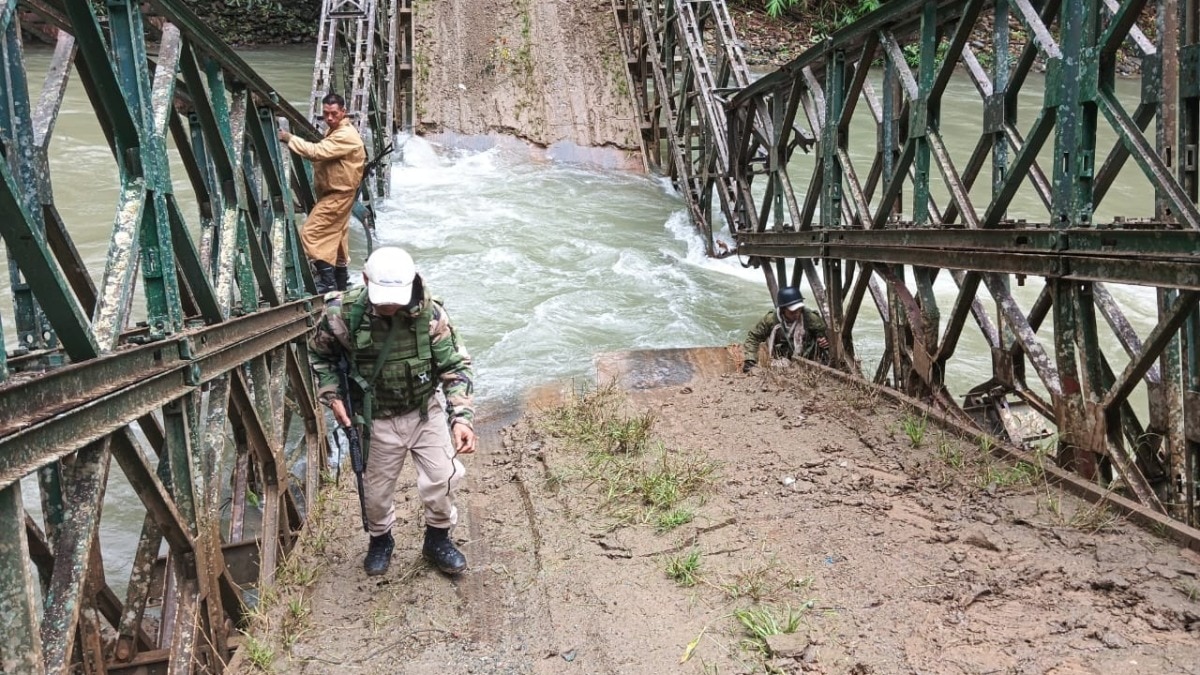
A suspected militant strike on a Bailey bridge in Manipur's Kamjong district on July 22, 2026, destroyed the structure and set a telecom vehicle ablaze, cutting off several villages from the district headquarters. Police allege the use of improvised explosive devices (IEDs) and have launched a comprehensive investigation.
Key Takeaways (मुख्य बिंदु)
- Bailey bridge destroyed using IEDs
- Telecom department vehicle set on fire
- Multiple villages lose road connectivity, investigation underway
On the morning of July 22, 2026, at approximately 9:30 a.m., a suspected militant group detonated an improvised explosive device (IED) on a Bailey bridge spanning the Namban Lok River between Phange and Chatric villages in Kamjong district, Manipur. The explosion also ignited a Bolero pick‑up belonging to the Telecom Department, which was parked nearby, reducing the vehicle to ashes.
The bridge was built under the Pradhan Mantri Gram Sadak Yojana (PMGSY) and served as the sole road link connecting Chatric and surrounding villages to the Kamjong district headquarters. Its destruction has halted daily commutes, obstructed emergency services, and disrupted the flow of essential goods and information.
According to police statements, the attackers had pre‑planted the IED beneath the bridge’s foundation, timing the blast to maximise damage. The concurrent arson of the telecom vehicle appears to be a calculated move to cripple communication networks, amplify fear among locals, and showcase the militants’ capability to target critical infrastructure.
Law enforcement promptly lodged a suo motu case at the CSD Police Station and has begun a thorough investigation under relevant statutes. No militant outfit has claimed responsibility yet, but heightened security patrols have been deployed across the border‑adjacent district.
Historical Background
Kamjong district borders Myanmar and has long been a flashpoint for ethnic tensions, insurgent activities, and cross‑border spill‑over. Over the past few years, the region has witnessed a series of arson attacks, village raids, and infrastructure sabotage, reflecting deep‑seated grievances and the fragile security environment in India's Northeast.
Why This Matters (इसके मायने क्या हैं)
BozokMedia analysis shows that attacks on rural infrastructure not only cripple local economies but also strain national development goals. When villages lose road access, agricultural markets, healthcare delivery, and education suffer, leading to a cycle of under‑development and heightened vulnerability.
Moreover, the incident underscores escalating security challenges along the India‑Myanmar frontier, influencing diplomatic relations and prompting a reassessment of border‑area counter‑insurgency strategies. A swift response is essential to restore confidence and safeguard the region’s growth trajectory.
"Infrastructure is the backbone of stability; attacks on it threaten both livelihoods and national security," says security analyst Dr. Rajesh Kumar.
Frequently Asked Questions (अक्सर पूछे जाने वाले प्रश्न)
Q1: Has any militant group claimed responsibility for the attack?
A: No group has publicly taken responsibility yet; investigations are focusing on several suspected outfits.
Q2: What steps are being taken to restore connectivity for the affected villages?
A: The government has earmarked emergency funds for rapid bridge repair and is exploring temporary alternate routes to re‑establish access.