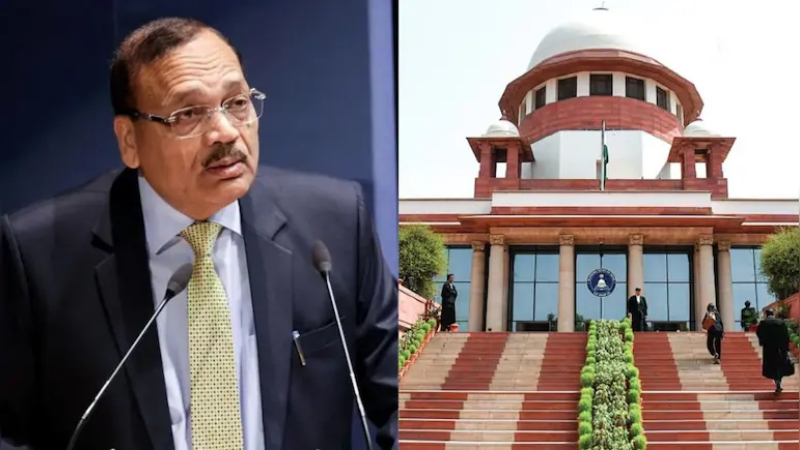
The Supreme Court of India has prohibited the unauthorized video recording and social media broadcasting of court proceedings, calling uncontrolled digital sharing a 'monster out of a bag.'
Key Takeaways
- Supreme Court prohibits unauthorized audio/video recording of court proceedings.
- Uncontrolled social media broadcasting labeled as a 'monster out of a bag.'
- Prior permission from Registrar Generals or SC Secretary is mandatory for digital sharing.
- The ban does not impact legitimate journalistic news reporting.
New Delhi: In a landmark move to preserve judicial sanctity, the Supreme Court of India has issued a strict prohibition against the unauthorized video recording and social media distribution of court proceedings. The apex court expressed grave concern over the uncontrolled dissemination of courtroom clips on digital platforms.
A bench comprising Chief Justice Surya Kant, Justice Joymalya Bagchi, and Justice V. Mohan issued this interim order while hearing a Public Interest Litigation (PIL). The bench went as far as to describe the unregulated broadcasting of court proceedings on social media as a 'monster out of a bag' that threatens the integrity of the legal process.
Why This Matters
BozokMedia analysis shows that this ruling addresses the growing trend of 'clip-culture,' where out-of-context snippets of judicial arguments are used to incite public sentiment or mock the legal process. By regulating digital content, the court aims to prevent the erosion of public trust in the judiciary caused by misinformation and sensationalism.
The judiciary must strike a balance between transparency and the prevention of sensationalist digital exploitation.
According to the order, no person is permitted to modify, broadcast, post, re-post, or upload any audio or video recordings of judicial proceedings without the prior explicit permission of the concerned High Court's Registrar General or the Principal Secretary of the Supreme Court. The court clarified that this mandate is not intended to stifle legitimate news reporting by journalists.
Historical Background
The rise of smartphones and high-speed internet has led to an era where courtroom moments are captured and shared instantly. While transparency is vital, the misuse of these recordings to present skewed versions of legal arguments has become a significant challenge for the Indian justice system, necessitating this intervention.
Frequently Asked Questions (FAQ)
1. Does this ban affect news reporters?
No, the Supreme Court explicitly stated that this order does not impact the news reporting of court proceedings.
2. Who provides the permission for digital sharing?
Permission must be obtained from the Registrar General of the respective High Court or the Principal Secretary of the Supreme Court.