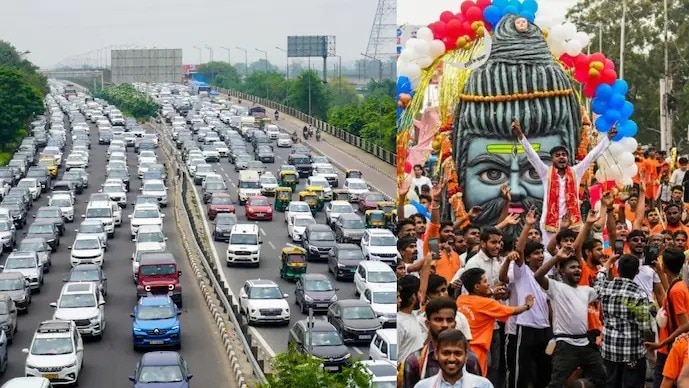
With the Sawan Shivratri festivities reaching their peak, police departments in Delhi, Noida, Ghaziabad, and Faridabad have issued comprehensive traffic advisories. Commuters are strongly advised to plan their journeys in advance, use metro services, and avoid major border routes prone to heavy congestion.
Key Takeaways
- Major traffic diversions implemented in Delhi, Noida, Ghaziabad, and Faridabad for Sawan Shivratri.
- Key border routes like DND Flyway, Kalindi Kunj, and Badarpur are expected to face severe congestion.
- Commuters are advised to opt for Delhi Metro and plan travel well in advance.
The Sawan Shivratri celebrations have brought a massive influx of Kanwariyas (devotees of Lord Shiva) to the streets of Delhi-NCR. To manage the immense crowd and ensure public safety, law enforcement agencies across Delhi, Noida, Ghaziabad, and Faridabad have enforced extensive traffic diversions. This movement is expected to significantly slow down vehicular movement throughout the day.
Major bottlenecks are anticipated along the Kalindi Kunj border, DND Flyway, and the Noida-Delhi Link Road. Commuters traveling between South Delhi, Faridabad, and Noida during peak office hours are likely to face significant delays. The Ashram-Mathura Road corridor and the Badarpur border are also under heavy surveillance with strict restrictions in place. Commuters are advised to leave early for airports or railway stations.
Why This Matters
BozokMedia analysis shows that seasonal religious events of this scale heavily test the infrastructure limits of metropolitan regions like Delhi-NCR. A lack of real-time communication often leads to multi-hour gridlocks, affecting economic productivity and emergency services. This year's proactive coordination between interstate police departments marks a crucial step toward smarter urban crowd management.
"With millions of devotees traversing the NCR corridors, switching to public transit systems like the Delhi Metro is not just an alternative, but a necessity to prevent total gridlock on our highways." — Senior Traffic Coordinator.
Historical Background
The Kanwar Yatra is an annual pilgrimage of devotees of Shiva, known as Kanwariyas, who travel to holy places like Haridwar, Gaumukh, and Gangotri in Uttarakhand to fetch holy waters of the Ganges River. Historically, the influx of millions of pilgrims walking along national highways has necessitated massive administrative and security deployments, making traffic management a recurring annual challenge for the NCR administration. This year, the crowd is expected to break previous records on the day of Shivratri.Affected Route Expected Congestion Level Recommended Alternative
Frequently Asked Questions
Q1: Which metro lines are best to avoid the Kanwar Yatra traffic?
A1: The Blue Line (connecting Noida/Ghaziabad to Delhi) and the Violet Line (connecting Delhi to Faridabad) are highly recommended as they bypass the major congested borders entirely.
Q2: Are heavy commercial vehicles allowed on these routes during Shivratri?
A2: No, most heavy commercial vehicles have been diverted to outer bypasses and expressway networks to ease the movement of pilgrims and light passenger vehicles.