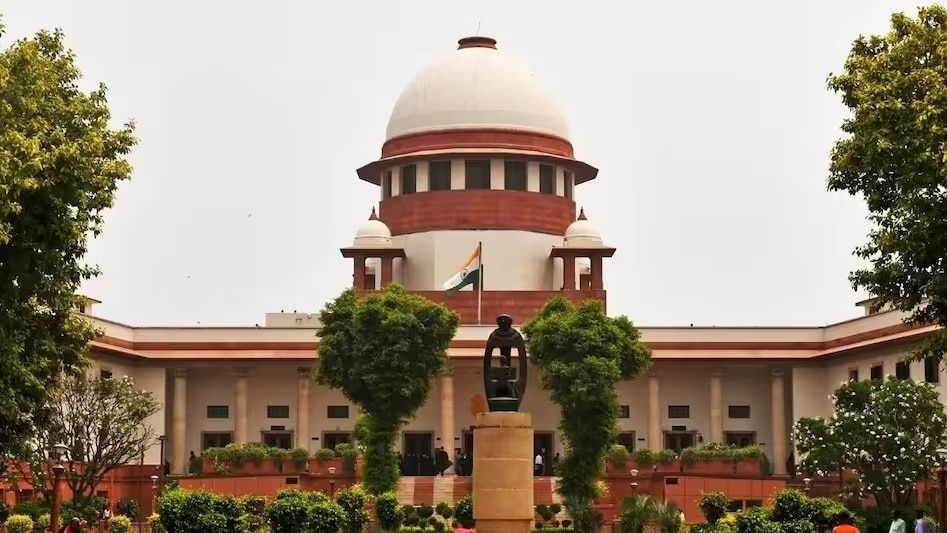
In a landmark ruling, the Supreme Court has directed the Jammu and Kashmir administration to pay rent for family land used as a police station since 1953, overturning a High Court decision that had dismissed the plea due to delay.
- SC directs J&K administration to pay rent for 7 kanals and 18 marlas of land used since 1953.
- Land acquisition proceedings to be initiated from 2021, not retrospectively from 1953.
- High Court's previous dismissal based on a 68-year delay was overturned regarding rental payments.
The Supreme Court of India, in a significant judgment concerning property rights and state accountability, has ordered the Jammu and Kashmir administration to compensate Abdul Rashid Wani for the unauthorized use of his family's land. The property, located in Kangan, Ganderbal, has served as a police station since 1953 without any formal acquisition process or payment of compensation to the owners.
A bench comprising Chief Justice Surya Kant, Justice Joymalya Bagchi, and Justice V Mohana scrutinized the case, noting that the state cannot simply occupy private land indefinitely without payment. The court has directed the land acquisition officer to calculate the applicable rent from 1953 for the property, which measures seven kanals and 18 marlas.
Why This Matters
BozokMedia analysis shows that this verdict reinforces the principle that the state's power of 'eminent domain' is not absolute and must be exercised through legal channels. By ordering rent for a period spanning seven decades, the Court is sending a clear signal that administrative negligence or the absence of formal paperwork does not grant the government a free pass to occupy private assets.
"The state cannot benefit from its own failure to follow legal acquisition procedures, regardless of the time elapsed."
The case took a complex turn when the Jammu and Kashmir and Ladakh High Court had previously dismissed Wani's petition. The High Court argued that the claim was a "dead cause of action" because Wani had waited nearly 68 years to approach the judiciary. The High Court further rejected Wani's claim that his father's illiteracy prevented earlier legal action, noting that Wani himself had been an adult for decades.
While the Supreme Court granted the rent, it declined to order retrospective acquisition from 1953, citing the extreme delay. Instead, it ordered the acquisition process to begin from 2021, the year Wani first approached the High Court. The final compensation and the total rent amount will be determined by the High Court.
The UT administration had opposed the petition, claiming that the police department had been in peaceful possession of the land for decades and that official records from the 1950s were difficult to produce. Wani, on the other hand, claimed that evidence of his prior attempts to seek redress were lost during the devastating 2014 floods.
Frequently Asked Questions
1. Why did the High Court initially dismiss the plea?
The High Court dismissed it because of an unexplained delay of 68 years, labeling it a 'dead cause of action'.
2. Will the government acquire the land from 1953?
No, the Supreme Court directed the acquisition process to start from 2021, though rent must be paid from 1953.